AudioTimeSourceStream: A stream that provides time information based on the audio data actually processed - implements the TimeSource interface. millis() (inherited, unmodified) is plain wall time; playbackTime() is the audio-derived progress, which is what a consumer that must stay tied to genuine playback (e.g. PacedVideoOutput) should use instead - see playbackTime()'s own comment for why they can diverge. More...
#include <AudioIO.h>
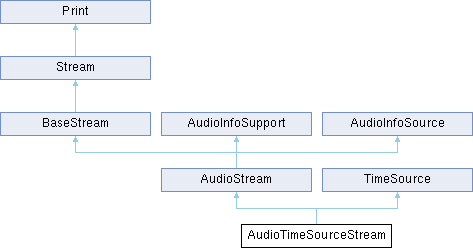
Public Member Functions | |
| AudioTimeSourceStream ()=default | |
| AudioTimeSourceStream (AudioOutput &out) | |
| AudioTimeSourceStream (AudioStream &stream) | |
| AudioTimeSourceStream (Print &print) | |
| AudioTimeSourceStream (Stream &stream) | |
| virtual void | addNotifyAudioChange (AudioInfoSupport &bi) |
| Adds target to be notified about audio changes. | |
| virtual AudioInfo | audioInfo () override |
| provides the actual input AudioInfo | |
| virtual AudioInfo | audioInfoOut () |
| virtual int | available () override |
| virtual int | availableForWrite () override |
| bool | begin () |
| virtual void | clearNotifyAudioChange () |
| Deletes all change notify subscriptions. | |
| virtual void | end () |
| virtual void | flush () override |
| bool | isNotifyActive () |
| Checks if the automatic AudioInfo update is active. | |
| virtual uint32_t | millis () |
| virtual | operator bool () |
| uint32_t | playbackTime () override |
| size_t | readBytes (uint8_t *data, size_t len) override |
| virtual size_t | readSilence (uint8_t *buffer, size_t length) |
| Source to generate silence: just sets the buffer to 0. | |
| virtual bool | removeNotifyAudioChange (AudioInfoSupport &bi) |
| Removes a target in order not to be notified about audio changes. | |
| virtual void | setAudioInfo (AudioInfo newInfo) override |
| Defines the input AudioInfo. | |
| void | setNotifyActive (bool flag) |
| Deactivate/Reactivate automatic AudioInfo updates: (default is active) | |
| void | setOutput (AudioOutput &out) |
| void | setOutput (Print &out) |
| void | setStream (AudioStream &stream) |
| void | setStream (Stream &stream) |
| void | setTimeCallback (void(*cb)(uint32_t time_ms)) |
| Defines a callback function to be called whenever the time is updated. | |
| void | setTimeCallbackAfter (void(*cb)(uint32_t time_ms)) |
| Defines a callback function to be called whenever the time is updated. | |
| void | setWriteBufferSize (int size) |
| size_t | write (const uint8_t *data, size_t len) override |
| virtual size_t | write (uint8_t ch) override |
| virtual void | writeSilence (size_t len) |
| Writes len bytes of silence (=0). | |
Protected Member Functions | |
| virtual int | not_supported (int out, const char *msg="") |
| void | notifyAudioChange (AudioInfo info) |
| void | refillReadBuffer () |
| Refill small read buffer (e.g. 8 bytes) to avoid single byte reads when calling read() | |
| void | resetTime () |
| void | updateTime (size_t bytes) |
Protected Attributes | |
| int | _timeout = 10 |
| AudioInfo | info |
| bool | is_notify_active = true |
| Vector< AudioInfoSupport * > | notify_vector |
| Print * | p_out = nullptr |
| Stream * | p_stream = nullptr |
| uint32_t | playback_time_ms = 0 |
| void(* | time_callback_after )(uint32_t time_ms) = nullptr |
| void(* | time_callback_before )(uint32_t time_ms) = nullptr |
| RingBuffer< uint8_t > | tmp_in {0} |
| RingBuffer< uint8_t > | tmp_out {0} |
| int | write_buffer_size = MAX_SINGLE_CHARS |
Detailed Description
AudioTimeSourceStream: A stream that provides time information based on the audio data actually processed - implements the TimeSource interface. millis() (inherited, unmodified) is plain wall time; playbackTime() is the audio-derived progress, which is what a consumer that must stay tied to genuine playback (e.g. PacedVideoOutput) should use instead - see playbackTime()'s own comment for why they can diverge.
Constructor & Destructor Documentation
◆ AudioTimeSourceStream() [1/5]
|
default |
◆ AudioTimeSourceStream() [2/5]
|
inline |
◆ AudioTimeSourceStream() [3/5]
|
inline |
◆ AudioTimeSourceStream() [4/5]
|
inline |
◆ AudioTimeSourceStream() [5/5]
|
inline |
Member Function Documentation
◆ addNotifyAudioChange()
|
inlinevirtualinherited |
Adds target to be notified about audio changes.
Reimplemented in CodecNOP, EncodedAudioOutput, EncodedAudioStream, AACDecoderFDK, DecoderBasic, CodecChain, MP3DecoderHelix, MP3DecoderMAD, OggContainerDecoder, RTSPClient< TcpClient, UdpSocket >, Pipeline, and Pipeline::ModifyingStreamAdapter.
◆ audioInfo()
|
inlineoverridevirtualinherited |
provides the actual input AudioInfo
Implements AudioInfoSupport.
Reimplemented in JupyterAudioT< T >, MozziStream, TimerCallbackAudioStream, EncodedAudioStream, PureDataStream, AdapterAudioOutputToAudioStream, GeneratedSoundStream< T >, GeneratedSoundStream< int16_t >, and InputMerge< T >.
◆ audioInfoOut()
|
inlinevirtualinherited |
provides the actual output AudioInfo: this is usually the same as audioInfo() unless we use a transforming stream
Reimplemented in MP3EncoderShine, PureDataStream, PWMAudioOutput< PWMDriverT >, ChannelFormatConverterStreamT< T >, ChannelFormatConverterStream, NumberFormatConverterStreamT< TFrom, TTo >, NumberFormatConverterStream, FormatConverterStream, Pipeline, ResampleStream, ResampleStreamT< TInterpolator >, and SupportedRatesStream.
◆ available()
|
inlineoverridevirtualinherited |
Reimplemented from Stream.
Reimplemented in AudioKitStream, AudioLoRa, URLStreamBufferedT< T >, URLStreamBufferedT< ICYStream >, VBANStream, AudioStreamWrapper, FaustStream< DSP >, AudioMP34DT05, I2SCodecStream, MiniAudioStream, StdioStream, TfLiteAudioStream, A2DPStream, ESPNowStream, HammingFEC< bytecount, block_t >, HLSStreamT< URLStream >, HttpRequest, ICYStreamT< T >, URLStream, BufferedTaskStream, NRF24Stream, ReedSolomonFEC< bytecount, additional_bytes >, SPIAudioSlave, UDPStream, USBAudioStreamBase, AutomaticGainControlStream, FrequencyDetectorAutoCorrelation, FrequencyDetectorZeroCrossing, MeasuringStream, QualityAnalysisStream, VolumeStream, AnalogAudioStream, AudioEffectStreamT< T >, AudioEffectStream, Equalizer3BandsT< T >, Equalizer3BandsPerChannelT< T >, I2SStream, ReformatBaseStream, TimedStream, MemoryStream, RingBufferStream, GeneratedSoundStream< T >, GeneratedSoundStream< int16_t >, BufferedStream, ConverterStream< T >, ProgressStream, Throttle, InputMixer< T, SumT >, InputMerge< T >, CallbackStream, FilteredStream< T, TF >, FilteredStream< int16_t, int16_t >, ChannelFormatConverterStreamT< T >, ChannelFormatConverterStream, NumberFormatConverterStreamT< TFrom, TTo >, NumberFormatConverterStream, CatStream, QueueStream< T >, QueueStream< uint8_t >, DynamicMemoryStream, FadeStream, Pipeline, Pipeline::ModifyingStreamAdapter, SupportedRatesStream, FileLoopT< FileType >, FileLoopT< File >, AudioFFTBase, AudioBLEClient, AudioBLEClient, AudioBLEServer, and AudioBLEServer.
◆ availableForWrite()
|
inlineoverridevirtualinherited |
Reimplemented from Print.
Reimplemented in AudioLoRa, UDPStream, VBANStream, AudioStreamWrapper, ConverterStream< T >, EncodedAudioStream, FaustStream< DSP >, I2SCodecStream, MiniAudioStream, StdioStream, A2DPStream, ESPNowStream, HammingFEC< bytecount, block_t >, AbstractURLStream, URLStreamESP32, NRF24Stream, ReedSolomonFEC< bytecount, additional_bytes >, SPIAudioSlave, USBAudioStreamBase, AutomaticGainControlStream, FrequencyDetectorAutoCorrelation, FrequencyDetectorZeroCrossing, MeasuringStream, QualityAnalysisStream, VolumeStream, AnalogAudioStream, AudioEffectStreamT< T >, AudioEffectStream, Equalizer3BandsT< T >, Equalizer3BandsPerChannelT< T >, I2SStream, ReformatBaseStream, TimedStream, MemoryStream, RingBufferStream, ProgressStream, Throttle, FilteredStream< T, TF >, FilteredStream< int16_t, int16_t >, ChannelFormatConverterStreamT< T >, ChannelFormatConverterStream, NumberFormatConverterStreamT< TFrom, TTo >, NumberFormatConverterStream, QueueStream< T >, QueueStream< uint8_t >, DynamicMemoryStream, FadeStream, Pipeline, SupportedRatesStream, AudioFFTBase, AudioBLEClient, AudioBLEClient, AudioBLEServer, and AudioBLEServer.
◆ begin()
|
inlinevirtual |
Optional: explicitly (re)starts playbackTime() at 0 - use this if you need an explicit restart point (e.g. looping/seeking). Not required otherwise: the first byte that actually flows through write()/readBytes() anchors it on its own (see updateTime()) - most callers just wire this in as a plain Print/AudioStream target (e.g. PacedVideoOutput::setAudioClock()'s usage pattern) and never call begin() on it directly.
Reimplemented from BaseStream.
◆ clearNotifyAudioChange()
|
inlinevirtualinherited |
Deletes all change notify subscriptions.
Reimplemented in RTSPClient< TcpClient, UdpSocket >.
◆ end()
|
inlinevirtualinherited |
Reimplemented in FaustStream< DSP >, AudioMP34DT05, I2SCodecStream, MozziStream, PureDataStream, SPDIFOutput, VS1053Stream, WM8960Stream, AdaptiveResamplingStream, AudioLoRa, ESPNowStream, BufferedTaskStream, URLStreamBufferedT< T >, URLStreamBufferedT< ICYStream >, USBAudioDeviceBase, USBAudioHostBase, GoertzelStream, Equalizer3BandsT< T >, I2SStream, AudioStreamWrapper, TimerCallbackAudioStream, FormatConverterStream, FileLoopT< FileType >, FileLoopT< File >, EqualizerNBands< SampleT, AccT, NUM_TAPS, NUM_BANDS >, EncodedAudioStream, AudioKitStream, MiniAudioStream, PortAudioStream, StdioStream, A2DPStream, HLSStreamT< URLStream >, HttpRequest, ICYStreamT< T >, URLStream, URLStreamESP32, NRF24Stream, SPIAudioSlave, AutomaticGainControlStream, VolumeStream, AnalogAudioStream, AudioEffectStreamT< T >, AudioEffectStream, Equalizer3BandsPerChannelT< T >, ReformatBaseStream, AdapterAudioOutputToAudioStream, MemoryStream, GeneratedSoundStream< T >, GeneratedSoundStream< int16_t >, InputMixer< T, SumT >, InputMerge< T >, CallbackStream, FilteredStream< T, TF >, FilteredStream< int16_t, int16_t >, ChannelFormatConverterStream, NumberFormatConverterStream, CatStream, QueueStream< T >, QueueStream< uint8_t >, DynamicMemoryStream, Pipeline, Pipeline::ModifyingStreamAdapter, SupportedRatesStream, AudioFFTBase, AudioBLEClient, AudioBLEClient, AudioBLEServer, AudioBLEServer, AbstractURLStream, and AudioBLEStream.
◆ flush()
|
inlineoverridevirtualinherited |
Reimplemented from Print.
Reimplemented in PureDataStream, URLStreamBufferedT< T >, URLStreamBufferedT< ICYStream >, ReformatBaseStream, AudioStreamWrapper, ResampleStream, EncodedAudioStream, URLStream, BufferedTaskStream, AutomaticGainControlStream, MeasuringStream, QualityAnalysisStream, VolumeStream, AudioEffectStreamT< T >, AudioEffectStream, Equalizer3BandsT< T >, Equalizer3BandsPerChannelT< T >, I2SStream, TimedStream, MemoryStream, RingBufferStream, GeneratedSoundStream< T >, GeneratedSoundStream< int16_t >, BufferedStream, FilteredStream< T, TF >, FilteredStream< int16_t, int16_t >, QueueStream< T >, QueueStream< uint8_t >, FadeStream, Pipeline::ModifyingStreamAdapter, SupportedRatesStream, and EqualizerNBands< SampleT, AccT, NUM_TAPS, NUM_BANDS >.
◆ isNotifyActive()
|
inlineinherited |
Checks if the automatic AudioInfo update is active.
◆ millis()
|
inlinevirtualinherited |
Wall-clock elapsed time (ms) - real time passing, regardless of whatever this TimeSource actually tracks. The default implementation just forwards to Arduino's own millis(); override only if this TimeSource needs a different wall-clock source - most subclasses should leave this alone and override playbackTime() instead.
◆ not_supported()
|
inlineprotectedvirtualinherited |
◆ notifyAudioChange()
|
inlineprotectedinherited |
◆ operator bool()
|
inlinevirtualinherited |
◆ playbackTime()
|
inlineoverridevirtual |
Elapsed playback time (ms): the sum of audio duration (sample_rate/channels/bits_per_sample-derived) actually handed to write()/readBytes() so far - see TimeSource::playbackTime(). Purely a running total of processed bytes: never extrapolated by, or otherwise dependent on, wall-clock time (see millis(), inherited unmodified, for that) - so it stalls exactly when the caller stalls (e.g. busy elsewhere in a shared demux/decode loop) instead of continuing to advance. Returns 0 before the first byte has ever been processed (begin() is optional - see its own comment).
Reimplemented from TimeSource.
◆ readBytes()
|
inlineoverridevirtual |
Reimplemented from AudioStream.
◆ readSilence()
|
inlinevirtualinherited |
Source to generate silence: just sets the buffer to 0.
◆ refillReadBuffer()
|
inlineprotectedinherited |
Refill small read buffer (e.g. 8 bytes) to avoid single byte reads when calling read()
◆ removeNotifyAudioChange()
|
inlinevirtualinherited |
Removes a target in order not to be notified about audio changes.
Reimplemented in RTSPClient< TcpClient, UdpSocket >.
◆ resetTime()
|
inlineprotected |
◆ setAudioInfo()
|
inlineoverridevirtualinherited |
Defines the input AudioInfo.
Implements AudioInfoSupport.
Reimplemented in VS1053Stream, WM8960Stream, AutomaticGainControlStream, VolumeStream, ChannelFormatConverterStreamT< T >, ChannelFormatConverterStream, MiniAudioStream, PortAudioStream, I2SCodecStream, MozziStream, SPDIFOutput, AudioLoRa, AnalogAudioStream, I2SStream, TimerCallbackAudioStream, AudioBLEStream, MDFEchoCancellationStream< T, SampleType >, AudioKitStream, NRF24Stream, SPIAudioSlave, USBAudioDeviceBase, USBAudioHostBase, VBANStream, GoertzelStream, MeasuringStream, QualityAnalysisStream, Equalizer3BandsT< T >, Equalizer3BandsPerChannelT< T >, AdapterAudioOutputToAudioStream, TimedStream, ProgressStream, CallbackStream, VolumeMeter, AudioInputMonitor, FormatConverterStream, FadeStream, Pipeline::ModifyingStreamAdapter, AudioFFTBase, EncodedAudioStream, PureDataStream, GeneratedSoundStream< T >, GeneratedSoundStream< int16_t >, NumberFormatConverterStreamT< TFrom, TTo >, NumberFormatConverterStream, Pipeline, ResampleStream, ResampleStreamT< TInterpolator >, and SupportedRatesStream.
◆ setNotifyActive()
|
inlineinherited |
Deactivate/Reactivate automatic AudioInfo updates: (default is active)
◆ setOutput() [1/2]
|
inline |
◆ setOutput() [2/2]
|
inline |
◆ setStream() [1/2]
|
inline |
◆ setStream() [2/2]
|
inline |
◆ setTimeCallback()
|
inline |
Defines a callback function to be called whenever the time is updated.
◆ setTimeCallbackAfter()
|
inline |
Defines a callback function to be called whenever the time is updated.
◆ setWriteBufferSize()
|
inlineinherited |
◆ updateTime()
|
inlineprotected |
◆ write() [1/2]
|
inlineoverridevirtual |
Reimplemented from AudioStream.
◆ write() [2/2]
|
inlineoverridevirtualinherited |
Reimplemented in MemoryStream, AudioStreamWrapper, BufferedTaskStream, RingBufferStream, BufferedStream, and URLStream.
◆ writeSilence()
|
inlinevirtualinherited |
Writes len bytes of silence (=0).
Member Data Documentation
◆ _timeout
|
protectedinherited |
◆ info
|
protectedinherited |
◆ is_notify_active
|
protectedinherited |
◆ notify_vector
|
protectedinherited |
◆ p_out
|
protected |
◆ p_stream
|
protected |
◆ playback_time_ms
|
protected |
◆ time_callback_after
|
protected |
◆ time_callback_before
|
protected |
◆ tmp_in
|
protectedinherited |
◆ tmp_out
|
protectedinherited |
◆ write_buffer_size
|
protectedinherited |
The documentation for this class was generated from the following file:
- src/AudioTools/CoreAudio/AudioIO.h