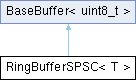
Lock-free Single-Producer Single-Consumer ring buffer. More...
#include <RingBufferSPSC.h>
Public Member Functions | |
| RingBufferSPSC ()=default | |
| RingBufferSPSC (const RingBufferSPSC &)=delete | |
| RingBufferSPSC (size_t capacity) | |
| ~RingBufferSPSC () override=default | |
| T * | address () override |
| returns the address of the start of the physical read buffer | |
| int | available () override |
| provides the number of entries that are available to read | |
| int | availableForWrite () override |
| provides the number of entries that are available to write | |
| virtual int | bufferCountEmpty () |
| Provides the number of entries that are available to write: -1 does not apply. | |
| virtual int | bufferCountFilled () |
| Provides the number of entries that are available to read: -1 does not apply. | |
| void | clear () |
| same as reset | |
| virtual int | clearArray (int len) |
| Removes the next len entries. | |
| virtual void | flush () |
| virtual float | freePercent () |
| Returns the free space of the buffer in %. | |
| bool | isEmpty () |
| virtual bool | isFull () |
| checks if the buffer is full | |
| virtual float | levelPercent () |
| Returns the level of the buffer in %. | |
| RingBufferSPSC & | operator= (const RingBufferSPSC &)=delete |
| virtual bool | peek (uint8_t &result)=0 |
| peeks the actual entry from the buffer | |
| bool | peek (T &result) override |
| virtual bool | read (uint8_t &result)=0 |
| reads a single value | |
| bool | read (T &result) override |
| virtual int | readArray (uint8_t data[], int len) |
| reads multiple values | |
| int | readArray (T data[], int len) override |
| void | reset () override |
| clears the buffer | |
| bool | resize (size_t capacity) override |
| Resizes the buffer if supported: returns false if not supported. | |
| void | setUsePSRAM (bool flag) |
| size_t | size () override |
| virtual bool | write (uint8_t data)=0 |
| write add an entry to the buffer | |
| bool | write (T data) override |
| virtual int | writeArray (const uint8_t data[], int len) |
| Fills the buffer data. | |
| int | writeArray (const T data[], int len) override |
| virtual int | writeArrayOverwrite (const uint8_t data[], int len) |
| Fills the buffer data and overwrites the oldest data if the buffer is full. | |
Detailed Description
class audio_tools::RingBufferSPSC< T >
Lock-free Single-Producer Single-Consumer ring buffer.
Safe to use from two cores / contexts simultaneously only when there is exactly one writer and exactly one reader — e.g. an ISR or a second core filling the buffer while the main loop drains it (USB audio RX path on RP2040 with core-1 tud_task).
Design ──────
- head_ is the element-count of everything ever written; only the producer writes it (release store) and the consumer reads it (acquire load).
- tail_ is the element-count of everything ever read; only the consumer writes it (release store) and the producer reads it (acquire load).
- No shared mutable counter between the two sides — the shared mutable state of RingBuffer<T>::_numElems is the classic data race on M0+.
- Capacity is rounded up to the next power of two so that index masking replaces modulo and wrap-around is handled by a single bit-AND.
- readArray / writeArray use memcpy for bulk transfers and split them at the wrap-around point, giving at most two memcpy calls per operation (T=uint8_t makes this a byte copy; for other T it's an element copy).
Not suitable for MPMC (multiple producers or consumers); use QueueLockFree for that.
Backing storage is a Vector<T>, using Vector's own default allocator (plain heap - unaffected, existing callers like the I2S/USB audio TX/RX buffers see no change at all). setUsePSRAM(true), called before the first resize(), switches it to an allocator that prefers PSRAM and falls back to the plain heap silently where PSRAM isn't available - useful for a buffer sized to soak up bursty backlogs (see e.g. PacedVideoOutput) where a few hundred KB would be far too much to ask of internal RAM but is a rounding error against multiple MB of PSRAM.
- Template Parameters
-
T Element type. Works for any trivially-copyable T; the bulk-copy optimisation is most effective for T=uint8_t (audio streams).
- Copyright
- GPLv3
Constructor & Destructor Documentation
◆ RingBufferSPSC() [1/3]
|
default |
◆ RingBufferSPSC() [2/3]
|
inlineexplicit |
◆ ~RingBufferSPSC()
|
overridedefault |
◆ RingBufferSPSC() [3/3]
|
delete |
Member Function Documentation
◆ address()
|
inlineoverridevirtual |
returns the address of the start of the physical read buffer
Implements BaseBuffer< uint8_t >.
◆ available()
|
inlineoverridevirtual |
provides the number of entries that are available to read
Implements BaseBuffer< uint8_t >.
◆ availableForWrite()
|
inlineoverridevirtual |
provides the number of entries that are available to write
Implements BaseBuffer< uint8_t >.
◆ bufferCountEmpty()
|
inlinevirtualinherited |
Provides the number of entries that are available to write: -1 does not apply.
Reimplemented in NBuffer< T >, NBuffer< T >, NBuffer< uint8_t >, NBuffer< T >, SynchronizedNBufferRTOST< uint8_t >, and SynchronizedNBufferZephyrT< uint8_t >.
◆ bufferCountFilled()
|
inlinevirtualinherited |
Provides the number of entries that are available to read: -1 does not apply.
Reimplemented in NBuffer< T >, NBuffer< T >, NBuffer< uint8_t >, NBuffer< T >, SynchronizedNBufferRTOST< uint8_t >, and SynchronizedNBufferZephyrT< uint8_t >.
◆ clear()
|
inlineinherited |
same as reset
◆ clearArray()
|
inlinevirtualinherited |
Removes the next len entries.
Reimplemented in SingleBuffer< T >, SingleBuffer< T >, SingleBuffer< uint8_t >, and SingleBuffer< T >.
◆ flush()
|
inlinevirtualinherited |
Submit any partially-filled write buffer so the reader can access it. Only meaningful for NBuffer-style block pools; no-op for ring buffers.
Reimplemented in NBuffer< T >, NBuffer< T >, NBuffer< uint8_t >, and NBuffer< T >.
◆ freePercent()
|
inlinevirtualinherited |
Returns the free space of the buffer in %.
◆ isEmpty()
|
inlineinherited |
◆ isFull()
|
inlinevirtualinherited |
checks if the buffer is full
Reimplemented in NBuffer< T >, NBuffer< T >, NBuffer< uint8_t >, RingBuffer< T >, RingBuffer< T >, RingBuffer< uint8_t >, SingleBuffer< T >, SingleBuffer< T >, SingleBuffer< uint8_t >, BufferRP2040T< uint8_t >, BufferRTOS< uint8_t >, NBuffer< T >, RingBuffer< T >, and SingleBuffer< T >.
◆ levelPercent()
|
inlinevirtualinherited |
Returns the level of the buffer in %.
Reimplemented in AdaptiveResamplingBuffer.
◆ operator=()
|
delete |
◆ peek() [1/2]
|
pure virtualinherited |
peeks the actual entry from the buffer
Implemented in AdaptiveResamplingBuffer, NBuffer< uint8_t >, RingBuffer< uint8_t >, RingBufferSPSC< uint8_t >, SingleBuffer< uint8_t >, BufferRP2040T< uint8_t >, and BufferRTOS< uint8_t >.
◆ peek() [2/2]
|
inlineoverride |
◆ read() [1/2]
|
pure virtualinherited |
reads a single value
Implemented in AdaptiveResamplingBuffer, NBuffer< uint8_t >, RingBuffer< uint8_t >, RingBufferSPSC< uint8_t >, SingleBuffer< uint8_t >, BufferRP2040T< uint8_t >, and BufferRTOS< uint8_t >.
◆ read() [2/2]
|
inlineoverride |
◆ readArray() [1/2]
|
inlinevirtualinherited |
reads multiple values
Reimplemented in AdaptiveResamplingBuffer, NBuffer< uint8_t >, RingBuffer< uint8_t >, RingBufferSPSC< uint8_t >, BufferRP2040T< uint8_t >, and BufferRTOS< uint8_t >.
◆ readArray() [2/2]
|
inlineoverride |
◆ reset()
|
inlineoverridevirtual |
clears the buffer
Implements BaseBuffer< uint8_t >.
◆ resize()
|
inlineoverridevirtual |
Resizes the buffer if supported: returns false if not supported.
Reimplemented from BaseBuffer< uint8_t >.
◆ setUsePSRAM()
|
inline |
◆ size()
|
inlineoverridevirtual |
Implements BaseBuffer< uint8_t >.
◆ write() [1/2]
|
pure virtualinherited |
write add an entry to the buffer
Implemented in AdaptiveResamplingBuffer, NBuffer< uint8_t >, RingBuffer< uint8_t >, RingBufferSPSC< uint8_t >, SingleBuffer< uint8_t >, BufferRP2040T< uint8_t >, and BufferRTOS< uint8_t >.
◆ write() [2/2]
|
inlineoverride |
◆ writeArray() [1/2]
|
inlinevirtualinherited |
Fills the buffer data.
Reimplemented in AdaptiveResamplingBuffer, RingBuffer< uint8_t >, RingBufferSPSC< uint8_t >, SingleBuffer< uint8_t >, BufferRP2040T< uint8_t >, and BufferRTOS< uint8_t >.
◆ writeArray() [2/2]
|
inlineoverride |
◆ writeArrayOverwrite()
|
inlinevirtualinherited |
Fills the buffer data and overwrites the oldest data if the buffer is full.
The documentation for this class was generated from the following file:
- src/AudioTools/Concurrency/LockFree/RingBufferSPSC.h
Generated by
 1.15.0