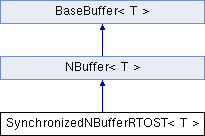
NBuffer which uses FreeRTOS queues to manage the available and filled buffers, making it safe for cross-core SPSC (single producer, single consumer) use on dual-core ESP32. More...
#include <SynchronizedNBufferRTOS.h>
Public Member Functions | |
| SynchronizedNBufferRTOST (int bufferSize, int bufferCount, TickType_t writeMaxWait=1000, TickType_t readMaxWait=1000) | |
| ~SynchronizedNBufferRTOST () | |
| T * | address () |
| returns the address of the start of the actual physical read buffer | |
| int | available () |
| determines the available entries for the current read buffer | |
| int | availableForWrite () |
| determines the available entries for the write buffer | |
| int | bufferCountEmpty () |
| Provides the number of entries that are available to write. | |
| int | bufferCountFilled () |
| Provides the number of entries that are available to read. | |
| void | clear () |
| same as reset | |
| virtual int | clearArray (int len) |
| Removes the next len entries. | |
| void | flush () |
| virtual float | freePercent () |
| Returns the free space of the buffer in %. | |
| bool | isEmpty () |
| bool | isFull () |
| checks if the buffer is full | |
| virtual float | levelPercent () |
| Returns the level of the buffer in %. | |
| bool | peek (T &result) override |
| peeks the actual entry from the buffer | |
| bool | read (T &result) override |
| reads an entry from the buffer | |
| int | readArray (T data[], int len) override |
| void | reset () |
| resets all buffers | |
| bool | resize (size_t bufferSize, int bufferCount) |
| virtual bool | resize (size_t bytes) |
| Resize the buffer to the next multiple of buffer size. | |
| unsigned long | sampleRate () |
| provides the actual sample rate | |
| void | setReadMaxWait (TickType_t ticks) |
| Set how long the reader waits for a filled block (0 = non-blocking) | |
| void | setWriteMaxWait (TickType_t ticks) |
| Set how long the writer waits for a free block (0 = non-blocking) | |
| size_t | size () |
| Provides the total capacity (=buffer size * buffer count) | |
| bool | write (T data) |
| write add an entry to the buffer | |
| virtual int | writeArray (const T data[], int len) |
| Fills the buffer data. | |
| virtual int | writeArrayOverwrite (const T data[], int len) |
| Fills the buffer data and overwrites the oldest data if the buffer is full. | |
Protected Member Functions | |
| bool | addAvailableBuffer (BaseBuffer< T > *buffer) override |
| bool | addFilledBuffer (BaseBuffer< T > *buffer) override |
| void | applyWaitTimes () |
| void | cleanup () |
| void | freeMemory () |
| BaseBuffer< T > * | getNextAvailableBuffer () override |
| BaseBuffer< T > * | getNextFilledBuffer () override |
| void | resetCurrent () |
Protected Attributes | |
| BaseBuffer< T > * | actual_read_buffer |
| BaseBuffer< T > * | actual_write_buffer |
| QueueFromVector< BaseBuffer< T > * > | available_buffers |
| QueueRTOS< BaseBuffer< T > * > | available_queue_ {0, 1000 , 0} |
| size_t | buffer_count |
| int | buffer_size |
| QueueFromVector< BaseBuffer< T > * > | filled_buffers |
| QueueRTOS< BaseBuffer< T > * > | filled_queue_ {0, 1000 , 0} |
| TickType_t | read_max_wait_ = 1000 |
| unsigned long | sample_count |
| unsigned long | start_time |
| TickType_t | write_max_wait_ = 1000 |
Detailed Description
class audio_tools::SynchronizedNBufferRTOST< T >
NBuffer which uses FreeRTOS queues to manage the available and filled buffers, making it safe for cross-core SPSC (single producer, single consumer) use on dual-core ESP32.
The writer (e.g. sketch task, core 1) calls write()/writeArray()/availableForWrite(). The reader (e.g. USB task, core 0) calls read()/readArray()/available()/address(). Block ownership is transferred via FreeRTOS queues which provide the necessary memory barriers for cross-core visibility.
- Note
- Supported by all FreeRTOS platforms
- Template Parameters
-
T
Constructor & Destructor Documentation
◆ SynchronizedNBufferRTOST()
|
inline |
◆ ~SynchronizedNBufferRTOST()
|
inline |
Member Function Documentation
◆ addAvailableBuffer()
|
inlineoverrideprotectedvirtual |
Reimplemented from NBuffer< T >.
◆ addFilledBuffer()
|
inlineoverrideprotectedvirtual |
Reimplemented from NBuffer< T >.
◆ address()
|
inlinevirtualinherited |
returns the address of the start of the actual physical read buffer
Implements BaseBuffer< T >.
◆ applyWaitTimes()
|
inlineprotected |
Apply wait times with correct semantics: Writer needs: available_queue_ READ wait + filled_queue_ WRITE wait Reader needs: filled_queue_ READ wait + available_queue_ WRITE wait
◆ available()
|
inlinevirtualinherited |
determines the available entries for the current read buffer
Implements BaseBuffer< T >.
◆ availableForWrite()
|
inlinevirtualinherited |
determines the available entries for the write buffer
Implements BaseBuffer< T >.
◆ bufferCountEmpty()
|
inlinevirtual |
Provides the number of entries that are available to write.
Reimplemented from NBuffer< T >.
◆ bufferCountFilled()
|
inlinevirtual |
Provides the number of entries that are available to read.
Reimplemented from NBuffer< T >.
◆ cleanup()
|
inlineprotected |
◆ clear()
|
inlineinherited |
same as reset
◆ clearArray()
|
inlinevirtualinherited |
Removes the next len entries.
Reimplemented in SingleBuffer< T >.
◆ flush()
|
inlinevirtualinherited |
Submit the partially-filled write buffer to the filled queue so the reader can access it immediately. Call after writeArray() when the writer won't add more data to the current block for a while.
Reimplemented from BaseBuffer< T >.
◆ freeMemory()
|
inlineprotectedinherited |
◆ freePercent()
|
inlinevirtualinherited |
Returns the free space of the buffer in %.
◆ getNextAvailableBuffer()
|
inlineoverrideprotectedvirtual |
Reimplemented from NBuffer< T >.
◆ getNextFilledBuffer()
|
inlineoverrideprotectedvirtual |
Reimplemented from NBuffer< T >.
◆ isEmpty()
|
inlineinherited |
◆ isFull()
|
inlinevirtualinherited |
checks if the buffer is full
Reimplemented from BaseBuffer< T >.
◆ levelPercent()
|
inlinevirtualinherited |
Returns the level of the buffer in %.
◆ peek()
|
inlineoverridevirtualinherited |
peeks the actual entry from the buffer
Implements BaseBuffer< T >.
◆ read()
|
inlineoverridevirtualinherited |
reads an entry from the buffer
Implements BaseBuffer< T >.
◆ readArray()
|
inlineoverridevirtualinherited |
Reads up to len entries, spanning across multiple blocks. BaseBuffer::readArray stops at the first block boundary because it calls available() once. This override keeps reading across blocks.
Reimplemented from BaseBuffer< T >.
◆ reset()
|
inlinevirtualinherited |
resets all buffers
Implements BaseBuffer< T >.
◆ resetCurrent()
|
inlineprotectedinherited |
◆ resize() [1/2]
|
inlinevirtual |
Resize the buffers by defining a new buffer size and buffer count. If the block size changes, existing blocks can't be reused, so all buffered data is discarded (with a warning). If only the count changes, existing blocks and their data are kept: buffers are just allocated or freed to reach the new count.
Reimplemented from NBuffer< T >.
◆ resize() [2/2]
|
inlinevirtualinherited |
Resize the buffer to the next multiple of buffer size.
Reimplemented from BaseBuffer< T >.
◆ sampleRate()
|
inlineinherited |
provides the actual sample rate
◆ setReadMaxWait()
|
inline |
Set how long the reader waits for a filled block (0 = non-blocking)
◆ setWriteMaxWait()
|
inline |
Set how long the writer waits for a free block (0 = non-blocking)
◆ size()
|
inlinevirtual |
Provides the total capacity (=buffer size * buffer count)
Reimplemented from NBuffer< T >.
◆ write()
|
inlinevirtualinherited |
write add an entry to the buffer
Implements BaseBuffer< T >.
◆ writeArray()
|
inlinevirtualinherited |
Fills the buffer data.
Reimplemented in BufferBlocking< T >, BufferRTOS< T >, SynchronizedBuffer< T >, RedisBuffer< T >, BufferRP2040T< T >, BufferZephyr< T >, SingleBuffer< T >, RingBuffer< T >, RingBufferFile< File, T >, NBufferFile< File, T >, and DynamicMultiBuffer< T, BufferType >.
◆ writeArrayOverwrite()
|
inlinevirtualinherited |
Fills the buffer data and overwrites the oldest data if the buffer is full.
Member Data Documentation
◆ actual_read_buffer
|
protectedinherited |
◆ actual_write_buffer
|
protectedinherited |
◆ available_buffers
|
protectedinherited |
◆ available_queue_
|
protected |
◆ buffer_count
|
protectedinherited |
◆ buffer_size
|
protectedinherited |
◆ filled_buffers
|
protectedinherited |
◆ filled_queue_
|
protected |
◆ read_max_wait_
|
protected |
◆ sample_count
|
protectedinherited |
◆ start_time
|
protectedinherited |
◆ write_max_wait_
|
protected |
The documentation for this class was generated from the following file:
- src/AudioTools/Concurrency/RTOS/SynchronizedNBufferRTOS.h