Video track configuration for MuxerMP4 - update before calling begin(). More...
#include <ContainerMP4.h>
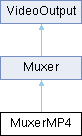
Public Member Functions | |
| MuxerMP4 () | |
| MuxerMP4 (Print &out) | |
| size_t | addAudioFrame (const uint8_t *data, size_t len) override |
| size_t | addI420Frame (const uint8_t *data, size_t len) override |
| size_t | addJpegFrame (const uint8_t *data, size_t len) override |
| size_t | addRGB565Frame (const uint8_t *data, size_t len) override |
| size_t | addVideoFrame (const uint8_t *data, size_t len, bool isKeyFrame=true) override |
| size_t | addYUV422Frame (const uint8_t *data, size_t len) override |
| uint32_t | audioFrameCount () |
| Number of audio frames (fragments) written so far. | |
| AudioInfoFormat & | audioInfo () override |
| Provides read/write access to the audio track's AudioInfoFormat. | |
| bool | begin () override |
| void | end () override |
| Closes the encoder: no trailer is required for playback. | |
| virtual void | flush () |
| float | getAudioSamplesPerVideoFrame () |
| MuxerVideoConfig | getVideoInfo () override |
| Provides the video track configuration. | |
| virtual uint32_t | getWriteTimeMs () const |
| Optional: returns the time (ms) spent in the last write() call. | |
| virtual bool | hadOutput () const |
| virtual bool | isKeyFrame (const uint8_t *data, size_t len) |
| const char * | mimeVideo () override |
| operator bool () override | |
| void | setAudioInfo (AudioInfoFormat info) override |
| void | setAudioProfile (int aacProfile) |
| void | setOutput (Print &out) override |
| Defines the output: e.g. a local File or a network Client. | |
| virtual void | setSkipRender (bool skip) |
| void | setStreamType (StreamContentType type) override |
| void | setVideoInfo (MuxerVideoConfig config) override |
| Defines the video track configuration - call before begin() | |
| virtual void | setVideoInfoSource (VideoInfoSource &source) |
| StreamContentType | streamType () override |
| The track write() currently targets (see setStreamType()) | |
| virtual uint64_t | totalDecodeMs () const |
| uint32_t | videoFrameCount () |
| Number of video frames (fragments) written so far. | |
| size_t | write (const uint8_t *data, size_t len) override |
Protected Member Functions | |
| size_t | addRawFrame (const uint8_t *data, size_t len) |
| void | checkRawFrame (VideoFormat expected, size_t len) |
| void | checkVideoFormat (VideoFormat expected) |
| void | setVideoConfigData (const uint8_t *spsPpsAnnexB, size_t len) |
| bool | tryWriteMoov () |
| void | writeAudioSampleEntryHeader (MP4BoxWriter &b) |
| void | writeAudioStbl (MP4BoxWriter &b) |
| void | writeAvcC (MP4BoxWriter &b) |
| void | writeDinf (MP4BoxWriter &b) |
| void | writeEsds (MP4BoxWriter &b) |
| void | writeEsdsMjpeg (MP4BoxWriter &b) |
| void | writeFtypMoov () |
| void | writeHdlr (MP4BoxWriter &b, const char *handlerType, const char *name) |
| void | writeMdhd (MP4BoxWriter &b, uint32_t timescale) |
| void | writeMoofMdat (uint32_t trackId, const uint8_t *data, size_t len, uint32_t sampleDuration, bool isKeyFrame, uint32_t baseTime) |
| void | writeMvex (MP4BoxWriter &b) |
| void | writeMvhd (MP4BoxWriter &b) |
| void | writeTkhd (MP4BoxWriter &b, uint32_t trackId, bool isVideo) |
| void | writeTrak (MP4BoxWriter &b, uint32_t trackId, bool isVideo) |
| void | writeVideoStbl (MP4BoxWriter &b) |
Static Protected Member Functions | |
| static int | aacSampleRateIndex (uint32_t sampleRate) |
| template<typename F > | |
| static void | forEachAnnexBNal (const uint8_t *data, size_t len, F callback) |
Protected Attributes | |
| uint32_t | audio_base_time = 0 |
| uint32_t | audio_frame_count = 0 |
| AudioInfoFormat | audio_info |
| int | audio_profile = 2 |
| uint32_t | audio_sample_duration = 1024 |
| uint32_t | audio_seq = 0 |
| uint32_t | audio_timescale = 0 |
| MP4BoxWriter | box |
| scratch buffer, reused for 'moov' and each 'moof' | |
| uint32_t | fragment_seq = 0 |
| bool | has_audio = false |
| bool | is_open = false |
| bool | moov_written = false |
| Vector< uint8_t > | nal_tmp |
| scratch buffer for Annex-B -> AVCC conversion | |
| Print * | p_out = nullptr |
| Print * | p_print = nullptr |
| Vector< uint8_t > | pps_data |
| Vector< uint8_t > | sps_data |
| uint32_t | video_base_time = 0 |
| MuxerVideoConfig | video_cfg |
| uint32_t | video_frame_count = 0 |
| uint32_t | video_sample_duration = 0 |
| uint32_t | video_seq = 0 |
| uint32_t | video_timescale = 90000 |
| StreamContentType | write_stream_type = StreamContentType::Video |
Static Protected Attributes | |
| static const uint32_t | kAudioTrackId = 2 |
| static const uint32_t | kVideoTrackId = 1 |
Detailed Description
Video track configuration for MuxerMP4 - update before calling begin().
Fragmented MP4 (fMP4) container encoder: muxes an already-encoded H.264 video stream (Annex-B access units, converted internally to AVCC for the 'mdat' samples) and an optional raw AAC audio stream into a fragmented MP4 stream written to a Print (a local File to record, or e.g. a network Client to publish a live stream to an HTTP/TCP client).
Unlike a classic single-'moov' MP4 (which needs the complete stsz/stco sample tables known upfront, and thus either a seekable output to place 'moov' before 'mdat', or buffering the entire recording in memory), fragmented MP4 writes 'ftyp'+'moov' once (with empty sample tables plus an 'mvex' box that tells the player to expect fragments) and then a self-contained 'moof'+'mdat' pair per frame - no seeking required, the same Print-only, forward-only design DemuxerMP4 already assumes on the read side and MuxerAVI uses for AVI.
Usage:
- Note
- v1 scope: one video track, either VideoFormat::H264 (default - matching the only video codec DemuxerMP4 reads back; write via addVideoFrame(), Annex-B access units) or one of the same raw/MJPEG formats MuxerAVI supports (DemuxerMP4 cannot read any of these back - muxer-only for now): VideoFormat::MJPEG (addJpegFrame(), one complete JPEG image per frame; 'mp4v'/'esds' sample entry, objectTypeIndication 0x6C), VideoFormat::YUV422 (addYUV422Frame(), packed YUY2/YUYV; 'yuvs' sample entry), VideoFormat::RGB565 (addRGB565Frame(), 16-bit 5-6-5; 'L565' sample entry), or VideoFormat::I420 (addI420Frame(), planar 4:2:0; 'I420' sample entry). All five formats were verified to produce a file ffprobe/ffmpeg parses and decodes cleanly (probe_score 100) - see the individual addXxxFrame() methods for exactly what was checked against real ffmpeg-generated reference data. Plus one optional audio track, either AAC (the default - raw, ADTS-less frames, matching the 'mdat' sample convention MP4 itself uses, not the ADTS-wrapped convention DemuxerMP4 hands to its own audio output; config limited to the common 2-byte AudioSpecificConfig case, LC profile, standard sample rates) or raw PCM (setAudioInfo() with format = AudioFormat::PCM - little-endian signed samples, 'sowt' sample entry, no encoder needed; only 16-bit has been validated). No mfra index / seeking metadata is written (not required for playback). SPS/PPS (needed for H264's 'avcC') are captured automatically from the first video frame(s) that carry them - typical H.264 encoders prepend them to (at least) the first access unit, so no separate setup call is needed; frames arriving before SPS/PPS have been seen are dropped (logged), as is any audio arriving before that same point, since 'moov'
- which describes both tracks - cannot be written until then. MJPEG needs no such stream-derived config, so for it 'moov' is already written by the time begin() returns.
- Copyright
- GPLv3
Constructor & Destructor Documentation
◆ MuxerMP4() [1/2]
|
inline |
◆ MuxerMP4() [2/2]
Member Function Documentation
◆ aacSampleRateIndex()
|
inlinestaticprotected |
◆ addAudioFrame()
|
inlineoverridevirtual |
Writes one complete audio frame as a single 'moof'+'mdat' fragment. For AudioFormat::AAC (default): one raw (ADTS-less) AAC frame - the AAC config is described once via 'esds', unlike AVI/ADTS where it is repeated per frame. For AudioFormat::PCM: any number of interleaved PCM samples (e.g. one read buffer's worth) - the fragment's duration is derived from len, so callers may pass differently-sized chunks from call to call. Like addVideoFrame(), frames arriving before 'moov' can be written (i.e. before the video track's SPS/PPS have been seen) are dropped (logged).
Implements Muxer.
◆ addI420Frame()
|
inlineoverridevirtual |
Writes one planar 4:2:0 YUV (I420/IYUV: full-res Y, then quarter-res U, then quarter-res V) frame as a single 'moof'+'mdat' fragment. Expects exactly width*height*3/2 bytes - mismatches are logged, not rejected. No-op (returns 0) unless getVideoInfo().format is VideoFormat::I420.
- Note
- Muxer-only; see addYUV422Frame()'s note - its 'I420' sample entry round-trips correctly through ffprobe/ffmpeg despite ffmpeg's own rawvideo encoder having no direct pix_fmt+tag combination that produces one (a limitation of that one encoder path, not of the 'I420' tag itself - a hand-built file with the correct box structure decodes fine).
Implements Muxer.
◆ addJpegFrame()
|
inlineoverridevirtual |
Writes one complete Motion-JPEG frame (a full, already-encoded JPEG image, e.g. as produced by an ESP32-CAM or other hardware JPEG encoder) as a single 'moof'+'mdat' fragment - no-op (returns 0) unless getVideoInfo().format is VideoFormat::MJPEG.
Implements Muxer.
◆ addRawFrame()
|
inlineprotected |
Writes one complete frame's bytes through as-is (no NAL-style framing needed - used by MJPEG, which is self-delimiting, and the raw pixel formats YUV422/RGB565/I420) as a single 'moof'+'mdat' fragment. Every such frame is independently decodable, so it is always marked as a sync sample. None of these formats need stream-derived config (unlike H264's SPS/PPS), so 'moov' is already written by the time begin() returns - tryWriteMoov() here is just a safety net.
◆ addRGB565Frame()
|
inlineoverridevirtual |
Writes one uncompressed RGB565 (16-bit, 5-6-5) frame as a single 'moof'+'mdat' fragment. Expects exactly width*height*2 bytes - mismatches are logged, not rejected. No-op (returns 0) unless getVideoInfo().format is VideoFormat::RGB565.
- Note
- Muxer-only; see addYUV422Frame()'s note - its 'L565' sample entry matches what ffmpeg itself writes/reads for rgb565le-in-MOV.
Implements Muxer.
◆ addVideoFrame()
|
inlineoverridevirtual |
Writes one complete H.264 access unit (Annex-B: SPS/PPS NALs, if present, are captured for 'avcC' - see setVideoConfigData() - and then stripped, since they end up described there instead) as a single 'moof'+'mdat' fragment. Until SPS/PPS have been seen (from this or an earlier call), 'moov' cannot be written yet, so the frame is dropped (logged) rather than buffered. For the other formats (MJPEG, YUV422, RGB565, I420) the frame is forwarded to the matching addJpegFrame()/addYUV422Frame()/addRGB565Frame()/addI420Frame(), so that generic callers (VideoMuxer, MuxerVideoSink, ...) work with every format.
- Parameters
-
isKeyFrame marks the sample as a sync sample (IDR) in the fragment's 'trun' flags - matters for players seeking into the stream; pass false for P/B (non-IDR) frames if known.
Implements Muxer.
◆ addYUV422Frame()
|
inlineoverridevirtual |
Writes one packed 4:2:2 YUV frame (YUY2/YUYV byte order) as a single 'moof'+'mdat' fragment. Expects exactly width*height*2 bytes - mismatches are logged, not rejected. No-op (returns 0) unless getVideoInfo().format is VideoFormat::YUV422.
- Note
- Muxer-only (DemuxerMP4 cannot read this back). Its 'yuvs' sample entry matches what ffmpeg itself writes for YUY2-in-MOV, and a muxed file round-trips cleanly through ffprobe/ffmpeg (correct pix_fmt, probe_score 100, decodes without error).
Implements Muxer.
◆ audioFrameCount()
|
inline |
Number of audio frames (fragments) written so far.
◆ audioInfo()
|
inlineoverridevirtual |
Provides read/write access to the audio track's AudioInfoFormat.
Implements Muxer.
◆ begin()
|
inlineoverridevirtual |
Prepares the encoder. 'ftyp'+'moov' (with an 'mvex' box signalling fragments will follow) is not written yet at this point - SPS/PPS (needed for 'avcC', part of 'moov') are only known once captured from the video stream itself, so it is written lazily, right before the first fragment that can actually be produced (see addVideoFrame()). Call after configuring video (and audio, if any) and before writing any frames.
Implements Muxer.
◆ checkRawFrame()
|
inlineprotected |
Validates both the configured format and (for fixed-size raw formats) that len matches the width*height based expectation.
◆ checkVideoFormat()
|
inlineprotected |
◆ end()
|
inlineoverridevirtual |
Closes the encoder: no trailer is required for playback.
Implements Muxer.
◆ flush()
|
inlinevirtualinherited |
Finalizes the frame most recently written via one or more write() calls - see class comment. Default no-op for implementations that display/decode synchronously in write() instead.
Reimplemented from VideoOutput.
◆ forEachAnnexBNal()
|
inlinestaticprotected |
Calls callback(nalDataPtr, nalDataLen) for every NAL unit found in an Annex-B buffer (data spans exclude the 00 00 01 / 00 00 00 01 start code itself).
◆ getAudioSamplesPerVideoFrame()
|
inlineinherited |
Average number of audio samples per video frame, derived from audioInfo().sample_rate and getVideoInfo().fps - the natural audio chunk size to write once per video frame if you want to keep both tracks advancing at roughly the same pace as you write them (not a hard requirement - see addAudioFrame()/addVideoFrame()). 0 if fps hasn't been set.
◆ getVideoInfo()
|
inlineoverridevirtual |
Provides the video track configuration.
Implements Muxer.
◆ getWriteTimeMs()
|
inlinevirtualinherited |
Optional: returns the time (ms) spent in the last write() call.
Reimplemented in OutputTFT_eSPI, OutputTinyGPU, and OutputOpenCV.
◆ hadOutput()
|
inlinevirtualinherited |
True if the most recent write()+flush() call actually produced a displayable picture - default true, matching every synchronous decoder (H264Decoder, MJPEGDecoder, ...), which always decodes and pushes pixels fully within that one call. Override this only if your decoder can legitimately accept/decode a frame's bytes without emitting a picture during that same call - e.g. MPGDecoder, whose B-picture display-order reordering can hold a just-decoded picture back and instead emit an earlier one (or nothing at all) from a given write(), see its own override. Used by PacedVideoOutput to avoid counting/timing a call that did no real rendering work as a rendered frame - without this, its outputFPS()/frameCountI()/ frameCountP()/avgFrameMs() would overcount for such a decoder.
Reimplemented in MPGDecoder.
◆ isKeyFrame()
|
inlinevirtualinherited |
True if data (one complete encoded frame, as handed to write()) is a keyframe/sync-sample - self-contained, decodable without any earlier frame. Used e.g. by PacedVideoOutput to decide which frames are safe to drop, and whether it's safe to resume decoding after abandoning a backlog (see its own class comment). Default false: a plain VideoOutput doesn't know or care about codec structure - override this in a decoder for the bitstream format it actually parses (see H264Decoder/H264DecoderESP32S3's isH264KeyFrame()-based override, MPGDecoder's isMpeg1KeyFrame()- based one). Getting this right matters beyond bookkeeping: a target whose frames are never recognized as keyframes can leave a caller like PacedVideoOutput unable to ever resume after a resync.
Reimplemented in PacedVideoOutput, H264Decoder, H264DecoderESP32S3< Alloc >, MJPEGDecoder, MPGDecoder, MultiVideoDecoder, and OutputFPSMeter.
◆ mimeVideo()
|
inlineoverridevirtual |
The container's MIME type (e.g. "video/avi", "video/mp4") - useful for e.g. an HTTP Content-Type header when streaming the muxed output to a client.
Implements Muxer.
◆ operator bool()
|
inlineoverridevirtual |
Implements Muxer.
◆ setAudioInfo()
|
inlineoverridevirtual |
Adds an (optional) interleaved audio track. 'info.format' selects the audio track's codec: AudioFormat::AAC (the default if left unset) writes an 'mp4a'/'esds' sample entry and expects raw (ADTS-less) AAC frames via addAudioFrame(); AudioFormat::PCM writes a 'sowt' (little-endian signed PCM) sample entry instead and expects raw interleaved PCM sample data - simplest option since it needs no encoder at all, but only 16-bit signed PCM has been validated. Call before begin().
Implements Muxer.
◆ setAudioProfile()
|
inline |
Defines the AAC profile (audio object type, default 2 = AAC LC) used to build the 'esds' AudioSpecificConfig - call before begin(). Not used for AudioFormat::PCM.
◆ setOutput()
|
inlineoverridevirtual |
◆ setSkipRender()
|
inlinevirtualinherited |
Hint to skip the expensive part of displaying the next frame(s) (e.g. the panel refresh) while still accepting and fully processing write() calls - used to recover from falling behind the playback schedule without breaking a codec's decode state (e.g. H.264 inter-prediction reference chain, which requires every frame to still be decoded even if it's never shown). Default no-op: implementations that can't skip rendering cheaply just ignore it and always render.
Reimplemented in MultiVideoDecoder, OutputFPSMeter, OutputTinyGPU, PacedVideoOutput, and VideoFrameMeter.
◆ setStreamType()
|
inlineoverridevirtual |
Selects whether write() feeds the video or the audio track, mirroring MuxerAVI's setStreamType(). Defaults to StreamContentType::Video; switch to StreamContentType::Audio (and back) around calls when using MuxerMP4 as a plain sink for both.
Implements Muxer.
◆ setVideoConfigData()
|
inlineprotected |
Scans an Annex-B video frame for SPS/PPS NALs and captures them (for the 'avcC' box) if found - called automatically from addVideoFrame() for every frame, so whichever frame(s) happen to carry them (typically the first, and/or every keyframe) fill in the config. Does not clear previously-captured data when a frame contains neither.
◆ setVideoInfo()
|
inlineoverridevirtual |
◆ setVideoInfoSource()
|
inlinevirtualinherited |
Optional: registers where width/height/fps/format (VideoInfo) come from - e.g. the demuxer feeding this output, so it can size its own buffers/panel setup without the caller having to duplicate that call per sketch (VideoPlayer::begin() does this automatically for whichever VideoOutput it was given). Default no-op: only implementations that actually need VideoInfo (OutputTinyGPU/ OutputOpenCV/OutputTFT_eSPI) override this.
Reimplemented in MultiVideoDecoder, OutputOpenCV, OutputTFT_eSPI, and OutputTinyGPU.
◆ streamType()
|
inlineoverridevirtual |
The track write() currently targets (see setStreamType())
Implements Muxer.
◆ totalDecodeMs()
|
inlinevirtualinherited |
Optional: sum of time (ms) spent purely decoding (excluding any surrounding convert/render/SPI work a subclass's write() also does) since begin() - see H264Decoder's own override for the only current implementation. Default 0: only meaningful for a decoder that separates decode time from render time internally: PacedVideoOutput:: logTo() prints a decode-vs-render split under "avg decode ms:" only when this returns nonzero.
Reimplemented in H264Decoder, and MultiVideoDecoder.
◆ tryWriteMoov()
|
inlineprotected |
Writes 'ftyp'+'moov', once SPS/PPS are available for H264 (MJPEG needs no equivalent stream-derived config, so it's ready immediately)
- a no-op once already written. Returns true if 'moov' has been (now or previously) written, i.e. fragments may be written.
◆ videoFrameCount()
|
inline |
Number of video frames (fragments) written so far.
◆ write()
|
inlineoverridevirtual |
VideoOutput API / generic sink: writes one complete frame to whichever track streamType() currently selects (see setStreamType()). Each call is dispatched immediately - the caller must hand over the complete frame in a single call (video: to the addXxxFrame() matching getVideoInfo().format; audio: to addAudioFrame()). flush() is a no-op; there is no accumulation across write() calls.
Implements VideoOutput.
◆ writeAudioSampleEntryHeader()
|
inlineprotected |
Writes the common 28-byte AudioSampleEntry fixed header shared by 'mp4a' (AAC) and 'sowt' (PCM) - the same layout DemuxerMP4 itself reads (see its setupAudioInfo()): reserved+data_reference_index, reserved, channelcount, samplesize, pre_defined+reserved, samplerate.
◆ writeAudioStbl()
|
inlineprotected |
◆ writeAvcC()
|
inlineprotected |
◆ writeDinf()
|
inlineprotected |
◆ writeEsds()
|
inlineprotected |
◆ writeEsdsMjpeg()
|
inlineprotected |
'esds' for the 'mp4v' MJPEG sample entry: objectTypeIndication 0x6C (ISO/IEC 10918-1, i.e. JPEG) with no DecoderSpecificInfo, since each JPEG sample is fully self-contained (its own quantization/Huffman tables) - unlike AAC, there is no shared out-of-band config. Layout verified against what ffmpeg itself writes for MJPEG-in-MP4.
◆ writeFtypMoov()
|
inlineprotected |
◆ writeHdlr()
|
inlineprotected |
◆ writeMdhd()
|
inlineprotected |
◆ writeMoofMdat()
|
inlineprotected |
Writes one 'moof' (mfhd + traf{tfhd,tfdt,trun}) + 'mdat' fragment for a single sample. data_offset in 'trun' is relative to the start of 'moof' (the "default-base-is-moof" convention) - computed by first assembling 'moof' in the scratch buffer (its size is independent of the sample bytes themselves) and backpatching the offset field.
◆ writeMvex()
|
inlineprotected |
◆ writeMvhd()
|
inlineprotected |
◆ writeTkhd()
|
inlineprotected |
◆ writeTrak()
|
inlineprotected |
◆ writeVideoStbl()
|
inlineprotected |
Member Data Documentation
◆ audio_base_time
|
protected |
◆ audio_frame_count
|
protected |
◆ audio_info
|
protected |
◆ audio_profile
|
protected |
◆ audio_sample_duration
|
protected |
◆ audio_seq
|
protected |
◆ audio_timescale
|
protected |
◆ box
|
protected |
scratch buffer, reused for 'moov' and each 'moof'
◆ fragment_seq
|
protected |
◆ has_audio
|
protected |
◆ is_open
|
protected |
◆ kAudioTrackId
|
staticprotected |
◆ kVideoTrackId
|
staticprotected |
◆ moov_written
|
protected |
True once 'ftyp'+'moov' has actually been written (deferred until SPS/PPS are known - see tryWriteMoov()).
◆ nal_tmp
|
protected |
scratch buffer for Annex-B -> AVCC conversion
◆ p_out
|
protected |
◆ p_print
|
protectedinherited |
◆ pps_data
|
protected |
◆ sps_data
|
protected |
◆ video_base_time
|
protected |
◆ video_cfg
|
protected |
◆ video_frame_count
|
protected |
◆ video_sample_duration
|
protected |
◆ video_seq
|
protected |
◆ video_timescale
|
protected |
◆ write_stream_type
|
protected |
The documentation for this class was generated from the following file:
- src/AudioTools/AudioCodecs/ContainerMP4.h