High-level video playback pipeline and controller - the video counterpart of AudioPlayer (CoreAudio/AudioPlayer.h). Wraps a container Demuxer, a VideoDecoder driven through a PacedVideoOutput, and optionally an audio decode chain synced against it, behind one object driven by a single copy() call per loop() iteration. More...
#include <VideoPlayer.h>
Protected Attributes | |
| bool | active = false |
| AudioTimeSourceStream | audio_clock |
| EncodedAudioStream | audio_out |
| int | buffer_size = 1024 |
| MultiDecoder | default_audio_decoder |
| MultiVideoDemuxer | default_demuxer |
| MultiVideoDecoder | default_video_decoder |
| Print * | p_audio_output = nullptr |
| AudioOutput * | p_audio_output_typed = nullptr |
| AudioStream * | p_audio_stream = nullptr |
| Stream * | p_source = nullptr |
| VideoOutput * | p_video_output = nullptr |
| bool | use_audio_clock = true |
| PacedVideoOutput | video_sync {default_video_decoder} |
Detailed Description
High-level video playback pipeline and controller - the video counterpart of AudioPlayer (CoreAudio/AudioPlayer.h). Wraps a container Demuxer, a VideoDecoder driven through a PacedVideoOutput, and optionally an audio decode chain synced against it, behind one object driven by a single copy() call per loop() iteration.
Nothing is pre-registered (no container/codec library dependency by default) - register what your content needs:
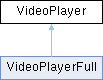
Use VideoPlayerFull (VideoPlayerFull.h) instead to pre-register every common container/video/audio codec at once, at the cost of pulling in all of their libraries unconditionally.
Pipeline: Stream -> copy() -> Demuxer -> [audio: EncodedAudioStream -> audio output] / [video: PacedVideoOutput -> VideoDecoder -> video output, own background task].
See the wiki's Video Playback page for the full picture: audio-clock scheduling (setUseAudioClock()), running video decode on its own core (setTaskParameters()), the seek-backed/spooled MP4 exception, and more.
- Copyright
- GPLv3
Constructor & Destructor Documentation
◆ VideoPlayer() [1/6]
|
default |
◆ VideoPlayer() [2/6]
|
inline |
Video-only playback (no audio track) - auto-detected video codec. demuxer is registered the same way an addDemuxer() call would (this is just a convenience for the common single-format case - call addDemuxer() separately, as many times as needed, for additional container formats).
◆ VideoPlayer() [3/6]
|
inline |
Video + audio playback (AudioOutput target, e.g. AudioBoardStream/ I2SStream) with auto-detected codecs. By default the video frame schedule is driven off this audio output's own playback progress (an "audio clock") rather than a free-running timer, so video stays in sync with audio even as the two decode at slightly different rates; call setUseAudioClock(false) if the content's audio track never actually delivers bytes (e.g. a silent/empty track), since the clock would then never advance and video would never play. demuxer is registered the same way as the video-only constructor above.
◆ VideoPlayer() [4/6]
|
inline |
Video + audio playback (a generic Print target) with auto-detected codecs - same audio-clock-driven scheduling as the AudioOutput overload above, and demuxer is registered the same way as the video-only constructor.
◆ VideoPlayer() [5/6]
|
inline |
Video + audio playback (AudioStream target, e.g. PortAudioStream) with auto-detected codecs - same audio-clock-driven scheduling as the AudioOutput overload above, and demuxer is registered the same way as the video-only constructor.
◆ VideoPlayer() [6/6]
|
delete |
Non-copyable: video_sync/audio_out below are wired against this object's own member addresses - copying would leave the copy's internal wiring pointing at the original.
Member Function Documentation
◆ addAudioDecoder()
|
inline |
Registers an audio codec decoder (MP3DecoderHelix/AACDecoderHelix/...) with the built-in MultiDecoder, keyed by the mime string given here (or the decoder's own default mime type if mime is null). The built-in decoder selector starts out completely empty, so this needs at least one call per audio codec your content actually uses before begin() is called - call it multiple times to support more than one codec.
◆ addDemuxer()
|
inline |
Registers a container demuxer implementation (DemuxerAVI/DemuxerMP4/ DemuxerMPG/...) with the built-in MultiVideoDemuxer, keyed under the demuxer's own Demuxer::mimeVideo(). The built-in demuxer selector starts out completely empty, so this needs at least one call per container format your content actually uses before begin() is called
- call it multiple times to support more than one format.
◆ addVideoDecoder()
|
inline |
Registers a video codec decoder (H264Decoder/MJPEGDecoder/MPGDecoder/ ...) with the built-in MultiVideoDecoder, keyed under the decoder's own VideoDecoder::codecFormat(). The built-in decoder selector starts out completely empty, so this needs at least one call per video codec your content actually uses before begin() is called - call it multiple times to support more than one codec.
◆ audioDecoder()
|
inline |
The built-in audio multi-decoder, empty until addAudioDecoder() has registered at least one audio codec decoder - also useful for diagnostics (e.g. selectedMime()).
◆ begin()
|
inline |
Wires the full pipeline (video decoder -> output via PacedVideoOutput; audio decoder -> [audio clock ->] output, if an audio output was given) and starts the demuxer. source (e.g. an open File) is read from on every subsequent copy() call - the caller owns it and is responsible for closing it once copy()/copyAll() signal end of stream (return 0).
◆ copy()
|
inline |
Reads and demuxes one chunk (setBufferSize(), default 1024 bytes) from the source given to begin() - call this every loop() iteration. Also keeps the video schedule's fps in sync with the demuxer's own parsed rate, since VideoInfo::fps only becomes known partway through (once the container's header has been parsed) - no separate polling needed in the caller's loop(), unlike the *.ino examples this class replaces.
- Returns
- bytes actually copied - 0 once the source is exhausted (or playback is inactive/not begin()'d), matching CodecCopy::copy()'s own "0 means stop" convention every current *.ino example already checks for.
◆ copyAll()
|
inline |
Copies until the source is exhausted (blocking).
◆ demuxer()
|
inline |
The built-in demuxer multi-selector, empty until addDemuxer() has registered at least one container demuxer - also useful for diagnostics (e.g. selectedDemuxer()/mimeVideo()).
◆ end()
|
inline |
◆ getStream()
◆ isActive()
|
inline |
◆ logTo()
|
inline |
Logs periodic playback diagnostics (frame count, average frame time, output fps, ...) to out - convenience shortcut for videoSyncTask().logTo(out).
◆ operator bool()
|
inline |
Same as isActive().
◆ operator=()
|
delete |
◆ setActive()
|
inline |
◆ setAudioOutput() [1/3]
|
inline |
◆ setAudioOutput() [2/3]
|
inline |
◆ setAudioOutput() [3/3]
|
inline |
Defines the final audio output target and enables the audio playback path - leave unset entirely for video-only content. The caller must already have configured/begin()'d it. Call before begin(). Also enables audio-clock-driven video scheduling by default (see setUseAudioClock()) - call setUseAudioClock(false) afterwards to turn that off.
Three overloads, mirroring AudioPlayer::setOutput(): AudioOutput and AudioStream are unrelated types (both derive from Print, but neither derives from the other), so the most specific one actually available should be used. Using the specific overload lets begin() wire the audio clock/EncodedAudioStream through the matching setOutput(AudioOutput&)/setStream(AudioStream&) overload instead of falling back to the generic Print& one - that's what makes things like audio-info change notifications reach the real output correctly.
◆ setBufferSize()
|
inline |
◆ setCatchUpThresholdFrames()
|
inline |
How many frame periods behind schedule playback must fall before non-keyframes start being proactively dropped to catch up, instead of only dropping once the frame queue is completely full. 1.0 (the default) starts dropping once the most recently rendered frame was at least one frame period late; a lower value catches up faster at the cost of more dropped frames, a higher value tolerates more backlog before reacting. Forwards to the built-in PacedVideoOutput; call before begin().
◆ setIgnorePFrames()
|
inline |
Unconditionally discards every non-keyframe (P/B-frame) as it arrives, before it is even queued for decode - a codec-agnostic way to render only keyframes, cheaper than letting the decoder decode and then discard each one. Off by default. Independent of the catch-up/backlog-driven dropping described above, which still applies when this is off. Forwards to the built-in PacedVideoOutput; call before begin().
◆ setMaxQueuedIFrames()
|
inline |
Number of not-yet-consumed keyframes sitting in the queue that triggers the same resync as the other two thresholds - catches a growing backlog earlier than either: once several groups-of-pictures worth of unconsumed keyframes have piled up, none of them are worth rendering in order anymore, so the freshest one is kept and the rest discarded. 3 by default (deliberately small); 0 disables this trigger. Forwards to the built-in PacedVideoOutput; call before begin().
◆ setQueueBytes()
|
inline |
Byte capacity of the frame queue sitting between the demuxer/decoder and the paced render task - default 32KB. Too small behaves like a 1-frame queue, where any single slow frame blocks the writer immediately; a larger queue absorbs transient jitter at the cost of more RAM and more frames buffered ahead of what's actually on screen. It does not change what happens under a sustained rate mismatch - the queue still eventually fills, just later. Forwards to the built-in PacedVideoOutput; call before begin()/the first frame - not supported afterwards.
◆ setQueueUsePSRAM()
|
inline |
Whether the frame queue above is allocated from PSRAM instead of the internal heap - silently falls back to internal heap on boards without PSRAM. On by default, since internal heap is a scarcer shared resource on most ESP32 boards and video decoding already needs PSRAM for other buffers (decoded picture buffers, scaling scratch space, ...). Turn it off for a queue small enough that internal heap is preferable, or on a board with no PSRAM where the fallback path is undesired. Forwards to the built-in PacedVideoOutput; call before begin()/the first frame - has no effect on an already-allocated queue.
◆ setResyncQueueFillFraction()
|
inline |
Byte-occupancy fraction (0..1) of the internal frame queue that triggers the same forward-jump resync as setResyncThresholdMs(), but from a different signal: dropped frames can keep the most recently rendered frame's own lateness low even while newer, not-yet-rendered bytes keep piling up faster than they're consumed. 0.8 (80% full) by default; 0 disables this trigger. Forwards to the built-in PacedVideoOutput; call before begin().
◆ setResyncThresholdMs()
|
inline |
How far behind schedule (milliseconds) playback must fall before it gives up trying to catch up frame-by-frame and instead jumps its internal schedule forward to the current time - dropping frames alone can only slow a backlog's growth, never actually shrink it, since decoding can't outrun real time. Content in the skipped gap is never shown - this trades a visible jump for recovering instead of lagging further and further behind. 2000ms by default; 0 disables this resync behavior entirely. Forwards to the built-in PacedVideoOutput; call before begin().
◆ setSchedulingDelayMs()
|
inline |
Corrects for the real audio output's own buffering latency: the audio clock advances as soon as bytes are accepted by write(), not when they actually become audible - e.g. ~100ms ahead on a device with ~100ms of internal buffering, which would otherwise make every video frame appear that much too early. Delaying each frame's schedule by this amount cancels that out. There's no way to derive it automatically - set it to roughly match the audio output's own buffering latency. 0 (the default) applies no correction. Forwards to the built-in PacedVideoOutput; call before begin().
◆ setTaskParameters()
|
inline |
Stack size (in words), priority, and (optionally) CPU core for the background task that renders queued video frames on schedule. core pins that task to a specific core - e.g. core 0, to keep it off whichever core runs copy()/loop() (audio decode/demuxing), giving audio and video decoding their own separate cores with no further setup. -1 (the default) leaves core assignment up to the RTOS. Forwards to the built-in PacedVideoOutput; call before begin() - has no effect on an already-running render task.
◆ setUseAudioClock()
|
inline |
Whether video frames are scheduled against the real audio output's playback progress (an "audio clock", via AudioTimeSourceStream) instead of a free-running timer - keeps video in sync with audio even as the two decode at slightly different rates, since the audio clock only advances as audio is actually consumed. True (on) by default once an audio output is set via setAudioOutput() - calling setAudioOutput() again does not reset this. Turn it off if the content's audio track never actually delivers bytes (e.g. a silent/empty track), since the clock would then never advance and video would never play. Call before begin().
◆ setVideoOutput()
|
inline |
Defines the final video display target (e.g. OutputTinyGPU, OutputOpenCV) - the caller must already have configured/begin()'d it (board/panel init, such as pin setup or a TFT library's own begin(), is outside this class's scope). Call before begin().
◆ useAudioClock()
|
inline |
Current setUseAudioClock() setting.
◆ videoDecoder()
|
inline |
The built-in video multi-decoder, empty until addVideoDecoder() has registered at least one video codec decoder - also useful for diagnostics (e.g. selectedFormat()).
◆ videoSyncTask()
|
inline |
Escape hatch for tuning beyond this class's own surface - e.g. setTaskParameters()/setQueueBytes()/setMaxQueuedIFrames()/ setIgnorePFrames()/setSchedulingDelayMs(), or the frameCount()/ avgFrameMs()/outputFPS() family of diagnostics - returns the PacedVideoOutput instance that VideoPlayer's own tuning forwarders above delegate to.
Member Data Documentation
◆ active
|
protected |
◆ audio_clock
|
protected |
◆ audio_out
|
protected |
◆ buffer_size
|
protected |
◆ default_audio_decoder
|
protected |
◆ default_demuxer
|
protected |
◆ default_video_decoder
|
protected |
◆ p_audio_output
|
protected |
◆ p_audio_output_typed
|
protected |
◆ p_audio_stream
|
protected |
◆ p_source
|
protected |
◆ p_video_output
|
protected |
◆ use_audio_clock
|
protected |
◆ video_sync
|
protected |
The documentation for this class was generated from the following file:
- src/AudioTools/Video/VideoPlayer.h