H.264 video decoder for ESP32-S3: wraps esp_h264::H264Decoder (https://github.com/pschatzmann/ESP32S3-h264) as a VideoOutput, so it can be plugged directly into e.g. DemuxerAVI::setOutputVideo()/ DemuxerMP4::setOutputVideo() - the same role H264Decoder (CodecH264.h, the portable TinyH264-based decoder) plays, for boards where the ESP32-S3-specific esp_h264 backend is preferred instead. Consumes an Annex-B H.264 bitstream via write() and, once a complete picture has been decoded, writes it - converted to setVideoFormat()'s format (RGB565 by default, the common TFT wire format) - to the Print target configured via setOutput(), one write() call per decoded picture.
More...
#include <CodecH264ESP32S3.h>
template<typename Alloc = H264_DEFAULT_ALLOCATOR>
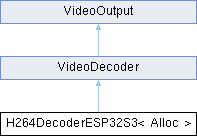
class audio_tools::H264DecoderESP32S3< Alloc >
H.264 video decoder for ESP32-S3: wraps esp_h264::H264Decoder (https://github.com/pschatzmann/ESP32S3-h264) as a VideoOutput, so it can be plugged directly into e.g. DemuxerAVI::setOutputVideo()/ DemuxerMP4::setOutputVideo() - the same role H264Decoder (CodecH264.h, the portable TinyH264-based decoder) plays, for boards where the ESP32-S3-specific esp_h264 backend is preferred instead. Consumes an Annex-B H.264 bitstream via write() and, once a complete picture has been decoded, writes it - converted to setVideoFormat()'s format (RGB565 by default, the common TFT wire format) - to the Print target configured via setOutput(), one write() call per decoded picture.
write()/flush() implement the VideoOutput contract (see Video.h): write() may be called one or more times per frame - bytes are forwarded to the wrapped decoder's decode() immediately, which invokes the frame callback synchronously for every completed picture found in that call, not deferred to flush(). flush() is a no-op, kept only because some producers (e.g. DemuxerAVI/DemuxerMP4) call it unconditionally after each frame.
No setup beyond setOutput() is required before begin() - unlike esp_h264::H264Decoder's own defaultConfig() (sized for VGA), this wrapper defaults its input/output buffers to sizes that fit typical small-panel use directly; setInputBufferSize()/setOutputBufferSize() exist only as an optional performance tweak (see their own comments).
The Alloc template parameter is forwarded to esp_h264::H264Decoder - see that class's own file comment (H264Decoder.h) for the PSRAM- vs. internal-RAM allocator choice (H264DecoderPSRAM/H264DecoderRAM aliases). Defaults to H264_DEFAULT_ALLOCATOR.
- Author
- Phil Schatzmann
- Copyright
- GPLv3
◆ H264DecoderESP32S3() [1/3]
template<typename Alloc = H264_DEFAULT_ALLOCATOR>
◆ H264DecoderESP32S3() [2/3]
template<typename Alloc = H264_DEFAULT_ALLOCATOR>
| H264DecoderESP32S3 |
( |
Print & | out | ) |
|
|
inline |
◆ H264DecoderESP32S3() [3/3]
template<typename Alloc = H264_DEFAULT_ALLOCATOR>
◆ begin()
template<typename Alloc = H264_DEFAULT_ALLOCATOR>
Initializes the decoder - see esp_h264::H264Decoder::begin().
Implements VideoDecoder.
◆ codecFormat()
template<typename Alloc = H264_DEFAULT_ALLOCATOR>
◆ decodeErrors()
template<typename Alloc = H264_DEFAULT_ALLOCATOR>
| uint32_t decodeErrors |
( |
| ) |
const |
|
inline |
Number of decode errors since begin().
◆ driver()
template<typename Alloc = H264_DEFAULT_ALLOCATOR>
| esp_h264::H264Decoder< Alloc > & driver |
( |
| ) |
|
|
inline |
Direct access to the wrapped esp_h264::H264Decoder.
◆ end()
template<typename Alloc = H264_DEFAULT_ALLOCATOR>
Releases the decoder's resources - see esp_h264::H264Decoder::end().
Implements VideoDecoder.
◆ flush()
template<typename Alloc = H264_DEFAULT_ALLOCATOR>
No-op - kept to satisfy the VideoOutput/Print contract; decoding already happens synchronously in write() (see class comment).
Reimplemented from VideoOutput.
◆ frameCount()
template<typename Alloc = H264_DEFAULT_ALLOCATOR>
| uint32_t frameCount |
( |
| ) |
const |
|
inline |
Number of frames successfully decoded since begin().
◆ getWriteTimeMs()
| virtual uint32_t getWriteTimeMs |
( |
| ) |
const |
|
inlinevirtualinherited |
◆ hadOutput()
| virtual bool hadOutput |
( |
| ) |
const |
|
inlinevirtualinherited |
True if the most recent write()+flush() call actually produced a displayable picture - default true, matching every synchronous decoder (H264Decoder, MJPEGDecoder, ...), which always decodes and pushes pixels fully within that one call. Override this only if your decoder can legitimately accept/decode a frame's bytes without emitting a picture during that same call - e.g. MPGDecoder, whose B-picture display-order reordering can hold a just-decoded picture back and instead emit an earlier one (or nothing at all) from a given write(), see its own override. Used by PacedVideoOutput to avoid counting/timing a call that did no real rendering work as a rendered frame - without this, its outputFPS()/frameCountI()/ frameCountP()/avgFrameMs() would overcount for such a decoder.
Reimplemented in MPGDecoder.
◆ isKeyFrame()
template<typename Alloc = H264_DEFAULT_ALLOCATOR>
| bool isKeyFrame |
( |
const uint8_t * | data, |
|
|
size_t | len ) |
|
inlineoverridevirtual |
◆ isValid()
| virtual bool isValid |
( |
const uint8_t * | data, |
|
|
size_t | len ) |
|
inlinevirtualinherited |
True if data (the start of an access unit, as handed to write()) looks like this decoder's own bitstream format - content-sniffing, not a guarantee (see the concrete class for exactly what's checked). Used by MultiVideoDecoder to auto-select a registered decoder when no VideoInfoSource answer is available (see its own class comment); not otherwise part of the write()/flush() decode path. Default false, matching VideoOutput::isKeyFrame()'s own default - a decoder not meant to be auto-detected this way (e.g. a hardware-accelerated backend not registered by default, still usable via an explicit VideoInfoSource-based selection) simply never overrides it.
Reimplemented in H264Decoder, MJPEGDecoder, and MPGDecoder.
◆ setInputBufferSize()
template<typename Alloc = H264_DEFAULT_ALLOCATOR>
| void setInputBufferSize |
( |
size_t | size | ) |
|
|
inline |
Optional: pre-sizes the input buffer the wrapped decoder copies write()'s data into - purely a performance knob, not a requirement: esp_h264::H264Decoder grows it on demand if a frame ever exceeds it (see H264Decoder::decode()), so a too-small (or never-called) value still decodes correctly, just with an occasional reallocation. Defaults to 64KB (see the constructor's comment). Call before begin().
◆ setOutput() [1/2]
template<typename Alloc = H264_DEFAULT_ALLOCATOR>
| void setOutput |
( |
Print & | out | ) |
|
|
inlineoverridevirtual |
◆ setOutput() [2/2]
template<typename Alloc = H264_DEFAULT_ALLOCATOR>
Defines the target each decoded picture is written to - the VideoOutput-specific counterpart of setOutput(Print&), for a target like OutputTinyGPU/OutputOpenCV that implements VideoOutput but not Print (the two are unrelated types - see VideoFrameMeter's own comment). Part of the base interface (unlike other decoder-specific extras) so code holding only a VideoDecoder& (e.g. VideoPlayer) can wire it to an arbitrary VideoOutput& without knowing the concrete decoder type - every current decoder already implemented this identically before it was pulled up into the interface.
Implements VideoDecoder.
◆ setOutputBufferSize()
template<typename Alloc = H264_DEFAULT_ALLOCATOR>
| void setOutputBufferSize |
( |
size_t | size | ) |
|
|
inline |
Optional: pre-sizes the output buffer the wrapped decoder allocates for the decoded/converted picture - purely a performance knob, not a requirement: it grows on demand to fit width*height*bytes-per- pixel for setVideoFormat()'s format if this proves too small (see H264Decoder::processDecodedFrame()). Defaults to 100KB (see the constructor's comment). Call before begin().
◆ setSkipRender()
| virtual void setSkipRender |
( |
bool | skip | ) |
|
|
inlinevirtualinherited |
Hint to skip the expensive part of displaying the next frame(s) (e.g. the panel refresh) while still accepting and fully processing write() calls - used to recover from falling behind the playback schedule without breaking a codec's decode state (e.g. H.264 inter-prediction reference chain, which requires every frame to still be decoded even if it's never shown). Default no-op: implementations that can't skip rendering cheaply just ignore it and always render.
Reimplemented in MultiVideoDecoder, OutputFPSMeter, OutputTinyGPU, PacedVideoOutput, and VideoFrameMeter.
◆ setVideoFormat()
template<typename Alloc = H264_DEFAULT_ALLOCATOR>
Selects the pixel format written to setOutput()'s target - this backend (esp_h264) only supports VideoFormat::RGB565 (the default) and VideoFormat::I420; any other value is logged and ignored (the previously selected format stays in effect) - use driver() and esp_h264_types.h's other ESP_H264_RAW_FMT_* values directly if you need one of those instead. Call before begin().
Implements VideoDecoder.
◆ setVideoInfoSource()
◆ totalDecodeMs()
| virtual uint64_t totalDecodeMs |
( |
| ) |
const |
|
inlinevirtualinherited |
Optional: sum of time (ms) spent purely decoding (excluding any surrounding convert/render/SPI work a subclass's write() also does) since begin() - see H264Decoder's own override for the only current implementation. Default 0: only meaningful for a decoder that separates decode time from render time internally: PacedVideoOutput:: logTo() prints a decode-vs-render split under "avg decode ms:" only when this returns nonzero.
Reimplemented in H264Decoder, and MultiVideoDecoder.
◆ videoInfo()
template<typename Alloc = H264_DEFAULT_ALLOCATOR>
Reports the format/dimensions of the picture written to setOutput()'s target - format is setVideoFormat()'s most recently selected value (RGB565 if never called); width/height are the most recently decoded picture's (0 before any picture has been decoded).
Implements VideoDecoder.
◆ write()
template<typename Alloc = H264_DEFAULT_ALLOCATOR>
| size_t write |
( |
const uint8_t * | data, |
|
|
size_t | len ) |
|
inlineoverridevirtual |
Feeds one chunk of Annex-B H.264 data - may be called more than once per frame. Decodes immediately, invoking setOutput()'s Print once per completed picture from within this call (not deferred to flush()).
Implements VideoOutput.
◆ config_
template<typename Alloc = H264_DEFAULT_ALLOCATOR>
| esp_h264::H264Decoder<Alloc>::Config config_ |
|
protected |
◆ decoder_
template<typename Alloc = H264_DEFAULT_ALLOCATOR>
| esp_h264::H264Decoder<Alloc> decoder_ |
|
protected |
◆ p_out
template<typename Alloc = H264_DEFAULT_ALLOCATOR>
◆ p_out_video
template<typename Alloc = H264_DEFAULT_ALLOCATOR>
The documentation for this class was generated from the following file:
 1.15.0