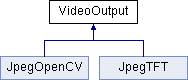
Abstract class for video playback. This class is used to assemble a complete video frame in memory. A video frame is written via one or more write() calls, then finalized with flush() - implementations use flush() to know a frame is complete (there is no separate frame-size hint, unlike a length-prefixed chunk format). More...
#include <VideoOutput.h>
Public Member Functions | |
| virtual void | flush () |
| virtual uint32_t | getWriteTimeMs () const |
| Optional: returns the time (ms) spent in the last write() call. | |
| virtual bool | hadOutput () const |
| virtual bool | isKeyFrame (const uint8_t *data, size_t len) |
| virtual void | setSkipRender (bool skip) |
| virtual void | setVideoInfoSource (VideoInfoSource &source) |
| virtual uint64_t | totalDecodeMs () const |
| virtual size_t | write (const uint8_t *data, size_t len)=0 |
Detailed Description
Abstract class for video playback. This class is used to assemble a complete video frame in memory. A video frame is written via one or more write() calls, then finalized with flush() - implementations use flush() to know a frame is complete (there is no separate frame-size hint, unlike a length-prefixed chunk format).
- Copyright
- GPLv3
Member Function Documentation
◆ flush()
|
inlinevirtual |
Finalizes the frame most recently written via one or more write() calls - see class comment. Default no-op for implementations that display/decode synchronously in write() instead.
Reimplemented in Muxer, H264DecoderESP32S3< Alloc >, MJPEGDecoder, MPGDecoder, MultiVideoDecoder, OutputFPSMeter, OutputOpenCV, PacedVideoOutput, and VideoFrameMeter.
◆ getWriteTimeMs()
|
inlinevirtual |
Optional: returns the time (ms) spent in the last write() call.
Reimplemented in OutputTFT_eSPI, OutputTinyGPU, and OutputOpenCV.
◆ hadOutput()
|
inlinevirtual |
True if the most recent write()+flush() call actually produced a displayable picture - default true, matching every synchronous decoder (H264Decoder, MJPEGDecoder, ...), which always decodes and pushes pixels fully within that one call. Override this only if your decoder can legitimately accept/decode a frame's bytes without emitting a picture during that same call - e.g. MPGDecoder, whose B-picture display-order reordering can hold a just-decoded picture back and instead emit an earlier one (or nothing at all) from a given write(), see its own override. Used by PacedVideoOutput to avoid counting/timing a call that did no real rendering work as a rendered frame - without this, its outputFPS()/frameCountI()/ frameCountP()/avgFrameMs() would overcount for such a decoder.
Reimplemented in MPGDecoder.
◆ isKeyFrame()
|
inlinevirtual |
True if data (one complete encoded frame, as handed to write()) is a keyframe/sync-sample - self-contained, decodable without any earlier frame. Used e.g. by PacedVideoOutput to decide which frames are safe to drop, and whether it's safe to resume decoding after abandoning a backlog (see its own class comment). Default false: a plain VideoOutput doesn't know or care about codec structure - override this in a decoder for the bitstream format it actually parses (see H264Decoder/H264DecoderESP32S3's isH264KeyFrame()-based override, MPGDecoder's isMpeg1KeyFrame()- based one). Getting this right matters beyond bookkeeping: a target whose frames are never recognized as keyframes can leave a caller like PacedVideoOutput unable to ever resume after a resync.
Reimplemented in PacedVideoOutput, H264Decoder, H264DecoderESP32S3< Alloc >, MJPEGDecoder, MPGDecoder, MultiVideoDecoder, and OutputFPSMeter.
◆ setSkipRender()
|
inlinevirtual |
Hint to skip the expensive part of displaying the next frame(s) (e.g. the panel refresh) while still accepting and fully processing write() calls - used to recover from falling behind the playback schedule without breaking a codec's decode state (e.g. H.264 inter-prediction reference chain, which requires every frame to still be decoded even if it's never shown). Default no-op: implementations that can't skip rendering cheaply just ignore it and always render.
Reimplemented in MultiVideoDecoder, OutputFPSMeter, OutputTinyGPU, PacedVideoOutput, and VideoFrameMeter.
◆ setVideoInfoSource()
|
inlinevirtual |
Optional: registers where width/height/fps/format (VideoInfo) come from - e.g. the demuxer feeding this output, so it can size its own buffers/panel setup without the caller having to duplicate that call per sketch (VideoPlayer::begin() does this automatically for whichever VideoOutput it was given). Default no-op: only implementations that actually need VideoInfo (OutputTinyGPU/ OutputOpenCV/OutputTFT_eSPI) override this.
Reimplemented in MultiVideoDecoder, OutputOpenCV, OutputTFT_eSPI, and OutputTinyGPU.
◆ totalDecodeMs()
|
inlinevirtual |
Optional: sum of time (ms) spent purely decoding (excluding any surrounding convert/render/SPI work a subclass's write() also does) since begin() - see H264Decoder's own override for the only current implementation. Default 0: only meaningful for a decoder that separates decode time from render time internally: PacedVideoOutput:: logTo() prints a decode-vs-render split under "avg decode ms:" only when this returns nonzero.
Reimplemented in H264Decoder, and MultiVideoDecoder.
◆ write()
|
pure virtual |
The documentation for this class was generated from the following file:
- src/AudioTools/Video/VideoOutput.h