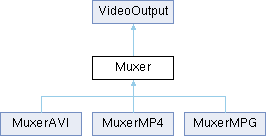
Common interface for muxers (MuxerAVI, MuxerMP4) that combine an already-encoded video track (and optionally an audio track) into a container written to a Print (a local File to record, or e.g. a network Client to publish a live stream to an HTTP/TCP client). Write code against this interface instead of a concrete class if it should work with either container format.
More...
#include <ContainerCommon.h>
Common interface for muxers (MuxerAVI, MuxerMP4) that combine an already-encoded video track (and optionally an audio track) into a container written to a Print (a local File to record, or e.g. a network Client to publish a live stream to an HTTP/TCP client). Write code against this interface instead of a concrete class if it should work with either container format.
write() (VideoOutput) treats each call as one complete, already-encoded frame for both MuxerAVI and MuxerMP4 - callers must hand over the full frame in a single call, not build it up incrementally across several write() calls. flush() is a no-op for both.
- Author
- Phil Schatzmann
- Copyright
- GPLv3
◆ addAudioFrame()
| virtual size_t addAudioFrame |
( |
const uint8_t * | data, |
|
|
size_t | len ) |
|
pure virtual |
Writes one complete audio frame/block. Meaning is container- and codec-specific (e.g. one raw AAC frame vs. an arbitrary PCM block); see the concrete class.
Implemented in MuxerAVI, MuxerMP4, MuxerMPG, and MuxerMTS.
◆ addI420Frame()
| virtual size_t addI420Frame |
( |
const uint8_t * | data, |
|
|
size_t | len ) |
|
pure virtual |
◆ addJpegFrame()
| virtual size_t addJpegFrame |
( |
const uint8_t * | data, |
|
|
size_t | len ) |
|
pure virtual |
◆ addRGB565Frame()
| virtual size_t addRGB565Frame |
( |
const uint8_t * | data, |
|
|
size_t | len ) |
|
pure virtual |
◆ addVideoFrame()
| virtual size_t addVideoFrame |
( |
const uint8_t * | data, |
|
|
size_t | len, |
|
|
bool | isKeyFrame = true ) |
|
pure virtual |
Writes one complete, already-encoded video frame (e.g. one H.264 access unit).
- Parameters
-
| isKeyFrame | hints that the frame is independently decodable (a sync/seek point) - used where the container format can express it (e.g. MP4's 'trun' sample flags); ignored where it can't (AVI). |
Implemented in MuxerAVI, MuxerMP4, MuxerMPG, and MuxerMTS.
◆ addYUV422Frame()
| virtual size_t addYUV422Frame |
( |
const uint8_t * | data, |
|
|
size_t | len ) |
|
pure virtual |
◆ audioInfo()
◆ begin()
Writes the container header. Call after configuring video (and audio, if any) and before writing any frames.
Implemented in MuxerAVI, MuxerMP4, MuxerMPG, and MuxerMTS.
◆ end()
◆ flush()
Finalizes the frame most recently written via one or more write() calls - see class comment. Default no-op for implementations that display/decode synchronously in write() instead.
Reimplemented from VideoOutput.
◆ getAudioSamplesPerVideoFrame()
| float getAudioSamplesPerVideoFrame |
( |
| ) |
|
|
inline |
Average number of audio samples per video frame, derived from audioInfo().sample_rate and getVideoInfo().fps - the natural audio chunk size to write once per video frame if you want to keep both tracks advancing at roughly the same pace as you write them (not a hard requirement - see addAudioFrame()/addVideoFrame()). 0 if fps hasn't been set.
◆ getVideoInfo()
◆ getWriteTimeMs()
| virtual uint32_t getWriteTimeMs |
( |
| ) |
const |
|
inlinevirtualinherited |
◆ hadOutput()
| virtual bool hadOutput |
( |
| ) |
const |
|
inlinevirtualinherited |
True if the most recent write()+flush() call actually produced a displayable picture - default true, matching every synchronous decoder (H264Decoder, MJPEGDecoder, ...), which always decodes and pushes pixels fully within that one call. Override this only if your decoder can legitimately accept/decode a frame's bytes without emitting a picture during that same call - e.g. MPGDecoder, whose B-picture display-order reordering can hold a just-decoded picture back and instead emit an earlier one (or nothing at all) from a given write(), see its own override. Used by PacedVideoOutput to avoid counting/timing a call that did no real rendering work as a rendered frame - without this, its outputFPS()/frameCountI()/ frameCountP()/avgFrameMs() would overcount for such a decoder.
Reimplemented in MPGDecoder.
◆ isKeyFrame()
| virtual bool isKeyFrame |
( |
const uint8_t * | data, |
|
|
size_t | len ) |
|
inlinevirtualinherited |
True if data (one complete encoded frame, as handed to write()) is a keyframe/sync-sample - self-contained, decodable without any earlier frame. Used e.g. by PacedVideoOutput to decide which frames are safe to drop, and whether it's safe to resume decoding after abandoning a backlog (see its own class comment). Default false: a plain VideoOutput doesn't know or care about codec structure - override this in a decoder for the bitstream format it actually parses (see H264Decoder/H264DecoderESP32S3's isH264KeyFrame()-based override, MPGDecoder's isMpeg1KeyFrame()- based one). Getting this right matters beyond bookkeeping: a target whose frames are never recognized as keyframes can leave a caller like PacedVideoOutput unable to ever resume after a resync.
Reimplemented in H264Decoder, H264DecoderESP32S3< Alloc >, MJPEGDecoder, MPGDecoder, MultiVideoDecoder, OutputFPSMeter, and PacedVideoOutput.
◆ mimeVideo()
| virtual const char * mimeVideo |
( |
| ) |
|
|
pure virtual |
The container's MIME type (e.g. "video/avi", "video/mp4") - useful for e.g. an HTTP Content-Type header when streaming the muxed output to a client.
Implemented in MuxerAVI, MuxerMP4, MuxerMPG, and MuxerMTS.
◆ operator bool()
| virtual operator bool |
( |
| ) |
|
|
pure virtual |
◆ setAudioInfo()
Adds an (optional) interleaved audio track, including the codec selection (the 'format' field) - which AudioFormat values are actually supported (and what they mean, e.g. default codec if unset) is container-specific; see the concrete class. Call before begin().
Implemented in MuxerAVI, MuxerMP4, MuxerMPG, and MuxerMTS.
◆ setOutput()
| virtual void setOutput |
( |
Print & | out | ) |
|
|
pure virtual |
◆ setSkipRender()
| virtual void setSkipRender |
( |
bool | skip | ) |
|
|
inlinevirtualinherited |
Hint to skip the expensive part of displaying the next frame(s) (e.g. the panel refresh) while still accepting and fully processing write() calls - used to recover from falling behind the playback schedule without breaking a codec's decode state (e.g. H.264 inter-prediction reference chain, which requires every frame to still be decoded even if it's never shown). Default no-op: implementations that can't skip rendering cheaply just ignore it and always render.
Reimplemented in MultiVideoDecoder, OutputFPSMeter, OutputTinyGPU, PacedVideoOutput, and VideoFrameMeter.
◆ setStreamType()
◆ setVideoInfo()
◆ setVideoInfoSource()
◆ streamType()
◆ totalDecodeMs()
| virtual uint64_t totalDecodeMs |
( |
| ) |
const |
|
inlinevirtualinherited |
Optional: sum of time (ms) spent purely decoding (excluding any surrounding convert/render/SPI work a subclass's write() also does) since begin() - see H264Decoder's own override for the only current implementation. Default 0: only meaningful for a decoder that separates decode time from render time internally: PacedVideoOutput:: logTo() prints a decode-vs-render split under "avg decode ms:" only when this returns nonzero.
Reimplemented in H264Decoder, and MultiVideoDecoder.
◆ write()
| virtual size_t write |
( |
const uint8_t * | data, |
|
|
size_t | len ) |
|
pure virtualinherited |
Implemented in H264Decoder, H264DecoderESP32S3< Alloc >, MJPEGDecoder, MPGDecoder, MultiVideoDecoder, MuxerAVI, MuxerMP4, MuxerMPG, MuxerMTS, OutputFPSMeter, OutputOpenCV, OutputTFT_eSPI, OutputTinyGPU, PacedVideoOutput, and VideoFrameMeter.
◆ p_print
The documentation for this class was generated from the following file:
 1.15.0