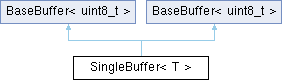
A simple Buffer implementation which just uses a (dynamically sized) array. More...
#include <CodecOpusOgg.h>
Public Member Functions | |
| SingleBuffer () | |
| Construct a new Single Buffer w/o allocating any memory. | |
| SingleBuffer () | |
| Construct a new Single Buffer w/o allocating any memory. | |
| SingleBuffer (const SingleBuffer &)=default | |
| SingleBuffer (const SingleBuffer &)=default | |
| SingleBuffer (int size, Allocator &allocator=DefaultAllocator) | |
| Construct a new Single Buffer object. | |
| SingleBuffer (int size, Allocator &allocator=DefaultAllocator) | |
| Construct a new Single Buffer object. | |
| T * | address () override |
| Provides address to beginning of the buffer. | |
| T * | address () override |
| Provides address to beginning of the buffer. | |
| int | available () override |
| provides the number of entries that are available to read | |
| int | available () override |
| provides the number of entries that are available to read | |
| int | availableForWrite () override |
| provides the number of entries that are available to write | |
| int | availableForWrite () override |
| provides the number of entries that are available to write | |
| virtual int | bufferCountEmpty () |
| Provides the number of entries that are available to write: -1 does not apply. | |
| virtual int | bufferCountFilled () |
| Provides the number of entries that are available to read: -1 does not apply. | |
| void | clear () |
| same as reset | |
| int | clearArray (int len) override |
| consumes len bytes and moves current data to the beginning | |
| int | clearArray (int len) override |
| consumes len bytes and moves current data to the beginning | |
| T * | data () |
| Provides address of actual data. | |
| T * | data () |
| Provides address of actual data. | |
| virtual void | flush () |
| virtual float | freePercent () |
| Returns the free space of the buffer in %. | |
| bool | isEmpty () |
| bool | isFull () override |
| checks if the buffer is full | |
| bool | isFull () override |
| checks if the buffer is full | |
| virtual float | levelPercent () |
| Returns the level of the buffer in %. | |
| void | onExternalBufferRefilled (void *data, int len) |
| notifies that the external buffer has been refilled | |
| void | onExternalBufferRefilled (void *data, int len) |
| notifies that the external buffer has been refilled | |
| SingleBuffer & | operator= (const SingleBuffer &)=default |
| SingleBuffer & | operator= (const SingleBuffer &)=default |
| virtual bool | peek (uint8_t &result)=0 |
| peeks the actual entry from the buffer | |
| bool | peek (T &result) override |
| bool | peek (T &result) override |
| int | peekArray (uint8_t *data, int len) |
| int | peekArray (uint8_t *data, int len) |
| virtual bool | read (uint8_t &result)=0 |
| reads a single value | |
| bool | read (T &result) override |
| bool | read (T &result) override |
| virtual int | readArray (uint8_t data[], int len) |
| reads multiple values | |
| void | reset () override |
| clears the buffer | |
| void | reset () override |
| clears the buffer | |
| bool | resize (size_t size) |
| Resizes the buffer if supported: returns false if not supported. | |
| bool | resize (size_t size) |
| Resizes the buffer if supported: returns false if not supported. | |
| size_t | setAvailable (size_t available_size) |
| size_t | setAvailable (size_t available_size) |
| void | setClearWithZero (bool flag) |
| Sets the buffer to 0 on clear. | |
| void | setClearWithZero (bool flag) |
| Sets the buffer to 0 on clear. | |
| void | setWritePos (int pos) |
| Updates the actual available data size. | |
| void | setWritePos (int pos) |
| Updates the actual available data size. | |
| size_t | size () override |
| size_t | size () override |
| void | trim () |
| Moves the unprocessed data to the beginning of the buffer. | |
| void | trim () |
| Moves the unprocessed data to the beginning of the buffer. | |
| virtual bool | write (uint8_t data)=0 |
| write add an entry to the buffer | |
| bool | write (T sample) override |
| bool | write (T sample) override |
| virtual int | writeArray (const uint8_t data[], int len) |
| Fills the buffer data. | |
| int | writeArray (const T data[], int len) override |
| int | writeArray (const T data[], int len) override |
| virtual int | writeArrayOverwrite (const uint8_t data[], int len) |
| Fills the buffer data and overwrites the oldest data if the buffer is full. | |
Public Attributes | |
| bool | active = true |
| Optional active/inactive status. | |
| int | id = 0 |
| Optional ID. | |
| uint64_t | timestamp = 0 |
| Optional timestamp. | |
Protected Attributes | |
| Allocator | _allocator |
| Vector< T > | buffer {0, _allocator} |
| int | current_read_pos = 0 |
| int | current_write_pos = 0 |
| bool | is_clear_with_zero = false |
| bool | owns_buffer = true |
Detailed Description
class audio_tools::audio_tools::SingleBuffer< T >
A simple Buffer implementation which just uses a (dynamically sized) array.
- Copyright
- GPLv3
Constructor & Destructor Documentation
◆ SingleBuffer() [1/6]
|
inline |
Construct a new Single Buffer object.
- Parameters
-
size in entries
◆ SingleBuffer() [2/6]
|
default |
◆ SingleBuffer() [3/6]
|
inline |
Construct a new Single Buffer w/o allocating any memory.
◆ SingleBuffer() [4/6]
|
inline |
Construct a new Single Buffer object.
- Parameters
-
size in entries
◆ SingleBuffer() [5/6]
|
default |
◆ SingleBuffer() [6/6]
|
inline |
Construct a new Single Buffer w/o allocating any memory.
Member Function Documentation
◆ address() [1/2]
|
inlineoverridevirtual |
Provides address to beginning of the buffer.
Implements BaseBuffer< uint8_t >.
◆ address() [2/2]
|
inlineoverridevirtual |
Provides address to beginning of the buffer.
Implements BaseBuffer< uint8_t >.
◆ available() [1/2]
|
inlineoverridevirtual |
provides the number of entries that are available to read
Implements BaseBuffer< uint8_t >.
◆ available() [2/2]
|
inlineoverridevirtual |
provides the number of entries that are available to read
Implements BaseBuffer< uint8_t >.
◆ availableForWrite() [1/2]
|
inlineoverridevirtual |
provides the number of entries that are available to write
Implements BaseBuffer< uint8_t >.
◆ availableForWrite() [2/2]
|
inlineoverridevirtual |
provides the number of entries that are available to write
Implements BaseBuffer< uint8_t >.
◆ bufferCountEmpty()
|
inlinevirtualinherited |
Provides the number of entries that are available to write: -1 does not apply.
Reimplemented in NBuffer< T >, NBuffer< T >, NBuffer< uint8_t >, NBuffer< T >, SynchronizedNBufferRTOST< uint8_t >, and SynchronizedNBufferZephyrT< uint8_t >.
◆ bufferCountFilled()
|
inlinevirtualinherited |
Provides the number of entries that are available to read: -1 does not apply.
Reimplemented in NBuffer< T >, NBuffer< T >, NBuffer< uint8_t >, NBuffer< T >, SynchronizedNBufferRTOST< uint8_t >, and SynchronizedNBufferZephyrT< uint8_t >.
◆ clear()
|
inlineinherited |
same as reset
◆ clearArray() [1/2]
|
inlineoverridevirtual |
consumes len bytes and moves current data to the beginning
Reimplemented from BaseBuffer< uint8_t >.
◆ clearArray() [2/2]
|
inlineoverridevirtual |
consumes len bytes and moves current data to the beginning
Reimplemented from BaseBuffer< uint8_t >.
◆ data() [1/2]
|
inline |
Provides address of actual data.
◆ data() [2/2]
|
inline |
Provides address of actual data.
◆ flush()
|
inlinevirtualinherited |
Submit any partially-filled write buffer so the reader can access it. Only meaningful for NBuffer-style block pools; no-op for ring buffers.
Reimplemented in NBuffer< T >, NBuffer< T >, NBuffer< uint8_t >, and NBuffer< T >.
◆ freePercent()
|
inlinevirtualinherited |
Returns the free space of the buffer in %.
◆ isEmpty()
|
inlineinherited |
◆ isFull() [1/2]
|
inlineoverridevirtual |
checks if the buffer is full
Reimplemented from BaseBuffer< uint8_t >.
◆ isFull() [2/2]
|
inlineoverridevirtual |
checks if the buffer is full
Reimplemented from BaseBuffer< uint8_t >.
◆ levelPercent()
|
inlinevirtualinherited |
Returns the level of the buffer in %.
Reimplemented in AdaptiveResamplingBuffer.
◆ onExternalBufferRefilled() [1/2]
|
inline |
notifies that the external buffer has been refilled
◆ onExternalBufferRefilled() [2/2]
|
inline |
notifies that the external buffer has been refilled
◆ operator=() [1/2]
|
default |
◆ operator=() [2/2]
|
default |
◆ peek() [1/3]
|
pure virtualinherited |
peeks the actual entry from the buffer
Implemented in AdaptiveResamplingBuffer, NBuffer< uint8_t >, RingBuffer< uint8_t >, RingBufferSPSC< uint8_t >, SingleBuffer< uint8_t >, BufferRP2040T< uint8_t >, and BufferRTOS< uint8_t >.
◆ peek() [2/3]
|
inlineoverride |
◆ peek() [3/3]
|
inlineoverride |
◆ peekArray() [1/2]
|
inline |
◆ peekArray() [2/2]
|
inline |
◆ read() [1/3]
|
pure virtualinherited |
reads a single value
Implemented in AdaptiveResamplingBuffer, NBuffer< uint8_t >, RingBuffer< uint8_t >, RingBufferSPSC< uint8_t >, SingleBuffer< uint8_t >, BufferRP2040T< uint8_t >, and BufferRTOS< uint8_t >.
◆ read() [2/3]
|
inlineoverride |
◆ read() [3/3]
|
inlineoverride |
◆ readArray()
|
inlinevirtualinherited |
reads multiple values
Reimplemented in AdaptiveResamplingBuffer, NBuffer< uint8_t >, RingBuffer< uint8_t >, RingBufferSPSC< uint8_t >, BufferRP2040T< uint8_t >, and BufferRTOS< uint8_t >.
◆ reset() [1/2]
|
inlineoverridevirtual |
clears the buffer
Implements BaseBuffer< uint8_t >.
◆ reset() [2/2]
|
inlineoverridevirtual |
clears the buffer
Implements BaseBuffer< uint8_t >.
◆ resize() [1/2]
|
inlinevirtual |
Resizes the buffer if supported: returns false if not supported.
Reimplemented from BaseBuffer< uint8_t >.
◆ resize() [2/2]
|
inlinevirtual |
Resizes the buffer if supported: returns false if not supported.
Reimplemented from BaseBuffer< uint8_t >.
◆ setAvailable() [1/2]
|
inline |
If we load values directly into the address we need to set the avialeble size
◆ setAvailable() [2/2]
|
inline |
If we load values directly into the address we need to set the avialeble size
◆ setClearWithZero() [1/2]
|
inline |
Sets the buffer to 0 on clear.
◆ setClearWithZero() [2/2]
|
inline |
Sets the buffer to 0 on clear.
◆ setWritePos() [1/2]
|
inline |
Updates the actual available data size.
◆ setWritePos() [2/2]
|
inline |
Updates the actual available data size.
◆ size() [1/2]
|
inlineoverridevirtual |
Implements BaseBuffer< uint8_t >.
◆ size() [2/2]
|
inlineoverridevirtual |
Implements BaseBuffer< uint8_t >.
◆ trim() [1/2]
|
inline |
Moves the unprocessed data to the beginning of the buffer.
◆ trim() [2/2]
|
inline |
Moves the unprocessed data to the beginning of the buffer.
◆ write() [1/3]
|
pure virtualinherited |
write add an entry to the buffer
Implemented in AdaptiveResamplingBuffer, NBuffer< uint8_t >, RingBuffer< uint8_t >, RingBufferSPSC< uint8_t >, SingleBuffer< uint8_t >, BufferRP2040T< uint8_t >, and BufferRTOS< uint8_t >.
◆ write() [2/3]
|
inlineoverride |
◆ write() [3/3]
|
inlineoverride |
◆ writeArray() [1/3]
|
inlinevirtualinherited |
Fills the buffer data.
Reimplemented in AdaptiveResamplingBuffer, RingBuffer< uint8_t >, RingBufferSPSC< uint8_t >, SingleBuffer< uint8_t >, BufferRP2040T< uint8_t >, and BufferRTOS< uint8_t >.
◆ writeArray() [2/3]
|
inlineoverride |
◆ writeArray() [3/3]
|
inlineoverride |
◆ writeArrayOverwrite()
|
inlinevirtualinherited |
Fills the buffer data and overwrites the oldest data if the buffer is full.
Member Data Documentation
◆ _allocator
|
protected |
◆ active
| bool active = true |
Optional active/inactive status.
◆ buffer
|
protected |
◆ current_read_pos
|
protected |
◆ current_write_pos
|
protected |
◆ id
| int id = 0 |
Optional ID.
◆ is_clear_with_zero
|
protected |
◆ owns_buffer
|
protected |
◆ timestamp
| uint64_t timestamp = 0 |
Optional timestamp.
The documentation for this class was generated from the following files:
- src/AudioTools/AudioCodecs/CodecOpusOgg.h
- src/AudioTools/AudioCodecs/CodecTSDemux.h
Generated by
 1.15.0