#include <AudioOutput.h>
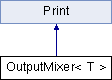
Public Member Functions | |
| OutputMixer (Allocator &allocator=DefaultAllocatorRAM) | |
| Default constructor. You must call setOutput() and setOutputCount() before use. | |
| OutputMixer (Print &finalOutput, int outputStreamCount, Allocator &allocator=DefaultAllocatorRAM) | |
| Constructor with output stream, number of input streams, and allocator. | |
| ~OutputMixer () | |
| int | available (int idx) |
| Provides the available bytes in the buffer. | |
| int | availableForWrite () override |
| Provides the bytes available to write for the current stream buffer. | |
| int | availableForWrite (int idx) |
| Provides the bytes available to write for the indicated stream index. | |
| int | availablePercent (int idx) |
| Provides the % fill level of the buffer for the indicated index. | |
| int | availableSamples () |
| Returns the minimum number of samples available across all buffers. | |
| bool | begin (int copy_buffer_size_bytes=DEFAULT_BUFFER_SIZE) |
| Starts the processing. | |
| void | end () |
| Remove all input streams. | |
| virtual void | flush () |
| virtual void | flush () |
| bool | flushMixer () |
| Force output to final destination. | |
| BaseBuffer< T > * | getBuffer (int idx) |
| Provides the write buffer for the indicated index. | |
| void | next () |
| Moves to the next mixing index. | |
| bool | resize (size_t sizeBytes) |
| Resizes the buffer to the indicated number of bytes. | |
| void | setAutoIndex (bool flag) |
| Automatically increment mixing index after each write. | |
| void | setCreateBufferCallback (BaseBuffer< T > *(*cb)(int size)) |
| Define callback to allocate custum buffer types. | |
| void | setIndex (int idx) |
| Sets the Output Stream index. | |
| void | setOutput (Print &finalOutput) |
| Sets the final output destination for mixed audio. | |
| void | setOutputCount (int count) |
| Sets the number of streams to mix. | |
| void | setWeight (int channel, float weight) |
| int | size () |
| Number of stremams to which are mixed together. | |
| size_t | write (const uint8_t *data, size_t len) override |
| size_t | write (int idx, const uint8_t *buffer_c, size_t bytes) |
| Write the data for an individual stream idx which will be mixed together. | |
| size_t | write (uint8_t) override |
| Single byte write - not supported, returns 0. | |
| size_t | writeSilence (int idx, size_t bytes) |
| Writes silence to the specified stream buffer. | |
| size_t | writeSilence (size_t bytes) |
| Writes silence to the current stream buffer. | |
Protected Member Functions | |
| bool | allocate_buffers (int sizeBytes) |
| Allocates ring buffers for all input streams. | |
| void | free_buffers () |
| Releases memory for all ring buffers. | |
| void | mixSamples (size_t samples) |
| Mixes the samples from all input streams into the output buffer. | |
| void | update_total_weights () |
| Recalculates the total weights for normalization. | |
Static Protected Member Functions | |
| static BaseBuffer< T > * | create_buffer (int sizeBytes, Allocator &allocator) |
| Creates a default ring buffer of the specified size. | |
Protected Attributes | |
| int | _timeout = 10 |
| Allocator & | allocator |
| Vector< BaseBuffer< T > * > | buffers {0, DefaultAllocatorRAM} |
| BaseBuffer< T > *(* | create_buffer_cb )(int size, Allocator &allocator) = create_buffer |
| bool | is_active = false |
| bool | is_auto_index = true |
| Vector< T > | output {0, allocator} |
| int | output_count = 0 |
| Print * | p_final_output = nullptr |
| void * | p_memory = nullptr |
| int | size_bytes = 0 |
| int | stream_idx = 0 |
| float | total_weights = 0.0 |
| Vector< float > | weights {0, DefaultAllocatorRAM} |
Constructor & Destructor Documentation
◆ OutputMixer() [1/2]
|
inline |
Default constructor. You must call setOutput() and setOutputCount() before use.
- Parameters
-
allocator Reference to the allocator to use for internal buffers (default: DefaultAllocatorRAM)
◆ OutputMixer() [2/2]
|
inline |
Constructor with output stream, number of input streams, and allocator.
- Parameters
-
finalOutput Reference to the Print object for mixed audio output outputStreamCount Number of input streams to mix allocator Reference to the allocator to use for internal buffers (default: DefaultAllocatorRAM)
◆ ~OutputMixer()
|
inline |
Member Function Documentation
◆ allocate_buffers()
|
inlineprotected |
Allocates ring buffers for all input streams.
◆ available()
|
inline |
Provides the available bytes in the buffer.
◆ availableForWrite() [1/2]
|
inlineoverridevirtual |
Provides the bytes available to write for the current stream buffer.
Reimplemented from Print.
◆ availableForWrite() [2/2]
|
inline |
Provides the bytes available to write for the indicated stream index.
◆ availablePercent()
|
inline |
Provides the % fill level of the buffer for the indicated index.
◆ availableSamples()
|
inline |
Returns the minimum number of samples available across all buffers.
◆ begin()
|
inline |
Starts the processing.
◆ create_buffer()
|
inlinestaticprotected |
Creates a default ring buffer of the specified size.
◆ end()
|
inline |
Remove all input streams.
◆ flush() [1/2]
|
inlinevirtualinherited |
Reimplemented in AudioOutput, AudioOutput, AudioStreamWrapper, AudioStreamWrapper, BaseStream, BaseStream, BufferedStream, BufferedStream, EncodedAudioStream, FilteredStream< T, TF >, FilteredStream< T, TF >, FilteredStream< int16_t, int16_t >, GeneratedSoundStream< T >, GeneratedSoundStream< T >, GeneratedSoundStream< int16_t >, HexDumpOutput, HexDumpOutput, MemoryStream, MemoryStream, MultiOutput, QueueStream< T >, QueueStream< T >, QueueStream< uint8_t >, ReformatBaseStream, RingBufferStream, RingBufferStream, TimedStream, AudioEffectStream, AudioEffectStreamT< T >, AudioOutput, AudioStreamWrapper, AutomaticGainControlStream, BaseStream, BufferedStream, BufferedTaskStream, EncodedAudioStream, Equalizer3BandsPerChannelT< T >, Equalizer3BandsPerChannelT< float >, Equalizer3BandsT< T >, Equalizer3BandsT< float >, EqualizerNBands< SampleT, AccT, NUM_TAPS, NUM_BANDS >, FadeStream, FilteredStream< T, TF >, GeneratedSoundStream< T >, HDLCStream, HexDumpOutput, I2SStream, MeasuringStream, MemoryStream, MultiOutput, NamePrinter, Pipeline::ModifyingStreamAdapter, PureDataStream, QualityAnalysisStream, QueueStream< T >, ReformatBaseStream, ResampleStream, RingBufferStream, SupportedRatesStream, TimedStream, URLStream, URLStreamBufferedT< T >, URLStreamBufferedT< ICYStream >, URLStreamBufferedT< ICYStreamESP32 >, URLStreamBufferedT< URLStream >, URLStreamBufferedT< URLStreamESP32 >, VFSFile, VolumeStream, and ZephyrFile.
◆ flush() [2/2]
|
inlinevirtualinherited |
Reimplemented in AudioOutput, AudioOutput, AudioStreamWrapper, AudioStreamWrapper, BaseStream, BaseStream, BufferedStream, BufferedStream, EncodedAudioStream, FilteredStream< T, TF >, FilteredStream< T, TF >, FilteredStream< int16_t, int16_t >, GeneratedSoundStream< T >, GeneratedSoundStream< T >, GeneratedSoundStream< int16_t >, HexDumpOutput, HexDumpOutput, MemoryStream, MemoryStream, MultiOutput, QueueStream< T >, QueueStream< T >, QueueStream< uint8_t >, ReformatBaseStream, RingBufferStream, RingBufferStream, TimedStream, AudioEffectStream, AudioEffectStreamT< T >, AudioOutput, AudioStreamWrapper, AutomaticGainControlStream, BaseStream, BufferedStream, BufferedTaskStream, EncodedAudioStream, Equalizer3BandsPerChannelT< T >, Equalizer3BandsPerChannelT< float >, Equalizer3BandsT< T >, Equalizer3BandsT< float >, EqualizerNBands< SampleT, AccT, NUM_TAPS, NUM_BANDS >, FadeStream, FilteredStream< T, TF >, GeneratedSoundStream< T >, HDLCStream, HexDumpOutput, I2SStream, MeasuringStream, MemoryStream, MultiOutput, NamePrinter, Pipeline::ModifyingStreamAdapter, PureDataStream, QualityAnalysisStream, QueueStream< T >, ReformatBaseStream, ResampleStream, RingBufferStream, SupportedRatesStream, TimedStream, URLStream, URLStreamBufferedT< T >, URLStreamBufferedT< ICYStream >, URLStreamBufferedT< ICYStreamESP32 >, URLStreamBufferedT< URLStream >, URLStreamBufferedT< URLStreamESP32 >, VFSFile, VolumeStream, and ZephyrFile.
◆ flushMixer()
|
inline |
Force output to final destination.
◆ free_buffers()
|
inlineprotected |
Releases memory for all ring buffers.
◆ getBuffer()
|
inline |
Provides the write buffer for the indicated index.
◆ mixSamples()
|
inlineprotected |
Mixes the samples from all input streams into the output buffer.
◆ next()
|
inline |
Moves to the next mixing index.
◆ resize()
|
inline |
Resizes the buffer to the indicated number of bytes.
◆ setAutoIndex()
|
inline |
Automatically increment mixing index after each write.
◆ setCreateBufferCallback()
|
inline |
Define callback to allocate custum buffer types.
◆ setIndex()
|
inline |
Sets the Output Stream index.
◆ setOutput()
|
inline |
Sets the final output destination for mixed audio.
◆ setOutputCount()
|
inline |
Sets the number of streams to mix.
◆ setWeight()
|
inline |
Defines a new weight for the indicated channel: If you set it to 0.0 it is muted. The initial value is 1.0
◆ size()
|
inline |
Number of stremams to which are mixed together.
◆ update_total_weights()
|
inlineprotected |
Recalculates the total weights for normalization.
◆ write() [1/3]
|
inlineoverridevirtual |
Write the data from a simgle stream which will be mixed together (the stream idx is increased)
Reimplemented from Print.
◆ write() [2/3]
|
inline |
Write the data for an individual stream idx which will be mixed together.
◆ write() [3/3]
|
inlineoverride |
Single byte write - not supported, returns 0.
◆ writeSilence() [1/2]
|
inline |
Writes silence to the specified stream buffer.
◆ writeSilence() [2/2]
|
inline |
Writes silence to the current stream buffer.
Member Data Documentation
◆ _timeout
|
protectedinherited |
◆ allocator
|
protected |
◆ buffers
|
protected |
◆ create_buffer_cb
|
protected |
◆ is_active
|
protected |
◆ is_auto_index
|
protected |
◆ output
◆ output_count
|
protected |
◆ p_final_output
|
protected |
◆ p_memory
|
protected |
◆ size_bytes
|
protected |
◆ stream_idx
|
protected |
◆ total_weights
|
protected |
◆ weights
|
protected |
The documentation for this class was generated from the following file:
- src/AudioTools/CoreAudio/AudioOutput.h
Generated by
 1.15.0