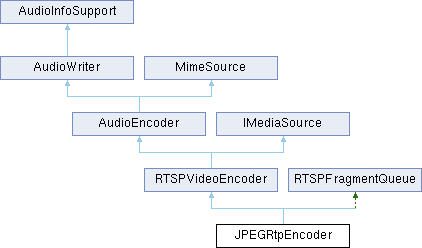
JPEG RTP Encoder - Fragments JPEG frames per RFC 2435 for RTSP video streaming. More...
#include <JPEGRtpEncoder.h>
Public Member Functions | |
| JPEGRtpEncoder ()=default | |
| JPEGRtpEncoder (size_t maxFragmentSize) | |
| Constructor with maximum fragment size. | |
| AudioInfo | audioInfo () override |
| provides the actual input AudioInfo | |
| virtual AudioInfo | audioInfoOut () |
| bool | begin () override |
| virtual bool | begin (AudioInfo info) |
| void | end () override |
| virtual uint32_t | frameDurationUs () |
| Optional rtsp function: provide the frame duration in microseconds. | |
| virtual int | frameSize () |
| RTSPFormat & | getFormat () override |
| Get the media format configuration. | |
| const char * | mime () override |
| Provides the mime type of the encoded result. | |
| operator bool () override | |
| int | packetSize () override |
| Size of the next queued, ready-to-send fragment, for sources that provide already RTP-payload-ready, self-delimited fragments (e.g. RFC 2435 JPEG) instead of a continuous byte stream. For these sources, readBytes() must always be called with exactly packetSize() as maxBytes, so each call retrieves exactly one complete fragment instead of the transport having to guess where one RTP payload ends and the next begins. | |
| int | readBytes (void *dest, int maxBytes) override |
| virtual uint16_t | samplesPerFrame () |
| Optional rtsp function: provide samples per the frame. | |
| void | setAudioInfo (AudioInfo info) override |
| Defines the sample rate, number of channels and bits per sample. | |
| void | setFormat (RTSPFormat &format) override |
| Associates the RTSPFormat (e.g. RTSPFormatMJPEG) that supplies width/height. | |
| void | setMaxFragmentSize (size_t size) |
| Set the maximum RTP payload size per packet (header + data) | |
| void | setMaxQueuedFrames (size_t frames) |
| Maximum number of complete frames buffered when the consumer falls behind. | |
| virtual void | setOutput (Print &out_stream) override |
| Default output assignment (encoders may override to store Print reference) | |
| void | start () override |
| Initialize media source for streaming. | |
| void | stop () override |
| Cleanup media source after streaming. | |
| size_t | write (const uint8_t *data, size_t len) override |
| Process JPEG frame data and queue the resulting RTP fragments. | |
Protected Member Functions | |
| void | appendFragment (const uint8_t *payload, size_t len, bool last) |
| void | buildJpegRtpHeader (uint8_t *buffer, size_t fragmentOffset, int width, int height, uint8_t type, uint8_t qValue) |
| void | clearQueue () |
| uint8_t | detectJpegType (const uint8_t *data, size_t headerLen) |
| Determine the RFC 2435 Type (0 = 4:2:2, 1 = 4:2:0) from the JPEG's SOF0/SOF1 marker so the receiver reconstructs the correct chroma subsampling. Defaults to 0 (4:2:2) if it cannot be determined. | |
| void | dropOldestFrame () |
| int | extractQuantTables (const uint8_t *data, size_t headerLen, uint8_t *out) |
| Extract the (8-bit precision) quantization tables 0 and 1 from the JPEG DQT segments found in [data, data+headerLen). RFC 2435 expects table 0 (luma) followed by table 1 (chroma), each 64 bytes in zigzag order exactly as stored in the JPEG - no reordering needed. | |
| size_t | findJpegDataStart () |
| Find the start of the entropy-coded scan data, i.e. the first byte after the SOS (Start Of Scan) marker segment. RFC 2435 requires everything before this point (SOI/APPn/DQT/SOF/SOS) to be stripped from the RTP payload. | |
| bool | isCompleteJpegFrame () |
| Check if current buffer contains a complete JPEG frame. | |
| void | processCompleteFrame () |
| Strip the JPEG headers, fragment the scan data and queue one RFC 2435 RTP payload per fragment. | |
| int | queuePacketSize () |
| int | queueReadBytes (void *dest, int maxBytes) |
| uint32_t | readQueueU32 (size_t pos) |
| void | writeBlocking (Print *out, uint8_t *data, size_t len) |
| void | writeQuantTableHeader (uint8_t *buffer, const uint8_t *qTable, int qTableLen) |
Protected Attributes | |
| RTSPFormatMJPEG | default_format |
| AudioInfo | info |
| Vector< uint8_t > | m_currentFrame |
| bool | m_frameComplete = true |
| bool | m_isStarted = false |
| size_t | m_maxFragmentSize = 1400 |
| size_t | m_maxQueuedFrames = 1 |
| Vector< uint8_t > | m_queue |
| size_t | m_queuedFrames = 0 |
| size_t | m_queueHead = 0 |
| Vector< uint8_t > | m_scratch |
| RTSPFormat * | p_format = nullptr |
Detailed Description
JPEG RTP Encoder - Fragments JPEG frames per RFC 2435 for RTSP video streaming.
This class plays both roles needed to get a JPEG frame onto the wire:
- As an AudioEncoder, write() accepts complete JPEG frames (e.g. straight from a camera).
- As an IMediaSource, packetSize()/readBytes() hand out the resulting RTP payloads one fragment at a time, each one already carrying its RFC 2435 header (and, on the first fragment of a frame, an embedded quantization-table header).
Keeping fragmentation and header construction in one place means the RTP transport never has to re-derive fragment boundaries or rebuild a JPEG header of its own - it only wraps each queued fragment in the generic RTP header (sequence number, shared timestamp, marker bit set once packetSize() reports the queue empty).
Per RFC 2435, the payload must be the raw entropy-coded scan data only; SOI/APPn/DQT/SOF/SOS markers are stripped and reconstructed by the receiver from the RTP header fields, so header stripping is not optional.
- Note
- Restart intervals (DRI) are not supported.
Usage with RTSPOutput:
Constructor & Destructor Documentation
◆ JPEGRtpEncoder() [1/2]
|
default |
◆ JPEGRtpEncoder() [2/2]
|
inline |
Constructor with maximum fragment size.
- Parameters
-
maxFragmentSize Maximum RTP payload size per packet, including the RFC 2435 header (default: 1400 bytes)
Member Function Documentation
◆ appendFragment()
|
inlineprotectedinherited |
◆ audioInfo()
|
inlineoverridevirtualinherited |
provides the actual input AudioInfo
Implements AudioInfoSupport.
Reimplemented in CodecNOP, MP3EncoderShine, BinaryContainerEncoder, and MP3ParserEncoder.
◆ audioInfoOut()
|
inlinevirtualinherited |
provides the actual output AudioInfo: this is usually the same as audioInfo() unless we use a transforming stream
Reimplemented in MP3EncoderShine, PureDataStream, PWMAudioOutput< PWMDriverT >, ChannelFormatConverterStreamT< T >, ChannelFormatConverterStream, NumberFormatConverterStreamT< TFrom, TTo >, NumberFormatConverterStream, FormatConverterStream, Pipeline, ResampleStream, ResampleStreamT< TInterpolator >, and SupportedRatesStream.
◆ begin() [1/2]
|
inlineoverridevirtual |
Implements AudioWriter.
◆ begin() [2/2]
|
inlinevirtualinherited |
Reimplemented in OpusOggEncoder, OggContainerEncoder, DecoderBasic, AudioDecoder, AACEncoderFAAC, AACEncoderFDK, AACEncoderVO, OggContainerDecoder, and MetaDataFilterEncoder.
◆ buildJpegRtpHeader()
|
inlineprotected |
◆ clearQueue()
|
inlineprotectedinherited |
◆ detectJpegType()
|
inlineprotected |
Determine the RFC 2435 Type (0 = 4:2:2, 1 = 4:2:0) from the JPEG's SOF0/SOF1 marker so the receiver reconstructs the correct chroma subsampling. Defaults to 0 (4:2:2) if it cannot be determined.
◆ dropOldestFrame()
|
inlineprotectedinherited |
◆ end()
|
inlineoverridevirtual |
Implements AudioWriter.
◆ extractQuantTables()
|
inlineprotected |
Extract the (8-bit precision) quantization tables 0 and 1 from the JPEG DQT segments found in [data, data+headerLen). RFC 2435 expects table 0 (luma) followed by table 1 (chroma), each 64 bytes in zigzag order exactly as stored in the JPEG - no reordering needed.
Some encoders emit a single quantization table shared by all components (SOF Tq=0 for luma and chroma alike) instead of two - a valid standalone JPEG, but not expressible in RFC 2435's wire format, whose receiver-side reconstruction (Appendix A) always assumes two distinct tables. Sending only the one table found would leave the reconstructed chroma table uninitialized on the receiver, corrupting decode; duplicating table 0 into table 1 is faithful to the source (both components really do use that table) and satisfies the two-table format.
- Returns
- Number of bytes written to out (0 or 128), 0 if no usable 8-bit-precision table was found
◆ findJpegDataStart()
|
inlineprotected |
Find the start of the entropy-coded scan data, i.e. the first byte after the SOS (Start Of Scan) marker segment. RFC 2435 requires everything before this point (SOI/APPn/DQT/SOF/SOS) to be stripped from the RTP payload.
- Returns
- Offset to the scan data, or 0 if no SOS marker was found
◆ frameDurationUs()
|
inlinevirtualinherited |
Optional rtsp function: provide the frame duration in microseconds.
Reimplemented in ADPCMEncoder, MP3EncoderShine, OpusOggEncoder, MP3ParserEncoder, and MetaDataFilterEncoder.
◆ frameSize()
|
inlinevirtualinherited |
Optional rtsp function: provide the encoded size (in bytes) of one frame, once known (e.g. after the encoder has seen real data). Lets an RTSPFormat size its RTP fragments to match one frame instead of a fixed guess, so throughput actually tracks frameDurationUs() - a fragment size covering several frames' worth of bytes sent at one-frame timing overruns real-time bandwidth and, over UDP (no flow control), causes packet loss. Returns 0 if not yet known/not applicable (fixed-frame-size codecs have no need to override this).
Reimplemented in ADPCMEncoder, EncoderALAC, AMRNBEncoder, AMRWBEncoder, and MP3ParserEncoder.
◆ getFormat()
|
inlineoverridevirtual |
Get the media format configuration.
Returns the RTSPFormat object that describes the media data characteristics including sample rate, bit depth, number of channels, and RTP packaging parameters. If no format has been explicitly set, creates a default 16-bit PCM format at 16kHz mono.
- Returns
- Pointer to RTSPFormat describing the media characteristics
- Note
- Default format: 16-bit PCM, 16000 Hz, 1 channel
- See also
- setFormat(), RTSPFormatPCM
Implements IMediaSource.
◆ isCompleteJpegFrame()
|
inlineprotected |
Check if current buffer contains a complete JPEG frame.
- Returns
- true if frame is complete (ends with 0xFF 0xD9)
◆ mime()
|
inlineoverridevirtual |
Provides the mime type of the encoded result.
Implements AudioEncoder.
◆ operator bool()
|
inlineoverridevirtual |
Implements AudioWriter.
◆ packetSize()
|
inlineoverridevirtual |
Size of the next queued, ready-to-send fragment, for sources that provide already RTP-payload-ready, self-delimited fragments (e.g. RFC 2435 JPEG) instead of a continuous byte stream. For these sources, readBytes() must always be called with exactly packetSize() as maxBytes, so each call retrieves exactly one complete fragment instead of the transport having to guess where one RTP payload ends and the next begins.
Call it once before each readBytes() to size that call, and again right after to tell whether the fragment just read was the last one currently available - a 0 result means the caller should set the RTP marker bit on the fragment it just sent (and may advance the timestamp for the next frame).
- Returns
- -1 if this source is not packetized (use the plain readBytes() stream instead), 0 if packetized but nothing is queued right now, otherwise the size in bytes of the next fragment
Reimplemented from IMediaSource.
◆ processCompleteFrame()
|
inlineprotected |
Strip the JPEG headers, fragment the scan data and queue one RFC 2435 RTP payload per fragment.
◆ queuePacketSize()
|
inlineprotectedinherited |
◆ queueReadBytes()
|
inlineprotectedinherited |
Retrieves the next queued fragment. Call queuePacketSize() first and pass its result as maxBytes so exactly one fragment is read.
◆ readBytes()
|
inlineoverridevirtual |
Retrieves the next queued fragment. Call packetSize() first and pass its result as maxBytes so exactly one fragment is read.
Implements IMediaSource.
◆ readQueueU32()
|
inlineprotectedinherited |
◆ samplesPerFrame()
|
inlinevirtualinherited |
Optional rtsp function: provide samples per the frame.
Reimplemented in OpusAudioEncoder, OpusMultiStreamAudioEncoder, MP3EncoderShine, MP3ParserEncoder, and MetaDataFilterEncoder.
◆ setAudioInfo()
|
inlineoverridevirtual |
Defines the sample rate, number of channels and bits per sample.
Reimplemented from AudioEncoder.
◆ setFormat()
|
inlineoverridevirtual |
Associates the RTSPFormat (e.g. RTSPFormatMJPEG) that supplies width/height.
Implements RTSPVideoEncoder.
◆ setMaxFragmentSize()
|
inline |
Set the maximum RTP payload size per packet (header + data)
◆ setMaxQueuedFrames()
|
inline |
Maximum number of complete frames buffered when the consumer falls behind.
◆ setOutput()
|
inlineoverridevirtualinherited |
Default output assignment (encoders may override to store Print reference)
Implements AudioWriter.
Reimplemented in EncoderBasic, DSFEncoder, WAVEncoder, EncoderBase64, CodecNOP, APTXEncoder, Codec2Encoder, CopyEncoder, G722Encoder, GSMEncoder, ILBCEncoder, LC3Encoder, MP3EncoderLAME, EncoderNetworkFormat, SBCEncoder, AACEncoderFAAC, AACEncoderFDK, AACEncoderVO, ADPCMEncoder, ADPCMEncoderXQ, EncoderALAC, AMRNBEncoder, AMRWBEncoder, CodecChain, FLACEncoder, EncoderFloat, G729Encoder, G7xxEncoder, EncoderL16, EncoderL8, MP3EncoderShine, OpusAudioEncoder, OpusMultiStreamAudioEncoder, MP3ParserEncoder, MetaDataFilterEncoder, BinaryContainerEncoder, OSCContainerEncoder, and OggContainerEncoder.
◆ start()
|
inlineoverridevirtual |
Initialize media source for streaming.
Called when streaming is about to begin. Implementations should use this to initialize hardware, allocate buffers, start media capture, or perform any other setup required for media data generation.
- Note
- Called by RTSPMediaStreamer.start()
- Default implementation does nothing (suitable for sources that need no setup)
Reimplemented from IMediaSource.
◆ stop()
|
inlineoverridevirtual |
Cleanup media source after streaming.
Called when streaming has ended. Implementations should use this to release hardware resources, deallocate buffers, stop media capture, or perform cleanup operations.
- Note
- Called by RTSPMediaStreamer.stop()
- Default implementation does nothing (suitable for sources that need no cleanup)
Reimplemented from IMediaSource.
◆ write()
|
inlineoverridevirtual |
Process JPEG frame data and queue the resulting RTP fragments.
- Parameters
-
data Pointer to JPEG frame data len Length of JPEG frame data
- Returns
- Number of bytes processed
Implements AudioWriter.
◆ writeBlocking()
|
inlineprotectedinherited |
◆ writeQuantTableHeader()
|
inlineprotected |
RFC 2435 Quantization Table header (only present on the first fragment of a frame when Q >= 128)
Member Data Documentation
◆ default_format
|
protected |
◆ info
|
protectedinherited |
◆ m_currentFrame
|
protected |
◆ m_frameComplete
|
protected |
◆ m_isStarted
|
protected |
◆ m_maxFragmentSize
|
protected |
◆ m_maxQueuedFrames
|
protectedinherited |
◆ m_queue
|
protectedinherited |
◆ m_queuedFrames
|
protectedinherited |
◆ m_queueHead
|
protectedinherited |
◆ m_scratch
|
protected |
◆ p_format
|
protected |
The documentation for this class was generated from the following file:
- src/AudioTools/Communication/RTSP/JPEGRtpEncoder.h