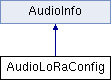
Configuration for AudioLoRa. More...
#include <AudioLoRa.h>
Public Member Functions | |
| virtual void | clear () |
| void | copyFrom (AudioInfo info) |
| Same as set. | |
| bool | equals (AudioInfo alt) |
| Returns true if alt values are the same like the current values. | |
| bool | equalsExSampleRate (AudioInfo alt) |
| Checks if only the sample rate is different. | |
| virtual void | logInfo (const char *source="") |
| operator bool () | |
| Returns true if all components are defined (no component is 0) | |
| bool | operator!= (AudioInfo alt) |
| Returns true if alt values are the different from the current values. | |
| bool | operator== (AudioInfo alt) |
| Returns true if alt values are the same like the current values. | |
| void | set (AudioInfo info) |
| Copies the values from info. | |
| void | setAudioInfo (AudioInfo info) |
| Same as set. | |
Public Attributes | |
| uint8_t | bits_per_sample = DEFAULT_BITS_PER_SAMPLE |
| Number of bits per sample (int16_t = 16 bits) | |
| uint16_t | channels = DEFAULT_CHANNELS |
| Number of channels: 2=stereo, 1=mono. | |
| int | frequency = 868E6 |
| int | max_size = 200 |
| int | pin_dio0 = 14 |
| int | pin_rst = 12 |
| int | pin_ss = 8 |
| bool | process_audio_info = true |
| sample_rate_t | sample_rate = DEFAULT_SAMPLE_RATE |
| Sample Rate: e.g 44100. | |
| int | signal_bandwidth |
| int32_t | spi_speed = 8E6 |
| int | spreading_factor = 6 |
| int | sync_word = 0xF3 |
| int | tx_power = 20 |
Detailed Description
Configuration for AudioLoRa.
LoRa is a long-range, low-power radio technology designed for occasional telemetry (a few bytes every so often), not for continuous audio. LoRa's PHY settings trade range/robustness for throughput: spreading_factor ranges from 6 (fastest, shortest range) to 12 (slowest, longest range), and signal_bandwidth from 7.8 kHz (slowest, longest range) to 500 kHz (fastest, shortest range). The defaults below (spreading_factor = 6, signal_bandwidth = 500 kHz) pick LoRa's fastest, shortest-range end of that scale, since audio needs throughput far more than a typical LoRa telemetry use case does. If you want LoRa's usual long range/robustness instead and don't care about audio, override these back towards 12 / 7.8 kHz – but expect only tens of bits per second at that end, which cannot carry audio at all.
Even at these fast defaults, usable throughput is still only on the order of tens of kbps – nowhere near typical PCM bitrates (8 kHz/8-bit mono alone is 64 kbps) – so audio only becomes practical once reduced to a very low sample rate, 8-bit and/or mono, and ideally compressed before it reaches this stream. Treat this as a fit for short clips or intermittent bursts, not a continuous/live stream; several regions additionally impose legal duty-cycle limits on the ISM bands LoRa uses (e.g. roughly 1% airtime in the EU 868 MHz band) that a sustained stream would likely violate.
Codec recommendation: encode speech with Codec2 (Codec2Encoder / Codec2Decoder in AudioTools/AudioCodecs/CodecCodec2.h) before writing to this stream, and decode it back out after reading. Codec2 was designed for exactly this situation – squeezing intelligible speech over narrowband radio links (it's the codec behind ham radio digital voice modes like FreeDV) – and offers modes from 3200 bit/s down to as low as 450 bit/s. At its 700 bit/s mode, a single ~200 byte LoRa packet carries over 2 seconds of speech, compared to a fraction of a second of raw 8-bit PCM; that's the difference between this being usable for short voice messages and not being usable at all. See the full codec list at https://github.com/pschatzmann/arduino-audio-tools/wiki/Encoding-and-Decoding-of-Audio for alternatives if Codec2 doesn't fit your case (e.g. GSM 06.10 at ~13 kbps if you have more throughput headroom and want wider codec compatibility with other systems).
Heltec LoRa 32 pins (as used by pin_ss/pin_rst/pin_dio0 below): NSS: 8, SCK: 9, MOSI: 10, MISO: 11, RST: 12, BUSY: 13, DIO1: 14
- Copyright
- GPLv3
Member Function Documentation
◆ clear()
|
inlinevirtualinherited |
◆ copyFrom()
|
inlineinherited |
Same as set.
◆ equals()
|
inlineinherited |
Returns true if alt values are the same like the current values.
◆ equalsExSampleRate()
|
inlineinherited |
Checks if only the sample rate is different.
◆ logInfo()
|
inlinevirtualinherited |
Reimplemented in I2SConfigESP32, I2SConfigESP32V1, I2SConfigStd, and I2SConfigZephyr.
◆ operator bool()
|
inlineinherited |
Returns true if all components are defined (no component is 0)
◆ operator!=()
|
inlineinherited |
Returns true if alt values are the different from the current values.
◆ operator==()
|
inlineinherited |
Returns true if alt values are the same like the current values.
◆ set()
|
inlineinherited |
Copies the values from info.
◆ setAudioInfo()
|
inlineinherited |
Same as set.
Member Data Documentation
◆ bits_per_sample
|
inherited |
Number of bits per sample (int16_t = 16 bits)
◆ channels
|
inherited |
Number of channels: 2=stereo, 1=mono.
◆ frequency
| int frequency = 868E6 |
◆ max_size
| int max_size = 200 |
◆ pin_dio0
| int pin_dio0 = 14 |
◆ pin_rst
| int pin_rst = 12 |
◆ pin_ss
| int pin_ss = 8 |
◆ process_audio_info
| bool process_audio_info = true |
◆ sample_rate
|
inherited |
Sample Rate: e.g 44100.
◆ signal_bandwidth
| int signal_bandwidth |
◆ spi_speed
| int32_t spi_speed = 8E6 |
◆ spreading_factor
| int spreading_factor = 6 |
◆ sync_word
| int sync_word = 0xF3 |
◆ tx_power
| int tx_power = 20 |
The documentation for this struct was generated from the following file:
- src/AudioTools/Communication/AudioLoRa.h