Simple Chorus effect with a single delay voice and mono output Chorus is effective between 15 and 20 miliseconds delay of original audio. Requires the sample rate when initialising. More...
#include <AudioEffectsSuite.h>
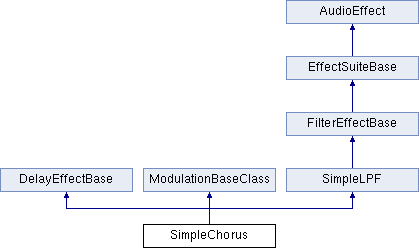
Public Member Functions | |
| SimpleChorus (int extSampleRate=44100) | |
| SimpleChorus (SimpleChorus ©)=default | |
| ~SimpleChorus ()=default | |
| virtual bool | active () |
| determines if the effect is active | |
| virtual bool | active () |
| determines if the effect is active | |
| virtual effectsuite_t_default | applyFilter (effectsuite_t_default sampVal) |
| void | clipWave (effectsuite_t_default amp) |
| SimpleChorus * | clone () override |
| effectsuite_t_default | envelope (effectsuite_t_default sample) |
| int | id () |
| Allows to identify an effect. | |
| int | id () |
| Allows to identify an effect. | |
| bool | isNoise () |
| void | printInterpTable () |
| virtual effect_t | process (effect_t inputSample) override |
| see applyFilter | |
| virtual effectsuite_t_default | processFloat (effectsuite_t_default inputSample) override |
| virtual effectsuite_t | processFloat (effectsuite_t inputSample) override |
| effectsuite_t_default | readNoise () |
| effectsuite_t_default | readTable (effectsuite_t_default freq) |
| virtual void | setActive (bool value) |
| sets the effect active/inactive | |
| virtual void | setActive (bool value) |
| sets the effect active/inactive | |
| void | setBase (effectsuite_t baseAmount) |
| bool | setChebyICoefficients (effectsuite_t_default cutFreqIn, bool shelfType, effectsuite_t_default rippleIn) |
| void | setDC () |
| void | setId (int id) |
| Allows to identify an effect. | |
| void | setId (int id) |
| Allows to identify an effect. | |
| bool | setInterpTable () |
| void | setNoise () |
| void | setOffSine () |
| void | setRamp () |
| void | setSawtooth () |
| void | setSine () |
| void | setSquare () |
| void | setSwing (effectsuite_t swingAmount) |
| void | setTriangle () |
| void | setupChorus (effectsuite_t extSampleRate) |
| void | setupDelayEffectBase (const int bufferSizeSamples) |
| void | setupModulationBaseClass (effectsuite_t_default extSampRate) |
| setup the class with a given sample rate. Basically reperforming the constructor | |
Public Attributes | |
| int | sampleRate |
| effectsuite_t_default | tableIndex |
| effectsuite_t_default | timeStep |
| effectsuite_t_default * | waveTable |
Static Protected Member Functions | |
| static effectsuite_t_default ** | setInterpolationTable () |
Protected Attributes | |
| bool | active_flag |
| bool | active_flag |
| effectsuite_t | base |
| int | bufferIndex |
| effectsuite_t_default | currentDelayReadIndex |
| int | currentDelayWriteIndex |
| effectsuite_t_default * | delayBuffer |
| int | delayTimeSamples |
| bool | error |
| int | filterOrder |
| float * | firBuffer |
| float * | firCoefficients |
| float * | firTemp |
| int | id_value |
| int | id_value |
| float * | iirBuffer |
| float * | iirCoefficients |
| float * | iirTemp |
| effectsuite_t_default | interpTable [order][res] |
| bool | is_noise |
| int | maxDelayBufferSize |
| effectsuite_t | modMax = .5 |
| effectsuite_t | modMin = .5 |
| effectsuite_t | modNorm = 1 / (modMax - modMin) |
| const effectsuite_t | readSpeed = ((this->readNoise() + 1) * .5) * .0005 |
| effectsuite_t_default * | rmsBuffer |
| int | rmsBufferIndex |
| const int | rmsWindowSize |
| int | samplingRate |
| effectsuite_t | swing |
Static Protected Attributes | |
| static effectsuite_t_default ** | interpolationTable |
| Table of interpolation values as a 2D array indexed by interpolationTable[pointIndex][alphaIndex]. One instance per DelayEffectBase<effectsuite_t> instantiation (previously a single namespace-scope global shared – and type-mismatched – across every effectsuite_t choice). | |
| static const int | interpOrder |
| static const int | interpResolution |
| static const int | order |
| static const int | res |
Detailed Description
class audio_tools::SimpleChorus< effectsuite_t >
Simple Chorus effect with a single delay voice and mono output Chorus is effective between 15 and 20 miliseconds delay of original audio. Requires the sample rate when initialising.
- Copyright
- MIT License
Constructor & Destructor Documentation
◆ SimpleChorus() [1/2]
|
inline |
Constructor: initialises the effect parameters Since the class inherits DelayEffectBase it must set a delay buffer size when initialisi.
◆ SimpleChorus() [2/2]
|
default |
◆ ~SimpleChorus()
|
default |
Member Function Documentation
◆ active() [1/2]
|
inlinevirtualinherited |
determines if the effect is active
◆ active() [2/2]
|
inlinevirtualinherited |
determines if the effect is active
◆ allocateBufferMemory()
|
inlineprotectedinherited |
will allocate memory to a buffer given the current filter order and set all values == 0.00
◆ allocateMemory()
|
inlineprotectedinherited |
allocate memory to internal wave table based on sample rate
- Returns
- returns true on success or false on failure
◆ applyFilter()
|
inlinevirtualinherited |
with the current filter coefficients this method filters a sample then stores it the sample Buffer and increments the index
- Parameters
-
sampVal is the sample to be processed
- Returns
- filtered audio sample
◆ changeChebyICoefficients()
|
inlineprotectedinherited |
set firCoefficients and iirCoefficients for required chebyshev type I filter sampleBuffer memory is also set @params cutFreq normalised cutoff frequency (0 < x < .5) @params shelfType bool filter shelf type, false = low pass, true = high pass @params ripple percentage ripple (<.2929) @params poles number of poles
- Returns
- boolean false on error and true on success
◆ clearMemory()
|
inlineprotectedinherited |
checks internal memory storage of filter coeffcients and deletes if required
◆ clip() [1/2]
|
inlineprotectedinherited |
generic clipping method
◆ clip() [2/2]
|
inlineprotectedinherited |
generic clipping method
◆ clipWave()
|
inlineinherited |
clip wave table values with a tanh function. Effect change with a variable amp to control intensity.
- Parameters
-
amp amount to multiply signal before being fed through a tanh function
◆ clone()
|
inlineoverridevirtual |
Implements AudioEffect.
◆ copyParent() [1/2]
|
inlineprotectedinherited |
◆ copyParent() [2/2]
|
inlineprotectedinherited |
◆ delaySample()
|
inlineprotectedinherited |
store input sample into the delay buffer and increment currentDelayWriteIndex for tracking when to loop back to start of buffer
- Parameters
-
inputSample sample to be stored for delay (effectsuite_t)
◆ envelope()
|
inlineinherited |
detect the envelop of an incoming signal
- Parameters
-
sample the incoming signal sample value
- Returns
- returns envelope dection signal sample value
◆ getInterpolatedOut()
|
inlineprotectedinherited |
get the value of the requested buffer index by interpolating other points
- Parameters
-
bufferIndex The required buffer index
- Returns
- interpolated output
◆ getInterpOut()
|
inlineprotectedinherited |
get the interpolated output of the waveTable from the given buffer index
- Parameters
-
bufferIndex buffer index as effectsuite_t
- Returns
- returns interpolated value from surrounding wavtable indices
◆ getModSignal()
|
inlineprotected |
modulation signal scaling equation: ((n - modMin)*modNorm*swing) + base modulates a random white noise signal by lowpass filtering then scaling to a range between 15 to 25 miliseconds of delay.
◆ getSplineOut()
|
inlineprotectedinherited |
get a cubic spline interpolated out from the wave table
Derived from code by Alec Wright at repository: https://github.com/Alec-Wright/Chorus
- Parameters
-
bufferIndex the required buffer index freq (speed) that the table is being read through
- Returns
- returns interpolated value as effectsuite_t
◆ id() [1/2]
|
inlineinherited |
Allows to identify an effect.
◆ id() [2/2]
|
inlineinherited |
Allows to identify an effect.
◆ incBufferIndex()
|
inlineprotectedinherited |
increment the buffer index and wrap it to the filter order
◆ incDelayBuffReadIndex()
|
inlineprotectedinherited |
Increments the currentDelayBufferReadIndex by indexInc
- Parameters
-
indexInc The amount to increment the delay buffer index
◆ incDelayBuffWriteIndex()
|
inlineprotectedinherited |
Increments the currentDelayWriteBufferIndex by 1
◆ isNoise()
|
inlineinherited |
◆ printInterpTable()
|
inlineinherited |
◆ process()
see applyFilter
Reimplemented from EffectSuiteBase< effectsuite_t_default >.
Reimplemented in FilteredDelay< effectsuite_t >.
◆ processFloat() [1/2]
|
inlineoverridevirtualinherited |
Implements EffectSuiteBase< effectsuite_t_default >.
◆ processFloat() [2/2]
|
inlineoverridevirtual |
apply chorus effect to audio sample
- Parameters
-
inputSample input audio sample
- Returns
- processed audio sample
◆ readNoise()
|
inlineinherited |
reads out white noise
- Returns
- random number between -1 and 1
◆ readTable()
|
inlineinherited |
Read through values in waveTable as a given frequency
- Parameters
-
freq read speed in Hz: essentially the number of samples jumped between reads
- Returns
- value from table as effectsuite_t
◆ rms()
|
inlineprotectedinherited |
root mean square of signal over a specific sample window
◆ setActive() [1/2]
|
inlinevirtualinherited |
sets the effect active/inactive
◆ setActive() [2/2]
|
inlinevirtualinherited |
sets the effect active/inactive
◆ setBase()
|
inline |
sets the 'base' of the chorus: the minimum delay in the signal.
- Parameters
-
baseAmount <#baseAmount description#>
◆ setChebyICoefficients()
|
inlineinherited |
changes the current Chebyshev type 1 coefficients without altering the filter order. This allows for use in an audio process thread as it avoids dynamic allocation of memory. Filter sample and coefficient buffers are unaltered for initialising a chebyshev type 1 filter
- See also
- setChebyICoefficients @params cutFreq normalised cutoff frequency (0 < x < .5) @params shelfType bool Filters shelf type, false = low pass, true = high pass @params ripple percentage ripple (<.2929)
- Returns
- boolean false on error and true on success
◆ setDC()
|
inlineinherited |
sets wavetable to DC one
◆ setDelayBuffer()
|
inlineprotectedinherited |
Allocates memory for delay buffer and initialises all elements to 0
- Parameters
-
bufferSizeSamples the size of delay buffer to be used
- Returns
- false and error description if there's a problem, or sets the internal delay buffer and returns true
◆ setDelayBuffReadIndex()
|
inlineprotectedinherited |
sets the currentDelayBufferReadIndex by indexInc (Currently no wrapping)
- Parameters
-
index the read index index required
◆ setId() [1/2]
|
inlineinherited |
Allows to identify an effect.
◆ setId() [2/2]
|
inlineinherited |
Allows to identify an effect.
◆ setInterpolationTable()
|
inlinestaticprotectedinherited |
Sets the internal lagrange interpolation table. Ideally it should be shared amongst all
- Returns
- false and an error description if there's a problem, or sets the interpolation lookup table and returns true
◆ setInterpTable()
|
inlineinherited |
populates the internal interpolation table
- Returns
- return tru on success, else false
◆ setNoise()
|
inlineinherited |
◆ setOffSine()
|
inlineinherited |
sets wavetable to one period of a sine wave oscillating between 0 and 1
◆ setRamp()
|
inlineinherited |
set wave table to be a ramp from 0 to 1
◆ setRandLfo()
|
inlineprotected |
◆ setSawtooth()
|
inlineinherited |
sets wavetable to one period of a sawtooth wave
◆ setSimpleLpf()
|
inlineprotectedinherited |
a simple normalised fir low pass filter @params order number of delay coefficients
◆ setSine()
|
inlineinherited |
sets wavetable to one period of a sine wave oscillating between -1 and 1
◆ setSquare()
|
inlineinherited |
sets wavetable to one period of a square wave
◆ setSwing()
|
inline |
set the 'swing' of the chorus: The amount intensity of vibrato in the delay signal
- Parameters
-
swingAmount <#swingAmount description#>
◆ setTriangle()
|
inlineinherited |
sets wavetable to one period of a triangle wave
◆ setupChorus()
|
inline |
set parameters and internal sample rate
- Parameters
-
extSampleRate external sample rate
◆ setupDelayEffectBase()
|
inlineinherited |
<Description#>
- Parameters
-
bufferSizeSamples <#bufferSizeSamples description#>
◆ setupModulationBaseClass()
|
inlineinherited |
setup the class with a given sample rate. Basically reperforming the constructor
- Parameters
-
extSampRate External sample rate
◆ storeSample()
|
inlineprotectedinherited |
store input sample into the delay buffer
- Parameters
-
inputSample sample to be stored for delay (effectsuite_t)
Member Data Documentation
◆ active_flag [1/2]
|
protectedinherited |
◆ active_flag [2/2]
|
protectedinherited |
◆ base
|
protected |
minimum delay in samples. Typically 10 milliseconds
◆ bufferIndex
|
protectedinherited |
current buffer index
◆ currentDelayReadIndex
|
protectedinherited |
◆ currentDelayWriteIndex
|
protectedinherited |
◆ delayBuffer
|
protectedinherited |
buffer to stored audio buffer for delay effects
◆ delayTimeSamples
|
protectedinherited |
the delay time of signal in samples
◆ error
|
protectedinherited |
internal class error boolean
◆ filterOrder
|
protectedinherited |
order of delay filter including the zero delay coefficients
◆ firBuffer
|
protectedinherited |
buffer to hold forward delay sample data
◆ firCoefficients
|
protectedinherited |
Numerator coefficients in delay filter firCoefficients[0] z^0 coeffcieint firCoefficients[1] z^-1 coefficient
◆ firTemp
|
protectedinherited |
hold temporary values for fir coeffcient buffer
◆ id_value [1/2]
|
protectedinherited |
◆ id_value [2/2]
|
protectedinherited |
◆ iirBuffer
|
protectedinherited |
buffer to hold backward delay sample data
◆ iirCoefficients
|
protectedinherited |
Denomiator coefficients in delay filter
- See also
- firCoefficients
◆ iirTemp
|
protectedinherited |
hold temporary values for iir coeffcient buffer
◆ interpolationTable
|
staticprotectedinherited |
Table of interpolation values as a 2D array indexed by interpolationTable[pointIndex][alphaIndex]. One instance per DelayEffectBase<effectsuite_t> instantiation (previously a single namespace-scope global shared – and type-mismatched – across every effectsuite_t choice).
◆ interpOrder
|
staticprotectedinherited |
◆ interpResolution
|
staticprotectedinherited |
◆ interpTable
|
protectedinherited |
◆ is_noise
|
protectedinherited |
◆ maxDelayBufferSize
|
protectedinherited |
Maximum number of samples that can be stored in delayBuffer
◆ modMax
|
protected |
the maximum value of the lowpassed random modulation signal
◆ modMin
|
protected |
the minimum value of the lowpassed random modulation signal
◆ modNorm
|
protected |
the normalising factor of the random delay signal
◆ order
|
staticprotectedinherited |
◆ readSpeed
|
protected |
◆ res
|
staticprotectedinherited |
◆ rmsBuffer
|
protectedinherited |
RMS window buffer
◆ rmsBufferIndex
|
protectedinherited |
current write index of rmsBuffer
◆ rmsWindowSize
|
protectedinherited |
window size in samples of rms window
◆ sampleRate
|
inherited |
Internal Sample Rate
◆ samplingRate
|
protectedinherited |
◆ swing
|
protected |
swing range of delayed audio index in samples typical maximum swing would be 15 milliseconds (i.e. 0.015*sampleRate)
◆ tableIndex
|
inherited |
current table read index
◆ timeStep
|
inherited |
time between samples: 1/sampRate
◆ waveTable
|
inherited |
store modulation signal as
The documentation for this class was generated from the following file:
- src/AudioTools/AudioLibs/AudioEffectsSuite.h
Generated by
 1.15.0