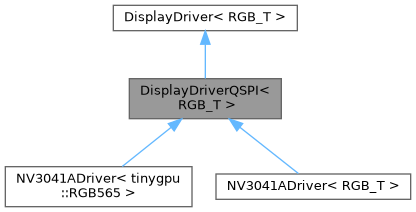
Base driver for QSPI ("4-wire quad SPI") TFT panels: 1 clock, 1 chip-select, 4 data lines, no separate D/C pin. Used by a family of compact panel controllers (NV3041A, ST77916, CO5300, SH8601, AXS15231B, ...) that all speak a de-facto-standardized QSPI wire protocol - see IQSPIBus.h for the exact 32-bit command-frame/data layout. More...
#include <DisplayDriverQSPI.h>
Public Member Functions | |
| DisplayDriverQSPI (int8_t cs, int8_t sclk, int8_t d0, int8_t d1, int8_t d2, int8_t d3, size_t width, size_t height, uint32_t pclkHz=40000000, spi_host_device_t host=SPI3_HOST) | |
| DisplayDriverQSPI (IQSPIBus &bus, size_t width, size_t height) | |
| void | end () override |
| ~DisplayDriverQSPI () override | |
| size_t | width () const override |
| size_t | height () const override |
| bool | writeData (ISurface< RGB_T > &surface) override |
| bool | writeData (ISurface< RGB_T > &surface, size_t x, size_t y) override |
 Public Member Functions inherited from DisplayDriver< RGB_T > Public Member Functions inherited from DisplayDriver< RGB_T > | |
| virtual | ~DisplayDriver ()=default |
| virtual bool | begin ()=0 |
| virtual void | end () |
| virtual bool | writeData (ISurface< RGB_T > &surface)=0 |
| virtual bool | writeData (ISurface< RGB_T > &surface, size_t x, size_t y)=0 |
| virtual void | setRotation (DisplayRotation rotation) |
| virtual size_t | width () const =0 |
| virtual size_t | height () const =0 |
| void | writeColor (size_t width, size_t height, RGB_T color) |
Protected Member Functions | |
| bool | beginBus () |
| bool | writeCommand (uint8_t cmd, const uint8_t *param=nullptr, size_t len=0) |
| bool | setAddressWindow (size_t x, size_t y, size_t w, size_t h) override |
| virtual bool | setAddressWindow (size_t x, size_t y, size_t w, size_t h)=0 |
Protected Attributes | |
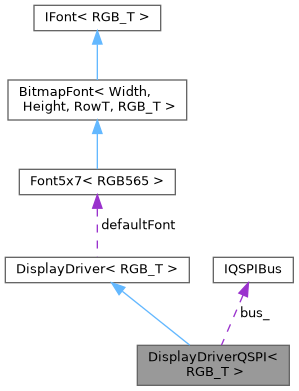
| IQSPIBus * | bus_ = nullptr |
| size_t | width_ |
| size_t | height_ |
| Protected Attributes inherited from DisplayDriver< RGB_T > | |
| Font5x7< RGB_T > | defaultFont |
Static Protected Attributes | |
| static constexpr uint8_t | kCmdRamWrite = 0x2C |
Detailed Description
class tinygpu::DisplayDriverQSPI< RGB_T >
Base driver for QSPI ("4-wire quad SPI") TFT panels: 1 clock, 1 chip-select, 4 data lines, no separate D/C pin. Used by a family of compact panel controllers (NV3041A, ST77916, CO5300, SH8601, AXS15231B, ...) that all speak a de-facto-standardized QSPI wire protocol - see IQSPIBus.h for the exact 32-bit command-frame/data layout.
The wire protocol is handled by an IQSPIBus (dependency-injected, see the two constructors below), not by this class - this class only turns ISurface writes into writeColor() calls and exposes writeCommand() to subclasses for their chip-specific init sequence, the same division of labor DisplayDriverSPI's setupPinsAndReset() uses for its SPI-panel subclasses. That split is what makes this family portable: adding a platform means implementing IQSPIBus once (see QSPIBusESP32.h, hardware/DMA-backed; QSPIBusBitBang.h, portable software fallback for RP2040/STM32/anything else), while every panel subclass (NV3041ADriver, ...) keeps working unchanged on every platform that has a bus.
Constructor & Destructor Documentation
◆ DisplayDriverQSPI() [1/2]
|
inline |
Pin-based constructor: builds and owns the platform's default IQSPIBus (QSPIBusESP32 on ESP32, QSPIBusBitBang everywhere else). pclkHz only affects the ESP32 backend - QSPIBusBitBang runs as fast as digitalWrite() allows, uncapped.
◆ DisplayDriverQSPI() [2/2]
|
inline |
Bus-injection constructor: use any IQSPIBus implementation (e.g. a future PIO-accelerated RP2040 bus) without changing this class or its panel subclasses. The caller keeps ownership of bus.
◆ ~DisplayDriverQSPI()
|
inlineoverride |
Member Function Documentation
◆ beginBus()
|
inlineprotected |
Sets up the bus. Subclasses call this first thing in their begin(), then send their chip's init register sequence via writeCommand() before returning.
◆ end()
|
inlineoverridevirtual |
Reimplemented from DisplayDriver< RGB_T >.
◆ height()
|
inlineoverridevirtual |
Implements DisplayDriver< RGB_T >.
◆ setAddressWindow()
|
inlineoverrideprotectedvirtual |
Implements DisplayDriver< RGB_T >.
◆ width()
|
inlineoverridevirtual |
Current addressable panel width/height in pixels - for a driver that supports setRotation(), these reflect the current rotation (landscape vs portrait swaps them; see isLandscapeFamily()), not necessarily the panel's native/physical orientation. Callers that need to lay out content (e.g. OutputTinyGPU's scale_to_fit target, or clearScreen()'s band loop) should read these fresh rather than caching their own copy, so a setRotation() call is picked up automatically without needing separate bookkeeping.
Implements DisplayDriver< RGB_T >.
◆ writeCommand()
|
inlineprotected |
◆ writeData() [1/2]
|
inlineoverridevirtual |
Implements DisplayDriver< RGB_T >.
◆ writeData() [2/2]
|
inlineoverridevirtual |
Implements DisplayDriver< RGB_T >.
Member Data Documentation
◆ bus_
|
protected |
◆ height_
|
protected |
◆ kCmdRamWrite
|
staticconstexprprotected |
◆ width_
|
protected |
The documentation for this class was generated from the following file:
- src/TinyGPU/Drivers/DisplayDriverQSPI.h