Owns a set of widgets, draws them, and routes gesture events to whichever one should handle each event - the one root Container every sketch has, plus what only a root needs: a second non-scrolling widget layer, modal dialog presentation, and actually writing to a display.
More...
|
| | Screen () |
| |
| | Screen (const MaterialTheme< RGB_T > &theme) |
| |
| void | addWidget (Widget< RGB_T > &widget) |
| |
| void | setContentProvider (typename Container< RGB_T >::ChildCountFn count, typename Container< RGB_T >::ChildAtFn at) |
| |
| void | addFixedWidget (Widget< RGB_T > &widget) |
| |
| void | setTheme (const MaterialTheme< RGB_T > &theme) override |
| |
| const MaterialTheme< RGB_T > & | theme () const |
| |
| void | setBackgroundColor (RGB_T color) |
| |
| bool | isDirty () const |
| |
| void | invalidate () |
| |
| void | draw (tinygpu::ISurface< RGB_T > &target) override |
| |
| void | drawDirect (tinygpu::DisplayDriver< RGB_T > &driver, tinygpu::ISurface< RGB_T > &scratch, int32_t viewportWidth, int32_t viewportHeight) |
| |
| bool | update (uint32_t nowMs) override |
| |
| bool | isDraggableAt (int32_t x, int32_t y) const |
| |
| void | handleGesture (const tinygpu::GestureEvent &event) |
| | Wire this to GestureDetector::onGesture.
|
| |
| bool | onGesture (const tinygpu::GestureEvent &event) override |
| | Handles one gesture event. Returns true if this widget consumed it.
|
| |
| void | presentDialog (Widget< RGB_T > &dialog) |
| |
| void | dismissDialog () |
| |
| bool | hasDialog () const |
| | True while a dialog (or menu, ...) is presented.
|
| |
| bool | isDialogPresented () const |
| |
| | Container ()=default |
| |
| | Container (Bounds containerBounds) |
| |
| void | addChild (Widget< RGB_T > &child) |
| |
| bool | removeChild (Widget< RGB_T > &child) |
| |
| void | clearChildren () |
| | Removes all children (they are not deleted) and scrolls to the top.
|
| |
| int | childrenCount () const |
| | Number of children added with addChild().
|
| |
| void | setScrollOffset (int32_t offset) |
| |
| void | scrollToChild (const Widget< RGB_T > &child, int32_t margin=4) |
| |
| void | setChildProvider (ChildCountFn count, ChildAtFn at) |
| |
| void | setUniformItemHeight (int32_t height) |
| |
| void | setTheme (const MaterialTheme< RGB_T > &theme) override |
| |
| void | draw (tinygpu::ISurface< RGB_T > &target) override |
| |
| void | drawBackground (tinygpu::ISurface< RGB_T > &target) override |
| |
| bool | update (uint32_t nowMs) override |
| |
| bool | onGesture (const tinygpu::GestureEvent &event) override |
| | Handles one gesture event. Returns true if this widget consumed it.
|
| |
| int | childCount () const override |
| |
| Widget< RGB_T > * | child (int index) override |
| |
| int32_t | scrollOffset () const |
| | Current vertical scroll offset (0 = content's natural top).
|
| |
| bool | isDraggableAt (int32_t x, int32_t y) const override |
| |
| bool | isContainer () const override |
| | Provides true if the widget is a container.
|
| |
| virtual | ~Widget ()=default |
| |
| virtual void | setTheme (const MaterialTheme< RGB_T > &theme) |
| |
| virtual void | draw (tinygpu::ISurface< RGB_T > &target)=0 |
| |
| virtual bool | onGesture (const tinygpu::GestureEvent &event) |
| | Handles one gesture event. Returns true if this widget consumed it.
|
| |
| virtual bool | update (uint32_t nowMs) |
| |
| virtual bool | isDraggable () const |
| |
| virtual bool | isDraggableAt (int32_t x, int32_t y) const |
| |
| virtual int | childCount () const |
| |
| virtual Widget< RGB_T > * | child (int index) |
| |
| virtual void | drawBackground (tinygpu::ISurface< RGB_T > &target) |
| |
| virtual void | setThemeTint (RGB_T background, RGB_T foreground) |
| |
| virtual bool | isContainer () const |
| | Provides true if the widget is a container.
|
| |
template<typename RGB_T = TINYMD_DEFAULT_RGB_T>
class tinymd::Screen< RGB_T >
Owns a set of widgets, draws them, and routes gesture events to whichever one should handle each event - the one root Container every sketch has, plus what only a root needs: a second non-scrolling widget layer, modal dialog presentation, and actually writing to a display.
Screen does not own the widgets (the sketch does, typically as globals - the same non-owning-reference composition TinyGPU itself uses everywhere, e.g. DeviceOutput(driver&)). Usage, mirroring TinyGPU's own examples:
Screen<RGB565> screen(theme); Button<RGB565> okButton(...); screen.addWidget(okButton);
GestureDetector gestures; gestures.onGesture = [](GestureEvent& e) { screen.handleGesture(e); }; gestures.isDraggable = [](int16_t x, int16_t y) { return screen.isDraggableAt(x, y); };
void loop() { gestures.update(touchDriver); screen.update(millis()); if (screen.isDirty()) { // see isDirty() - skips the (slow) screen.draw(surface); // redraw + display write when display.writeData(surface); // nothing changed this frame } }
Vertical scrolling: widgets added via addWidget() are Container's own children (see Container.h) - laid out in one "content" coordinate space that can be taller than the surface passed to draw() - if it is, dragging up/down over any non-interactive spot (an empty gap, a Label, a Card, ...) scrolls that content, the same gesture TouchDriver/GestureDetector already classify as kScroll/kPan. Widgets that should stay put while the content behind them scrolls - a top AppBar, a bottom Keyboard - go through addFixedWidget() instead; they're always drawn and hit-tested on top of the scrollable content, at their own authored (screen-space) bounds. If everything already fits within the drawn surface, scrolling never engages (offset stays 0), no scrollbar is drawn, and existing sketches that only call addWidget() are unaffected. A thin scrollbar on the right edge appears automatically whenever there's something to scroll - see Container::draw().
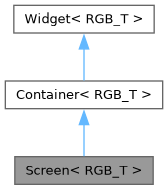
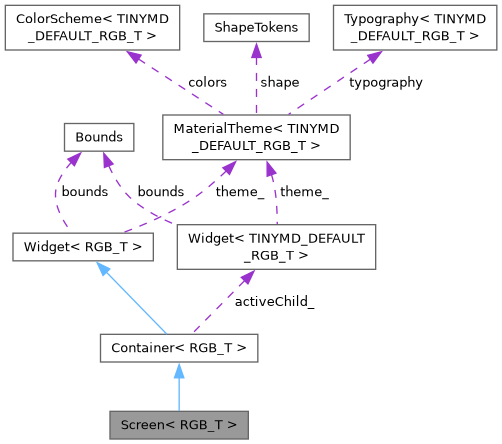
Since Screen is a Container (its scrollable content is just Container's own child list), an addWidget()'d widget can itself be a Container - nesting a smaller scrollable panel inside the one root scrollable area. See Container.h for that case's own scroll/gesture behavior and limitations (which Screen shares for its own content, listed below).
A widget that straddles the viewport's top/bottom edge while scrolled partway off it is cropped to the viewport (see ISurface::pushClipRect(), used the same way Container.h uses it for its own children) rather than rendered pinned to y=0 at full size or skipped outright.
| void drawDirect |
( |
tinygpu::DisplayDriver< RGB_T > & |
driver, |
|
|
tinygpu::ISurface< RGB_T > & |
scratch, |
|
|
int32_t |
viewportWidth, |
|
|
int32_t |
viewportHeight |
|
) |
| |
|
inline |
Renders the full layout straight to driver without ever needing a full-screen framebuffer - for boards that can't spare a single contiguous allocation the size of the whole screen (e.g. classic ESP32 without PSRAM: a 240x320 RGB565 buffer is 153,600 bytes, which can exceed the largest free block even with plenty of total free heap, since the heap ends up split into multiple smaller regions).
Each visible widget - scrollable or fixed, skipping anything invisible or entirely outside the viewport (including scrolled off it), same idea as content that's never drawn today - gets scratch resized to exactly its own bounds, is drawn into it once, and is blitted directly to the panel at its own position: genuinely one small buffer and one write per control, not a shared full-screen (or full-band) one. scratch is one small, reused, real (non-owning, already-begin()'d) surface - since Surface::resize() only reallocates when growing past its current capacity, repeatedly resizing it this way settles down to zero reallocation once it's been sized to the largest single widget this layout ever draws.
The one case that can't work this way is a presented modal (Dialog/Drawer): its scrim always covers the full viewport regardless of the modal's own bounds (see Dialog.h/Drawer.h), and it can itself span most of the screen (a full-height Drawer) - both too much for one small per-widget buffer. So while a modal is presented, everything else is skipped outright (it would just be fully occluded) and only the modal is drawn: its drawBackground() (see Widget.h) - scrim plus whatever chrome isn't one of its children - one short horizontal strip at a time via a WindowedSurface (see that class) that reports the full viewport size for the scrim's own math but clips actual pixel writes to the current strip, followed by each of its children (see childCount()/child()) individually via the same per-widget path as everything else - e.g. Drawer's own list items, each drawn once rather than redrawn on every strip. A modal type that doesn't override drawBackground()/childCount() (Dialog, as yet) falls back to the default drawBackground() = draw() and childCount() = 0, i.e. its entire contents (chrome + actions) drawn banded, same as before.
This is an alternative to draw()+writeData(surface) (unaffected by this method's existence) - pick whichever fits your board.
 Public Member Functions inherited from Container< RGB_T >