Horizontally paged, drag-to-swipe row of items (typically MediaCard), with a snap-to-item animation and a page-dot indicator - Material's "carousel", e.g. a row of featured stations/genres.
More...
#include <Carousel.h>
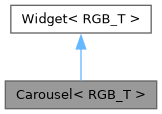
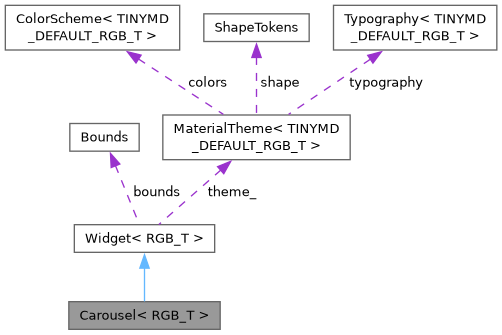
Public Types | |
| using | ItemCountFn = std::function< int()> |
| using | ItemAtFn = std::function< Widget< RGB_T > &(int index)> |
Public Member Functions | |
| Carousel ()=default | |
| Carousel (Bounds bounds, int32_t itemWidth=140, int32_t gap=12) | |
| void | addItem (Widget< RGB_T > &item) |
| void | setItemProvider (ItemCountFn count, ItemAtFn at) |
| Switches to callback-driven items - see the class comment. | |
| void | setTheme (const MaterialTheme< RGB_T > &theme) override |
| Bounds | itemRect (int index) const |
| int | currentIndex () const |
| int | pageCount () const |
| void | setCurrentIndex (int index, bool animate=true) |
| bool | isDraggable () const override |
| void | draw (tinygpu::ISurface< RGB_T > &target) override |
| bool | onGesture (const tinygpu::GestureEvent &event) override |
| Handles one gesture event. Returns true if this widget consumed it. | |
| bool | update (uint32_t nowMs) override |
 Public Member Functions inherited from Widget< RGB_T > | |
| virtual | ~Widget ()=default |
| virtual void | setTheme (const MaterialTheme< RGB_T > &theme) |
| virtual void | draw (tinygpu::ISurface< RGB_T > &target)=0 |
| virtual bool | onGesture (const tinygpu::GestureEvent &event) |
| Handles one gesture event. Returns true if this widget consumed it. | |
| virtual bool | update (uint32_t nowMs) |
| virtual bool | isDraggable () const |
| virtual bool | isDraggableAt (int32_t x, int32_t y) const |
| virtual int | childCount () const |
| virtual Widget< RGB_T > * | child (int index) |
| virtual void | drawBackground (tinygpu::ISurface< RGB_T > &target) |
| virtual void | setThemeTint (RGB_T background, RGB_T foreground) |
| virtual bool | isContainer () const |
| Provides true if the widget is a container. | |
Public Attributes | |
| std::function< void(int)> | onPageChange |
| Public Attributes inherited from Widget< RGB_T > | |
| Bounds | bounds |
| bool | visible = true |
| bool | enabled = true |
Additional Inherited Members | |
| Protected Member Functions inherited from Widget< RGB_T > | |
| const MaterialTheme< RGB_T > & | theme () const |
| Convenience accessor for draw() overrides - see theme_. | |
| Protected Attributes inherited from Widget< RGB_T > | |
| const MaterialTheme< RGB_T > * | theme_ = nullptr |
Detailed Description
class tinymd::Carousel< RGB_T >
Horizontally paged, drag-to-swipe row of items (typically MediaCard), with a snap-to-item animation and a page-dot indicator - Material's "carousel", e.g. a row of featured stations/genres.
Items are not owned by Carousel - same non-owning addItem() convention as Drawer/BottomSheet. Each item's bounds is authored in the carousel's own content space (see itemRect(), stacked left-to-right by itemWidth + gap, starting at x=0) rather than screen space - draw() temporarily shifts each item's bounds.x by the carousel's own position and current scroll offset before drawing it, then restores it, the same pattern Screen::draw() uses for its own vertically-scrolled content. onGesture() translates a tap's point the same way before forwarding it to whichever item it landed on.
Reports isDraggable() == true (like Slider) so a horizontal drag starting on the carousel is classified as GestureType::kDrag and latched to it for the drag's whole lifetime - see Screen:: isDraggableAt(). Releasing mid-drag snaps to the nearest item, animated over a few frames via update().
An item scrolled partway past the carousel's left/right edge is cropped to it (see ISurface::pushClipRect()), not drawn in full or skipped.
Alternative to addItem(): setItemProvider(count, at) switches to callback-driven items, for a station/genre list too large to keep every MediaCard resident at once - see Container.h's class comment for the same pattern. at(index)'s returned Widget has its bounds overwritten with itemRect(index) on every fetch (addItem() only does this once, since a vector-mode item's position never needs to change again).
Member Typedef Documentation
◆ ItemAtFn
◆ ItemCountFn
| using ItemCountFn = std::function<int()> |
Constructor & Destructor Documentation
◆ Carousel() [1/2]
|
default |
◆ Carousel() [2/2]
Member Function Documentation
◆ addItem()
|
inline |
Positions item's own bounds (see class comment) and appends it. Ignored while an item provider is active - see setItemProvider().
◆ currentIndex()
|
inline |
◆ draw()
|
inlineoverridevirtual |
Renders the widget into target using colors/fonts/tokens from its own theme (see theme()/setTheme()).
Implements Widget< RGB_T >.
◆ isDraggable()
|
inlineoverridevirtual |
Whether a continuous drag starting inside this widget's bounds should be classified as GestureType::kDrag (see GestureDetector::isDraggable and Screen::isDraggableAt). Only Slider (and Carousel, for its own horizontal swipe) needs true.
Reimplemented from Widget< RGB_T >.
◆ itemRect()
|
inline |
Suggested content-space rect for the index-th item - see class comment. Leaves room at the bottom for the page-dot indicator.
◆ onGesture()
|
inlineoverridevirtual |
Handles one gesture event. Returns true if this widget consumed it.
Reimplemented from Widget< RGB_T >.
◆ pageCount()
|
inline |
◆ setCurrentIndex()
|
inline |
Pages to index, clamped to a valid item - animated (the same snap-glide update() uses after a drag release) unless animate is false.
◆ setItemProvider()
|
inline |
Switches to callback-driven items - see the class comment.
◆ setTheme()
|
inlineoverridevirtual |
Sets the theme this widget draws itself with - see theme(). Screen pushes its own theme into a widget at registration time (addWidget()/addFixedWidget()/presentDialog()) and again whenever Screen::setTheme() is called; container widgets (Dialog, Drawer) cascade this down to whatever children they already hold.
Reimplemented from Widget< RGB_T >.
◆ update()
|
inlineoverridevirtual |
Called once per frame, before draw(), to advance any time-based animation (ripple fade, indeterminate progress sweep, ...). Returns true if that advance changed anything this widget will draw differently, so Screen can decide whether a redraw is actually needed - see Screen::isDirty(). Default: no-op, not dirty, so widgets that don't animate cost nothing extra.
Reimplemented from Widget< RGB_T >.
Member Data Documentation
◆ onPageChange
| std::function<void(int)> onPageChange |
Fired whenever the settled current page changes - by drag-release snap or by setCurrentIndex().
The documentation for this class was generated from the following file:
- src/TinyMaterialDesign/Widgets/Carousel.h