Jezar at Dreampoint's FreeVerb, implemented in STK. More...
#include <FreeVerb.h>
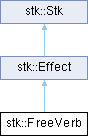
Public Member Functions | |
| FreeVerb () | |
| FreeVerb Constructor. | |
| ~FreeVerb () | |
| Destructor. | |
| void | setEffectMix (StkFloat mix) |
| Set the effect mix [0 = mostly dry, 1 = mostly wet]. | |
| void | setRoomSize (StkFloat value) |
| Set the room size (comb filter feedback gain) parameter [0,1]. | |
| StkFloat | getRoomSize (void) |
| Get the room size (comb filter feedback gain) parameter. | |
| void | setDamping (StkFloat value) |
| Set the damping parameter [0=low damping, 1=higher damping]. | |
| StkFloat | getDamping (void) |
| Get the damping parameter. | |
| void | setWidth (StkFloat value) |
| Set the width (left-right mixing) parameter [0,1]. | |
| StkFloat | getWidth (void) |
| Get the width (left-right mixing) parameter. | |
| void | setMode (bool isFrozen) |
| Set the mode [frozen = 1, unfrozen = 0]. | |
| StkFloat | getMode (void) |
| Get the current freeze mode [frozen = 1, unfrozen = 0]. | |
| void | clear (void) |
| Clears delay lines, etc. | |
| StkFloat | lastOut (unsigned int channel=0) |
| Return the specified channel value of the last computed stereo frame. | |
| StkFloat | tick (StkFloat inputL, StkFloat inputR=0.0, unsigned int channel=0) |
Input one or two samples to the effect and return the specified channel value of the computed stereo frame. | |
| StkFrames & | tick (StkFrames &frames, unsigned int channel=0) |
| Take two channels of the StkFrames object as inputs to the effect and replace with stereo outputs. | |
| StkFrames & | tick (StkFrames &iFrames, StkFrames &oFrames, unsigned int iChannel=0, unsigned int oChannel=0) |
Take one or two channels of the iFrames object as inputs to the effect and write stereo outputs to the oFrames object. | |
| StkFloat | tick (StkFloat input, unsigned int channel) override |
Input one sample to the effect and return the specified channel value of the computed mono frame. | |
| unsigned int | channelsOut (void) const |
| Return the number of output channels for the class. | |
| const StkFrames & | lastFrame (void) const |
| Return an StkFrames reference to the last output sample frame. | |
| void | ignoreSampleRateChange (bool ignore=true) |
| A function to enable/disable the automatic updating of class data when the STK sample rate changes. | |
Static Public Member Functions | |
| static StkFloat | sampleRate (void) |
| Static method that returns the current STK sample rate. | |
| static void | setSampleRate (StkFloat rate) |
| Static method that sets the STK sample rate. | |
| static void | clear_alertList () |
| Static method that frees memory from alertList_. | |
| static std::string | rawwavePath (void) |
| Static method that returns the current rawwave path. | |
| static void | setRawwavePath (std::string path) |
| Static method that sets the STK rawwave path. | |
| static void | swap16 (unsigned char *ptr) |
| Static method that byte-swaps a 16-bit data type. | |
| static void | swap32 (unsigned char *ptr) |
| Static method that byte-swaps a 32-bit data type. | |
| static void | swap64 (unsigned char *ptr) |
| Static method that byte-swaps a 64-bit data type. | |
| static void | sleep (unsigned long milliseconds) |
| Static cross-platform method to sleep for a number of milliseconds. | |
| static bool | inRange (StkFloat value, StkFloat min, StkFloat max) |
| Static method to check whether a value is within a specified range. | |
| static void | handleError (const char *message, StkError::Type type) |
| Static function for error reporting and handling using c-strings. | |
| static void | handleError (std::string message, StkError::Type type) |
| Static function for error reporting and handling using c++ strings. | |
| static void | showWarnings (bool status) |
| Toggle display of WARNING and STATUS messages. | |
| static void | printErrors (bool status) |
| Toggle display of error messages before throwing exceptions. | |
Static Public Attributes | |
| static const StkFormat | STK_SINT8 |
| static const StkFormat | STK_SINT16 |
| static const StkFormat | STK_SINT24 |
| static const StkFormat | STK_SINT32 |
| static const StkFormat | STK_FLOAT32 |
| static const StkFormat | STK_FLOAT64 |
Protected Member Functions | |
| void | update (void) |
| Update interdependent parameters. | |
| void | handleError (StkError::Type type) const |
Internal function for error reporting that assumes message in oStream_ variable. | |
| virtual void | sampleRateChanged (StkFloat newRate, StkFloat oldRate) |
| This function should be implemented in subclasses that depend on the sample rate. | |
| void | addSampleRateAlert (Stk *ptr) |
| Add class pointer to list for sample rate change notification. | |
| void | removeSampleRateAlert (Stk *ptr) |
| Remove class pointer from list for sample rate change notification. | |
Detailed Description
Jezar at Dreampoint's FreeVerb, implemented in STK.
Freeverb is a free and open-source Schroeder reverberator originally implemented in C++. The parameters of the reverberation model are exceptionally well tuned. FreeVerb uses 8 lowpass-feedback-comb-filters in parallel, followed by 4 Schroeder allpass filters in series. The input signal can be either mono or stereo, and the output signal is stereo. The delay lengths are optimized for a sample rate of 44100 Hz.
Ported to STK by Gregory Burlet, 2012.
Constructor & Destructor Documentation
◆ FreeVerb()
| stk::FreeVerb::FreeVerb | ( | ) |
Member Function Documentation
◆ lastOut()
| StkFloat stk::FreeVerb::lastOut | ( | unsigned int | channel = 0 | ) |
Return the specified channel value of the last computed stereo frame.
Use the lastFrame() function to get both values of the last computed stereo frame. The channel argument must be 0 or 1 (the first channel is specified by 0). However, range checking is only performed if STK_DEBUG is defined during compilation, in which case an out-of-range value will trigger an StkError exception.
◆ tick() [1/3]
| StkFloat stk::FreeVerb::tick | ( | StkFloat | inputL, |
| StkFloat | inputR = 0.0, | ||
| unsigned int | channel = 0 ) |
Input one or two samples to the effect and return the specified channel value of the computed stereo frame.
Use the lastFrame() function to get both values of the computed stereo output frame. The channel argument must be 0 or 1 (the first channel is specified by 0). However, range checking is only performed if STK_DEBUG is defined during compilation, in which case an out-of-range value will trigger an StkError exception.
◆ tick() [2/3]
Take two channels of the StkFrames object as inputs to the effect and replace with stereo outputs.
The StkFrames argument reference is returned. The stereo inputs are taken from (and written back to) the StkFrames argument starting at the specified channel. Therefore, the channel argument must be less than ( channels() - 1 ) of the StkFrames argument (the first channel is specified by 0). However, range checking is only performed if STK_DEBUG is defined during compilation, in which case an out-of-range value will trigger an StkError exception.
◆ tick() [3/3]
| StkFrames & stk::FreeVerb::tick | ( | StkFrames & | iFrames, |
| StkFrames & | oFrames, | ||
| unsigned int | iChannel = 0, | ||
| unsigned int | oChannel = 0 ) |
Take one or two channels of the iFrames object as inputs to the effect and write stereo outputs to the oFrames object.
The iFrames object reference is returned. The iChannel argument must be less than the number of channels in the iFrames argument (the first channel is specified by 0). If more than one channel of data exists in iFrames starting from iChannel, stereo data is input to the effect. The oChannel argument must be less than ( channels() - 1 ) of the oFrames argument. However, range checking is only performed if STK_DEBUG is defined during compilation, in which case an out-of-range value will trigger an StkError exception.
◆ setSampleRate()
|
staticinherited |
Static method that sets the STK sample rate.
The sample rate set using this method is queried by all STK classes that depend on its value. It is initialized to the default SRATE set in Stk.h. Many STK classes use the sample rate during instantiation. Therefore, if you wish to use a rate that is different from the default rate, it is imperative that it be set BEFORE STK objects are instantiated. A few classes that make use of the global STK sample rate are automatically notified when the rate changes so that internal class data can be appropriately updated. However, this has not been fully implemented. Specifically, classes that appropriately update their own data when either a setFrequency() or noteOn() function is called do not currently receive the automatic notification of rate change. If the user wants a specific class instance to ignore such notifications, perhaps in a multi-rate context, the function Stk::ignoreSampleRateChange() should be called.
◆ ignoreSampleRateChange()
|
inlineinherited |
A function to enable/disable the automatic updating of class data when the STK sample rate changes.
This function allows the user to enable or disable class data updates in response to global sample rate changes on a class by class basis.
Member Data Documentation
◆ STK_SINT8
|
staticinherited |
-128 to +127
◆ STK_SINT16
|
staticinherited |
-32768 to +32767
◆ STK_SINT24
|
staticinherited |
Lower 3 bytes of 32-bit signed integer.
◆ STK_SINT32
|
staticinherited |
-2147483648 to +2147483647.
◆ STK_FLOAT32
|
staticinherited |
Normalized between plus/minus 1.0.
◆ STK_FLOAT64
|
staticinherited |
Normalized between plus/minus 1.0.
The documentation for this class was generated from the following file:
Generated by
 1.15.0