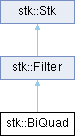
STK biquad (two-pole, two-zero) filter class. More...
#include <BiQuad.h>
Public Member Functions | |
| BiQuad () | |
| Default constructor creates a second-order pass-through filter. | |
| ~BiQuad () | |
| Class destructor. | |
| void | ignoreSampleRateChange (bool ignore=true) |
| A function to enable/disable the automatic updating of class data when the STK sample rate changes. | |
| void | setCoefficients (StkFloat b0, StkFloat b1, StkFloat b2, StkFloat a1, StkFloat a2, bool clearState=false) |
| Set all filter coefficients. | |
| void | setB0 (StkFloat b0) |
| Set the b[0] coefficient value. | |
| void | setB1 (StkFloat b1) |
| Set the b[1] coefficient value. | |
| void | setB2 (StkFloat b2) |
| Set the b[2] coefficient value. | |
| void | setA1 (StkFloat a1) |
| Set the a[1] coefficient value. | |
| void | setA2 (StkFloat a2) |
| Set the a[2] coefficient value. | |
| void | setResonance (StkFloat frequency, StkFloat radius, bool normalize=false) |
| Sets the filter coefficients for a resonance at frequency (in Hz). | |
| void | setNotch (StkFloat frequency, StkFloat radius) |
| Set the filter coefficients for a notch at frequency (in Hz). | |
| void | setEqualGainZeroes (void) |
| Sets the filter zeroes for equal resonance gain. | |
| StkFloat | lastOut (void) const |
| Return the last computed output value. | |
| StkFloat | tick (StkFloat input) |
| Input one sample to the filter and return a reference to one output. | |
| StkFrames & | tick (StkFrames &frames, unsigned int channel=0) |
| Take a channel of the StkFrames object as inputs to the filter and replace with corresponding outputs. | |
| StkFrames & | tick (StkFrames &iFrames, StkFrames &oFrames, unsigned int iChannel=0, unsigned int oChannel=0) |
Take a channel of the iFrames object as inputs to the filter and write outputs to the oFrames object. | |
| unsigned int | channelsIn (void) const |
| Return the number of input channels for the class. | |
| unsigned int | channelsOut (void) const |
| Return the number of output channels for the class. | |
| virtual void | clear (void) |
| Clears all internal states of the filter. | |
| void | setGain (StkFloat gain) |
| Set the filter gain. | |
| StkFloat | getGain (void) const |
| Return the current filter gain. | |
| StkFloat | phaseDelay (StkFloat frequency) |
| Return the filter phase delay at the specified frequency. | |
| const StkFrames & | lastFrame (void) const |
| Return an StkFrames reference to the last output sample frame. | |
Static Public Member Functions | |
| static StkFloat | sampleRate (void) |
| Static method that returns the current STK sample rate. | |
| static void | setSampleRate (StkFloat rate) |
| Static method that sets the STK sample rate. | |
| static void | clear_alertList () |
| Static method that frees memory from alertList_. | |
| static std::string | rawwavePath (void) |
| Static method that returns the current rawwave path. | |
| static void | setRawwavePath (std::string path) |
| Static method that sets the STK rawwave path. | |
| static void | swap16 (unsigned char *ptr) |
| Static method that byte-swaps a 16-bit data type. | |
| static void | swap32 (unsigned char *ptr) |
| Static method that byte-swaps a 32-bit data type. | |
| static void | swap64 (unsigned char *ptr) |
| Static method that byte-swaps a 64-bit data type. | |
| static void | sleep (unsigned long milliseconds) |
| Static cross-platform method to sleep for a number of milliseconds. | |
| static bool | inRange (StkFloat value, StkFloat min, StkFloat max) |
| Static method to check whether a value is within a specified range. | |
| static void | handleError (const char *message, StkError::Type type) |
| Static function for error reporting and handling using c-strings. | |
| static void | handleError (std::string message, StkError::Type type) |
| Static function for error reporting and handling using c++ strings. | |
| static void | showWarnings (bool status) |
| Toggle display of WARNING and STATUS messages. | |
| static void | printErrors (bool status) |
| Toggle display of error messages before throwing exceptions. | |
Static Public Attributes | |
| static const StkFormat | STK_SINT8 |
| static const StkFormat | STK_SINT16 |
| static const StkFormat | STK_SINT24 |
| static const StkFormat | STK_SINT32 |
| static const StkFormat | STK_FLOAT32 |
| static const StkFormat | STK_FLOAT64 |
Protected Member Functions | |
| void | handleError (StkError::Type type) const |
Internal function for error reporting that assumes message in oStream_ variable. | |
| void | addSampleRateAlert (Stk *ptr) |
| Add class pointer to list for sample rate change notification. | |
| void | removeSampleRateAlert (Stk *ptr) |
| Remove class pointer from list for sample rate change notification. | |
Detailed Description
STK biquad (two-pole, two-zero) filter class.
This class implements a two-pole, two-zero digital filter. Methods are provided for creating a resonance or notch in the frequency response while maintaining a constant filter gain.
by Perry R. Cook and Gary P. Scavone, 1995–2019.
Member Function Documentation
◆ setResonance()
| void stk::BiQuad::setResonance | ( | StkFloat | frequency, |
| StkFloat | radius, | ||
| bool | normalize = false ) |
Sets the filter coefficients for a resonance at frequency (in Hz).
This method determines the filter coefficients corresponding to two complex-conjugate poles with the given frequency (in Hz) and radius from the z-plane origin. If normalize is true, the filter zeros are placed at z = 1, z = -1, and the coefficients are then normalized to produce a constant unity peak gain (independent of the filter gain parameter). The resulting filter frequency response has a resonance at the given frequency. The closer the poles are to the unit-circle (radius close to one), the narrower the resulting resonance width. An unstable filter will result for radius >= 1.0. The frequency value should be between zero and half the sample rate.
◆ setNotch()
| void stk::BiQuad::setNotch | ( | StkFloat | frequency, |
| StkFloat | radius ) |
Set the filter coefficients for a notch at frequency (in Hz).
This method determines the filter coefficients corresponding to two complex-conjugate zeros with the given frequency (in Hz) and radius from the z-plane origin. No filter normalization is attempted. The frequency value should be between zero and half the sample rate. The radius value should be positive.
◆ setEqualGainZeroes()
| void stk::BiQuad::setEqualGainZeroes | ( | void | ) |
Sets the filter zeroes for equal resonance gain.
When using the filter as a resonator, zeroes places at z = 1, z = -1 will result in a constant gain at resonance of 1 / (1 - R), where R is the pole radius setting.
◆ tick() [1/2]
Take a channel of the StkFrames object as inputs to the filter and replace with corresponding outputs.
The StkFrames argument reference is returned. The channel argument must be less than the number of channels in the StkFrames argument (the first channel is specified by 0). However, range checking is only performed if STK_DEBUG is defined during compilation, in which case an out-of-range value will trigger an StkError exception.
Implements stk::Filter.
◆ tick() [2/2]
|
inline |
Take a channel of the iFrames object as inputs to the filter and write outputs to the oFrames object.
The iFrames object reference is returned. Each channel argument must be less than the number of channels in the corresponding StkFrames argument (the first channel is specified by 0). However, range checking is only performed if STK_DEBUG is defined during compilation, in which case an out-of-range value will trigger an StkError exception.
◆ setGain()
|
inlineinherited |
Set the filter gain.
The gain is applied at the filter input and does not affect the coefficient values. The default gain value is 1.0.
◆ phaseDelay()
|
inlineinherited |
Return the filter phase delay at the specified frequency.
Note that the phase delay calculation accounts for the filter gain. The frequency value should be greater than 0.0 and less than or equal to one-half the sample rate.
◆ setSampleRate()
|
staticinherited |
Static method that sets the STK sample rate.
The sample rate set using this method is queried by all STK classes that depend on its value. It is initialized to the default SRATE set in Stk.h. Many STK classes use the sample rate during instantiation. Therefore, if you wish to use a rate that is different from the default rate, it is imperative that it be set BEFORE STK objects are instantiated. A few classes that make use of the global STK sample rate are automatically notified when the rate changes so that internal class data can be appropriately updated. However, this has not been fully implemented. Specifically, classes that appropriately update their own data when either a setFrequency() or noteOn() function is called do not currently receive the automatic notification of rate change. If the user wants a specific class instance to ignore such notifications, perhaps in a multi-rate context, the function Stk::ignoreSampleRateChange() should be called.
Member Data Documentation
◆ STK_SINT8
|
staticinherited |
-128 to +127
◆ STK_SINT16
|
staticinherited |
-32768 to +32767
◆ STK_SINT24
|
staticinherited |
Lower 3 bytes of 32-bit signed integer.
◆ STK_SINT32
|
staticinherited |
-2147483648 to +2147483647.
◆ STK_FLOAT32
|
staticinherited |
Normalized between plus/minus 1.0.
◆ STK_FLOAT64
|
staticinherited |
Normalized between plus/minus 1.0.
The documentation for this class was generated from the following file:
Generated by
 1.15.0