Second-order IIR filter in Direct Form I. Maintains separate input and output histories (x and y delay lines). Requires more memory than DF2 but is less susceptible to quantization issues with fixed-point arithmetic.
More...
#include <CodecOpusOgg.h>
|
| | BiQuadDF1 (const T(&b)[3], const T(&a)[2]) |
| | BiQuadDF1 (const T(&b)[3], const T(&a)[2]) |
| | BiQuadDF1 (const T(&b)[3], const T(&a)[2], T gain) |
| | BiQuadDF1 (const T(&b)[3], const T(&a)[2], T gain) |
| | BiQuadDF1 (const T(&b)[3], const T(&a)[3]) |
| | BiQuadDF1 (const T(&b)[3], const T(&a)[3]) |
| | BiQuadDF1 (const T(&b)[3], const T(&a)[3], T gain) |
| | BiQuadDF1 (const T(&b)[3], const T(&a)[3], T gain) |
| T | process (T value) override |
| T | process (T value) override |
| virtual float | process (float in)=0 |
| | Processes the input value and returns the filtered output value.
|
| void | reset () override |
| void | reset () override |
template<typename T = float>
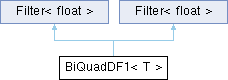
class audio_tools::audio_tools::BiQuadDF1< T >
Second-order IIR filter in Direct Form I. Maintains separate input and output histories (x and y delay lines). Requires more memory than DF2 but is less susceptible to quantization issues with fixed-point arithmetic.
- Author
- Pieter P tttapa / pschatzmann
- Copyright
- GNU General Public License v3.0
- Template Parameters
-
| T | sample type (use float or double, not integer types) |
◆ BiQuadDF1() [1/10]
template<typename T = float>
| BiQuadDF1 |
( |
const T(&) | b[3], |
|
|
const T(&) | a[3] ) |
|
inline |
◆ BiQuadDF1() [2/10]
template<typename T = float>
| BiQuadDF1 |
( |
const T(&) | b[3], |
|
|
const T(&) | a[2] ) |
|
inline |
◆ BiQuadDF1() [3/10]
template<typename T = float>
| BiQuadDF1 |
( |
const T(&) | b[3], |
|
|
const T(&) | a[2], |
|
|
T | gain ) |
|
inline |
◆ BiQuadDF1() [4/10]
template<typename T = float>
| BiQuadDF1 |
( |
const T(&) | b[3], |
|
|
const T(&) | a[3], |
|
|
T | gain ) |
|
inline |
◆ BiQuadDF1() [5/10]
template<typename T = float>
◆ BiQuadDF1() [6/10]
template<typename T = float>
| BiQuadDF1 |
( |
const T(&) | b[3], |
|
|
const T(&) | a[3] ) |
|
inline |
◆ BiQuadDF1() [7/10]
template<typename T = float>
| BiQuadDF1 |
( |
const T(&) | b[3], |
|
|
const T(&) | a[2] ) |
|
inline |
◆ BiQuadDF1() [8/10]
template<typename T = float>
| BiQuadDF1 |
( |
const T(&) | b[3], |
|
|
const T(&) | a[2], |
|
|
T | gain ) |
|
inline |
◆ BiQuadDF1() [9/10]
template<typename T = float>
| BiQuadDF1 |
( |
const T(&) | b[3], |
|
|
const T(&) | a[3], |
|
|
T | gain ) |
|
inline |
◆ BiQuadDF1() [10/10]
template<typename T = float>
◆ process() [1/3]
template<typename T = float>
◆ process() [2/3]
template<typename T = float>
◆ process() [3/3]
◆ reset() [1/2]
template<typename T = float>
Clears the internal state (delay lines) without changing the coefficients. Call after reconfiguring filter parameters via begin() to avoid transients from stale state.
Reimplemented from Filter< float >.
◆ reset() [2/2]
template<typename T = float>
Clears the internal state (delay lines) without changing the coefficients. Call after reconfiguring filter parameters via begin() to avoid transients from stale state.
Reimplemented from Filter< float >.
◆ a_1
template<typename T = float>
◆ a_2
template<typename T = float>
◆ b_0
template<typename T = float>
◆ b_1
template<typename T = float>
◆ b_2
template<typename T = float>
◆ x_0
template<typename T = float>
◆ x_1
template<typename T = float>
◆ y_1
template<typename T = float>
◆ y_2
template<typename T = float>
The documentation for this class was generated from the following files:
 1.15.0