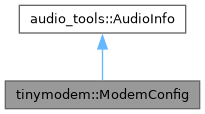
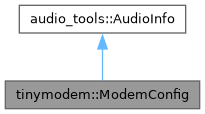
Configuration of the FSK modem. The fields correspond to the command line options of minimodem. Call setMode() to select one of the predefined baud modes ("1200", "300", "rtty", "tdd", "same", "callerid", "uic-train", "uic-ground", "V.21" or any number N for a Bell-like N bps modem) first and then change the individual fields. Fields which are left at 0 (or -1) are derived automatically when the encoder or decoder is started.
More...
#include <ModemConfig.h>
|
| float | baud_rate = 1200.0f |
| | baud rate in bits per second (default: 1200 baud Bell 202)
|
| float | mark_freq = 0.0f |
| | mark frequency in Hz (0 = auto)
|
| float | space_freq = 0.0f |
| | space frequency in Hz (0 = auto)
|
| float | bandwidth = 0.0f |
| | receive filter bandwidth in Hz (0 = auto)
|
| int | data_bits = 0 |
| | number of data bits per frame (0 = auto)
|
| int | start_bits = -1 |
| | number of start bits (-1 = auto)
|
| float | stop_bits = -1.0f |
| | number of stop bits (-1 = auto)
|
| bool | invert_start_stop = false |
| | invert the start and stop bits
|
| bool | inverted = false |
| | swap the mark and space frequencies
|
| bool | msb_first = false |
| | transmit the most significant data bit first
|
| bool | rx_sync = false |
| | receiver: synchronize on sync_byte
|
| int | tx_sync_bytes = 0 |
| | transmitter: number of sync bytes which are sent as preamble
|
| long long | sync_byte = -1 |
| | sync byte value (-1 = none)
|
| float | confidence = 1.5f |
| | minimum confidence threshold (signal-to-noise squelch)
|
| float | search_limit = 2.3f |
| | stop searching for a better frame when this confidence was reached
|
| bool | auto_carrier = false |
| | automatically detect the carrier frequency
|
| float | auto_carrier_threshold = 0.001f |
| | minimum magnitude for the carrier auto detection
|
| float | volume = 1.0f |
| | transmit amplitude (0.0 - 1.0)
|
| int | leader_bits = 2 |
| | number of mark bits which are sent before the first frame
|
| int | trailer_bits = 2 |
| | number of mark bits which are sent after the last frame
|
| bool | rx_one = false |
| | receiver: stop after the first carrier was lost
|
| bool | binary_output = false |
| | receiver: output the data bits as '0'/'1' text
|
| int | binary_raw_bits = 0 |
| | receiver: output n raw bits without framing (0 = disabled)
|
| bool | baudot_usos = true |
| | Baudot: unshift on space.
|
| bool | print_filter = false |
| | receiver: replace non printable characters with '.'
|
| DataFormat | format = DataFormat::ASCII |
| | data encoding
|
| const char * | expect_bits = nullptr |
| | custom expected frame pattern ('0','1','d')
|
| uint8_t | channel = 0 |
| | receiver: input channel which is used for the decoding
|
| float | rx_noise = 0.0f |
| | receiver: (testing only) amplitude of added uniform noise
|
| int | buffer_divisor = 12 |
| int | autodetect_shift = 0 |
| | derived: shift which is used for the carrier auto detection
|
Configuration of the FSK modem. The fields correspond to the command line options of minimodem. Call setMode() to select one of the predefined baud modes ("1200", "300", "rtty", "tdd", "same", "callerid", "uic-train", "uic-ground", "V.21" or any number N for a Bell-like N bps modem) first and then change the individual fields. Fields which are left at 0 (or -1) are derived automatically when the encoder or decoder is started.
- Author
- Phil Schatzmann (port), Kamal Mostafa (minimodem)
- Copyright
- GPLv3
◆ ModemConfig()
| tinymodem::ModemConfig::ModemConfig |
( |
| ) |
|
|
inline |
◆ equalsIgnoreCase()
| bool tinymodem::ModemConfig::equalsIgnoreCase |
( |
const char * | a, |
|
|
const char * | b ) |
|
inlinestaticprotected |
◆ frameBits()
| unsigned tinymodem::ModemConfig::frameBits |
( |
| ) |
const |
|
inline |
number of bits of a frame: start + data + stop bits
◆ isResolved()
| bool tinymodem::ModemConfig::isResolved |
( |
| ) |
const |
|
inline |
◆ isTxSupported()
| bool tinymodem::ModemConfig::isTxSupported |
( |
| ) |
const |
|
inline |
Returns true if the selected format supports transmitting.
◆ resetMode()
| void tinymodem::ModemConfig::resetMode |
( |
| ) |
|
|
inlineprotected |
◆ resolve()
| bool tinymodem::ModemConfig::resolve |
( |
| ) |
|
|
inline |
Derives the missing parameters: returns false if the configuration is invalid. This is called automatically by the encoder and decoder.
◆ setMode()
| bool tinymodem::ModemConfig::setMode |
( |
const char * | mode, |
|
|
bool | keep_options = false ) |
|
inline |
Selects one of the predefined baud modes: returns false if invalid. All mode related fields (baud rate, frequencies, bandwidth, framing, sync, format) are reset first, so the result does not depend on a previous mode. With keep_options=true the data_bits and stop_bits which were set before are kept where minimodem allows options to override the mode (like the minimodem command line).
◆ startsWithIgnoreCase()
| bool tinymodem::ModemConfig::startsWithIgnoreCase |
( |
const char * | str, |
|
|
const char * | prefix ) |
|
inlinestaticprotected |
◆ auto_carrier
| bool tinymodem::ModemConfig::auto_carrier = false |
automatically detect the carrier frequency
◆ auto_carrier_threshold
| float tinymodem::ModemConfig::auto_carrier_threshold = 0.001f |
minimum magnitude for the carrier auto detection
◆ autodetect_shift
| int tinymodem::ModemConfig::autodetect_shift = 0 |
derived: shift which is used for the carrier auto detection
◆ bandwidth
| float tinymodem::ModemConfig::bandwidth = 0.0f |
receive filter bandwidth in Hz (0 = auto)
◆ baud_rate
| float tinymodem::ModemConfig::baud_rate = 1200.0f |
baud rate in bits per second (default: 1200 baud Bell 202)
◆ baudot_usos
| bool tinymodem::ModemConfig::baudot_usos = true |
Baudot: unshift on space.
◆ binary_output
| bool tinymodem::ModemConfig::binary_output = false |
receiver: output the data bits as '0'/'1' text
◆ binary_raw_bits
| int tinymodem::ModemConfig::binary_raw_bits = 0 |
receiver: output n raw bits without framing (0 = disabled)
◆ buffer_divisor
| int tinymodem::ModemConfig::buffer_divisor = 12 |
receiver: the sample buffer holds at least sample_rate / buffer_divisor samples (0 = use the minimum size)
◆ channel
| uint8_t tinymodem::ModemConfig::channel = 0 |
receiver: input channel which is used for the decoding
◆ confidence
| float tinymodem::ModemConfig::confidence = 1.5f |
minimum confidence threshold (signal-to-noise squelch)
◆ data_bits
| int tinymodem::ModemConfig::data_bits = 0 |
number of data bits per frame (0 = auto)
◆ expect_bits
| const char* tinymodem::ModemConfig::expect_bits = nullptr |
custom expected frame pattern ('0','1','d')
◆ format
◆ invert_start_stop
| bool tinymodem::ModemConfig::invert_start_stop = false |
invert the start and stop bits
◆ inverted
| bool tinymodem::ModemConfig::inverted = false |
swap the mark and space frequencies
◆ is_resolved
| bool tinymodem::ModemConfig::is_resolved = false |
|
protected |
◆ leader_bits
| int tinymodem::ModemConfig::leader_bits = 2 |
number of mark bits which are sent before the first frame
◆ mark_freq
| float tinymodem::ModemConfig::mark_freq = 0.0f |
mark frequency in Hz (0 = auto)
◆ msb_first
| bool tinymodem::ModemConfig::msb_first = false |
transmit the most significant data bit first
◆ print_filter
| bool tinymodem::ModemConfig::print_filter = false |
receiver: replace non printable characters with '.'
◆ rx_noise
| float tinymodem::ModemConfig::rx_noise = 0.0f |
receiver: (testing only) amplitude of added uniform noise
◆ rx_one
| bool tinymodem::ModemConfig::rx_one = false |
receiver: stop after the first carrier was lost
◆ rx_sync
| bool tinymodem::ModemConfig::rx_sync = false |
receiver: synchronize on sync_byte
◆ search_limit
| float tinymodem::ModemConfig::search_limit = 2.3f |
stop searching for a better frame when this confidence was reached
◆ space_freq
| float tinymodem::ModemConfig::space_freq = 0.0f |
space frequency in Hz (0 = auto)
◆ start_bits
| int tinymodem::ModemConfig::start_bits = -1 |
number of start bits (-1 = auto)
◆ stop_bits
| float tinymodem::ModemConfig::stop_bits = -1.0f |
number of stop bits (-1 = auto)
◆ sync_byte
| long long tinymodem::ModemConfig::sync_byte = -1 |
sync byte value (-1 = none)
◆ trailer_bits
| int tinymodem::ModemConfig::trailer_bits = 2 |
number of mark bits which are sent after the last frame
◆ tx_sync_bytes
| int tinymodem::ModemConfig::tx_sync_bytes = 0 |
transmitter: number of sync bytes which are sent as preamble
◆ volume
| float tinymodem::ModemConfig::volume = 1.0f |
transmit amplitude (0.0 - 1.0)
The documentation for this struct was generated from the following file: