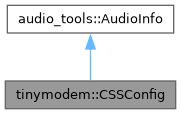
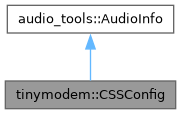
Configuration of the chirp spread spectrum modem (CSSEncoder, CSSDecoder), which works like LoRa in the audio band: each symbol is a linear chirp over the bandwidth, which starts at one of N = 2^SF frequencies and carries SF bits (SF = spreading factor). The signal can be received far below the noise level and is robust against frequency offsets, different clocks and echoes. It is not compatible with LoRa radios.
More...
#include <CSS.h>
|
| | CSSConfig () |
| bool | setMode (const char *mode) |
| int | chips () const |
| | chips (FFT bins) per symbol
|
| float | symbolTime () const |
| | duration of a symbol in seconds
|
| float | symbolRate () const |
| | symbols per second
|
| float | lowFreq () const |
| | lowest frequency of the chirps in Hz
|
| bool | isValid () const |
| | Checks the configuration: returns false (and logs the reason) if invalid.
|
|
| static bool | isMode (const char *mode) |
| | true if the mode is a chirp spread spectrum mode
|
|
| int | spreading_factor = 7 |
| float | bandwidth = 1000.0f |
| | bandwidth of the chirps in Hz
|
| float | center_freq = 1500.0f |
| | center frequency in Hz
|
| float | volume = 1.0f |
| | transmit amplitude (0.0 - 1.0)
|
| int | preamble_symbols = 8 |
| | transmitter: number of up chirps before the sync symbols
|
| int | max_frame = 64 |
| | transmitter: max number of bytes per frame (1 - 200)
|
| int | ecc_bytes = 8 |
| float | detect_threshold = 8.0f |
| bool | rx_one = false |
| | receiver: stop after the first frame
|
| uint8_t | channel = 0 |
| | receiver: input channel which is used for the decoding
|
| float | rx_noise = 0.0f |
| | receiver: (testing only) amplitude of added uniform noise
|
|
| static constexpr int | MAX_FRAME = 200 |
| | max payload of a frame
|
| static constexpr int | HEADER_ECC = 4 |
| | header: length byte and Reed-Solomon parity
|
|
| static bool | parseMode (const char *mode, int &sf, float &bw) |
Configuration of the chirp spread spectrum modem (CSSEncoder, CSSDecoder), which works like LoRa in the audio band: each symbol is a linear chirp over the bandwidth, which starts at one of N = 2^SF frequencies and carries SF bits (SF = spreading factor). The signal can be received far below the noise level and is robust against frequency offsets, different clocks and echoes. It is not compatible with LoRa radios.
A frame starts with preamble_symbols up chirps and 2 down chirps, followed by the header (length, Reed-Solomon protected) and the payload (CRC-16 and ecc_bytes Reed-Solomon parity bytes).
setMode() selects "css5" to "css10" (SF, 1000 Hz bandwidth) or e.g. "css7-500" or "css9-2000" (SF and bandwidth). "css" is "css7".
- Copyright
- GPLv3
◆ CSSConfig()
| tinymodem::CSSConfig::CSSConfig |
( |
| ) |
|
|
inline |
◆ chips()
| int tinymodem::CSSConfig::chips |
( |
| ) |
const |
|
inline |
chips (FFT bins) per symbol
◆ isMode()
| bool tinymodem::CSSConfig::isMode |
( |
const char * | mode | ) |
|
|
inlinestatic |
true if the mode is a chirp spread spectrum mode
◆ isValid()
| bool tinymodem::CSSConfig::isValid |
( |
| ) |
const |
|
inline |
Checks the configuration: returns false (and logs the reason) if invalid.
◆ lowFreq()
| float tinymodem::CSSConfig::lowFreq |
( |
| ) |
const |
|
inline |
lowest frequency of the chirps in Hz
◆ parseMode()
| bool tinymodem::CSSConfig::parseMode |
( |
const char * | mode, |
|
|
int & | sf, |
|
|
float & | bw ) |
|
inlinestaticprotected |
◆ setMode()
| bool tinymodem::CSSConfig::setMode |
( |
const char * | mode | ) |
|
|
inline |
Selects e.g. "css7" or "css9-500": returns false if invalid. The other settings are kept.
◆ symbolRate()
| float tinymodem::CSSConfig::symbolRate |
( |
| ) |
const |
|
inline |
◆ symbolTime()
| float tinymodem::CSSConfig::symbolTime |
( |
| ) |
const |
|
inline |
duration of a symbol in seconds
◆ bandwidth
| float tinymodem::CSSConfig::bandwidth = 1000.0f |
bandwidth of the chirps in Hz
◆ center_freq
| float tinymodem::CSSConfig::center_freq = 1500.0f |
◆ channel
| uint8_t tinymodem::CSSConfig::channel = 0 |
receiver: input channel which is used for the decoding
◆ detect_threshold
| float tinymodem::CSSConfig::detect_threshold = 8.0f |
receiver: min ratio of the peak power to the mean power of the other bins to detect the preamble
◆ ecc_bytes
| int tinymodem::CSSConfig::ecc_bytes = 8 |
Reed-Solomon parity bytes of the payload (2 - 64): corrects ecc_bytes / 2 wrong bytes
◆ HEADER_ECC
| int tinymodem::CSSConfig::HEADER_ECC = 4 |
|
staticconstexpr |
header: length byte and Reed-Solomon parity
◆ MAX_FRAME
| int tinymodem::CSSConfig::MAX_FRAME = 200 |
|
staticconstexpr |
◆ max_frame
| int tinymodem::CSSConfig::max_frame = 64 |
transmitter: max number of bytes per frame (1 - 200)
◆ preamble_symbols
| int tinymodem::CSSConfig::preamble_symbols = 8 |
transmitter: number of up chirps before the sync symbols
◆ rx_noise
| float tinymodem::CSSConfig::rx_noise = 0.0f |
receiver: (testing only) amplitude of added uniform noise
◆ rx_one
| bool tinymodem::CSSConfig::rx_one = false |
receiver: stop after the first frame
◆ spreading_factor
| int tinymodem::CSSConfig::spreading_factor = 7 |
bits per symbol (5 - 10): each step doubles the symbol duration and improves the sensitivity by about 2.5 dB
◆ volume
| float tinymodem::CSSConfig::volume = 1.0f |
transmit amplitude (0.0 - 1.0)
The documentation for this struct was generated from the following file: