An ISurface that reports a full width x height extent but physically redirects every pixel write into a much smaller backing surface, offset by (offsetX, offsetY), dropping anything that then falls outside backing's own bounds.
More...
#include <WindowedSurface.h>
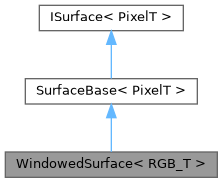
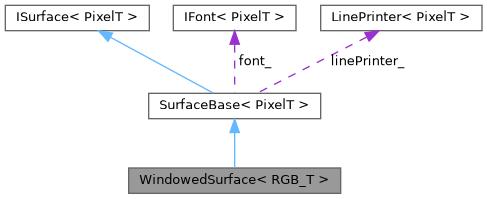
Public Member Functions | |
| WindowedSurface (ISurface< RGB_T > &backing, int32_t offsetX, int32_t offsetY, size_t fullWidth, size_t fullHeight, IFont< RGB_T > &font) | |
| size_t | width () const override |
| size_t | height () const override |
| Get the height of the surface. | |
| void | setPixel (size_t x, size_t y, RGB_T color) override |
| RGB_T | getPixel (size_t x, size_t y) const override |
| Abstract method: get the pixel color at (x, y). | |
| bool | resizeBuffer (size_t, size_t) override |
| const uint8_t * | data () const override |
| size_t | size () const override |
| Provides the total data size in bytes. | |
| bool | contains (size_t x, size_t y) override |
 Public Member Functions inherited from SurfaceBase< PixelT > Public Member Functions inherited from SurfaceBase< PixelT > | |
| SurfaceBase ()=default | |
| Default constructor. | |
| SurfaceBase (size_t width, size_t height, IFont< PixelT > &font) | |
| Construct with width, height, and font. | |
| bool | begin () |
| Initializes the surface by resizing it to the current dimensions. | |
| void | end () |
| Clears the surface and releases any allocated resources. | |
| ~SurfaceBase () override=default | |
| Virtual destructor. | |
| void | setPixel (size_t x, size_t y, PixelT color) override=0 |
| Abstract method: set a pixel at (x, y) to the specified color. | |
| PixelT | getPixel (size_t x, size_t y) const override=0 |
| Abstract method: get the pixel color at (x, y). | |
| void | setFont (IFont< PixelT > &font) |
| Set the font for text rendering. | |
| IFont< PixelT > & | font () override |
| Get the current font (mutable). | |
| const IFont< PixelT > & | font () const |
| Get the current font (const). | |
| bool | resize (size_t newWidth, size_t newHeight) override |
| Resize the surface to new dimensions. | |
| size_t | width () const override |
| Get the width of the surface. | |
| size_t | height () const override |
| Get the height of the surface. | |
| virtual bool | resizeBuffer (size_t, size_t)=0 |
| void | clear (PixelT color=PixelT()) override |
| Clears the framebuffer with a single color. | |
| void | scroll (int dx, int dy) |
| Scroll the surface content by (dx, dy) pixels. | |
| void | drawLine (size_t x0, size_t y0, size_t x1, size_t y1, PixelT color) override |
| Draw a line from (x0, y0) to (x1, y1) with the given color. | |
| void | drawRect (size_t x, size_t y, size_t w, size_t h, PixelT color) override |
| Draw a rectangle outline at (x, y) with width w, height h, and color. | |
| void | fillRect (size_t x, size_t y, size_t w, size_t h, PixelT color) override |
| void | drawCircle (size_t x, size_t y, size_t r, PixelT color) override |
| Draw a circle outline centered at (x, y) with radius r and color. | |
| void | fillCircle (size_t x, size_t y, size_t r, PixelT color) override |
| Fill a circle centered at (x, y) with radius r and color. | |
| void | drawSprite (size_t x, size_t y, const ISurface< PixelT > &sprite, PixelT invisibleColor=PixelT()) override |
| Draw a sprite at (x, y), skipping pixels matching invisibleColor. | |
| void | clearSprite (size_t x, size_t y, ISurface< PixelT > &sprite, PixelT clearColor=PixelT()) override |
| Clear the region covered by a sprite at (x, y) to clearColor. | |
| void | copySprite (size_t x, size_t y, const ISurface< PixelT > &sprite) override |
| Copy the framebuffer region at (x, y) into the sprite. | |
| void | drawText (int16_t x, int16_t y, const char *text, PixelT foreground, PixelT background=PixelT(), bool opaque=false, uint8_t scale=1, uint8_t spacing=1, uint8_t lineSpacing=1) override |
| LinePrinter< PixelT > & | linePrinter () |
| Get the line printer for this surface. | |
| bool | isInBounds (size_t x, size_t y) const |
| Returns true if (x, y) is within the surface bounds. | |
| void | setPixelClipped (size_t x, size_t y, PixelT color) |
| void | drawHorizontalLineClipped (int x0, int x1, int y, PixelT color) |
| bool | contains (size_t x, size_t y) override |
| Checks if the given coordinates are within the surface bounds. | |
| void | pushClipRect (size_t x, size_t y, size_t w, size_t h) override |
| void | popClipRect () override |
| See ISurface::popClipRect(). | |
| bool | isClipVisible (size_t x, size_t y) const override |
| See ISurface::isClipVisible(). | |
| Public Member Functions inherited from ISurface< PixelT > | |
| virtual | ~ISurface ()=default |
| Destroys the framebuffer interface. | |
| virtual bool | begin ()=0 |
| Initializes the framebuffer surface. | |
| virtual void | end ()=0 |
| Closes the framebuffer and releases resources. | |
| virtual bool | resize (size_t newWidth, size_t newHeight)=0 |
| Resizes the framebuffer surface. | |
| virtual void | setPixel (size_t x, size_t y, PixelT color)=0 |
| Sets a pixel at the given position. | |
| virtual PixelT | getPixel (size_t x, size_t y) const=0 |
| Returns the pixel at the given position. | |
| virtual void | scroll (int dx, int dy)=0 |
| Scrolls the framebuffer content by the specified offsets. | |
| virtual void | clear (PixelT color=PixelT(0))=0 |
| Clears the framebuffer with a single color. | |
| virtual void | drawLine (size_t x0, size_t y0, size_t x1, size_t y1, PixelT color)=0 |
| Draws a line between two points. | |
| virtual void | drawRect (size_t x, size_t y, size_t w, size_t h, PixelT color)=0 |
| Draws a rectangle outline. | |
| virtual void | fillRect (size_t x, size_t y, size_t w, size_t h, PixelT color)=0 |
| Fills a rectangle. | |
| virtual void | drawCircle (size_t x, size_t y, size_t r, PixelT color)=0 |
| Draws a circle outline. | |
| virtual void | fillCircle (size_t x, size_t y, size_t r, PixelT color)=0 |
| Fills a circle. | |
| virtual void | drawRoundRect (size_t x, size_t y, size_t w, size_t h, size_t radius, PixelT color) |
| virtual void | fillRoundRect (size_t x, size_t y, size_t w, size_t h, size_t radius, PixelT color) |
| virtual void | drawArc (size_t cx, size_t cy, size_t r, float startDeg, float endDeg, PixelT color, uint8_t thickness=1) |
| virtual void | drawSprite (size_t x, size_t y, const ISurface< PixelT > &sprite, PixelT invisibleColor=PixelT(0))=0 |
| Draws a sprite using an optional transparent color. | |
| virtual void | clearSprite (size_t x, size_t y, ISurface< PixelT > &sprite, PixelT clearColor=PixelT(0))=0 |
| Clears the area covered by a sprite. | |
| virtual void | copySprite (size_t x, size_t y, const ISurface< PixelT > &sprite)=0 |
| Copies pixels from the framebuffer into a sprite. | |
| virtual size_t | width () const=0 |
| Returns the framebuffer width in pixels. | |
| virtual size_t | height () const=0 |
| Returns the framebuffer height in pixels. | |
| virtual void | drawText (int16_t x, int16_t y, const char *text, PixelT foreground, PixelT background=PixelT(0), bool opaque=false, uint8_t scale=1, uint8_t spacing=1, uint8_t lineSpacing=1)=0 |
| Draws UTF-8 text using the configured font. | |
| virtual IFont< PixelT > & | font ()=0 |
| Returns the currently set font for text rendering. | |
| virtual const uint8_t * | data () const=0 |
| Provides access to the framebuffer as a byte buffer. | |
| virtual size_t | size () const=0 |
| Provides the total data size in bytes. | |
| virtual bool | contains (size_t x, size_t y)=0 |
| Checks if the given coordinates are within the surface bounds. | |
| virtual void | pushClipRect (size_t x, size_t y, size_t w, size_t h) |
| virtual void | popClipRect () |
| virtual bool | isClipVisible (size_t x, size_t y) const |
Additional Inherited Members | |
| Protected Attributes inherited from SurfaceBase< PixelT > | |
| size_t | width_ = 0 |
| size_t | height_ = 0 |
| IFont< PixelT > * | font_ = nullptr |
| LinePrinter< PixelT > | linePrinter_ |
Detailed Description
class tinygpu::WindowedSurface< RGB_T >
An ISurface that reports a full width x height extent but physically redirects every pixel write into a much smaller backing surface, offset by (offsetX, offsetY), dropping anything that then falls outside backing's own bounds.
Exists so a widget (or a handful of them) can be rendered into one small reused buffer instead of a full-screen framebuffer - see tinymd::Screen::drawDirect(), which uses this two ways:
- Per-widget:
backingresized to exactly one widget's own bounds,offsetX/offsetYat that widget's screen position,fullWidth/fullHeightequal to the widget's own w/h - so the widget draws into what looks to it like a normal, appropriately-sized surface. - Banded (for a presented modal, whose scrim needs the full viewport's width/height to size correctly - see Dialog.h/Drawer.h - and which can span most of the screen):
backingis one short, fixed-width strip;offsetYsteps through the viewport a strip at a time whilefullWidth/fullHeightstay pinned to the whole viewport, so the scrim still fills correctly even thoughbackingonly ever holds one strip's worth of pixels.
Either way, every higher-level drawing call a widget's draw() makes (fillRect, drawLine, drawCircle, drawText, drawSprite, fillRoundRect, a modal's full-width/height scrim fill, ...) is inherited unchanged from SurfaceBase, which implements all of them purely in terms of setPixel()/getPixel() - the only two primitives overridden here - so nothing being drawn needs to know the difference from a real surface.
A widget always draws using absolute screen coordinates (its own this->bounds.x/y, not 0), so - critically - the width_/height_ SurfaceBase itself uses internally to clip fillRect()/drawSprite()/etc. (inherited, not reimplemented here) must be set to where backing's far edge actually falls in that same absolute space - offsetX + backing.width(), not just backing.width() - or every one of those clips silently rejects nearly everything for any widget not sitting at (0, 0). What width()/height() report to callers (a modal's scrim math, chiefly) is a separate, independently overridden pair of accessors below, exactly because the two needs (correct internal clipping vs. "how big does the caller think the canvas is") are different numbers whenever offsetX/offsetY aren't both 0.
One instance is (cheaply) constructed per widget/strip; it owns no pixel storage of its own.
Constructor & Destructor Documentation
◆ WindowedSurface()
|
inline |
backing must outlive this object. fullWidth/fullHeight are what width()/height() report (see the class comment for the two ways callers pick these); offsetX/offsetY is where backing's own (0, 0) sits within that full logical space.
Member Function Documentation
◆ contains()
|
inlineoverridevirtual |
Absolute-coordinate bounds check, consistent with setPixel()/ getPixel() above (and so with SurfaceBase's inherited fillRect() etc., which clip against the same underlying width_/height_) - deliberately not fullWidth_/fullHeight_, which is what a caller (Dialog's/Drawer's own drawArc()-free code never calls contains() directly, but this keeps the two consistent regardless).
Reimplemented from SurfaceBase< PixelT >.
◆ data()
|
inlineoverridevirtual |
Not backed by one contiguous buffer, so there's no single pointer/ size to hand back - nothing in the normal widget draw() path calls these (pixels go through setPixel()/getPixel() instead), so these are stubs rather than real implementations.
Implements ISurface< PixelT >.
◆ getPixel()
|
inlineoverridevirtual |
Abstract method: get the pixel color at (x, y).
Implements SurfaceBase< PixelT >.
◆ height()
|
inlineoverridevirtual |
Get the height of the surface.
Reimplemented from SurfaceBase< PixelT >.
◆ resizeBuffer()
|
inlineoverridevirtual |
No storage of its own to (re)allocate - the internal clip bound is fixed at construction (see above). Only exists to satisfy SurfaceBase's pure-virtual resizeBuffer(); never meaningfully called.
Implements SurfaceBase< PixelT >.
◆ setPixel()
|
inlineoverride |
◆ size()
|
inlineoverridevirtual |
Provides the total data size in bytes.
Implements ISurface< PixelT >.
◆ width()
|
inlineoverridevirtual |
Reports the logical size (see class comment) - not the same as the internal clip bound SurfaceBase's inherited fillRect() etc. use, when offsetX/offsetY aren't both 0.
Reimplemented from SurfaceBase< PixelT >.
The documentation for this class was generated from the following file:
- src/TinyGPU/Surface/WindowedSurface.h