Bit-banged 4-wire resistive touch panel driver. More...
#include <TouchDriverArduino.h>
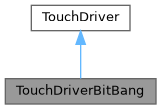
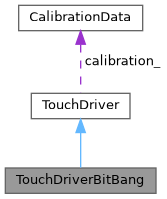
Public Member Functions | |
| TouchDriverBitBang (int8_t xPlusPin, int8_t xMinusPin, int8_t yPlusPin, int8_t yMinusPin) | |
| bool | begin () override |
| Initialize the controller. | |
| bool | isTouched () override |
| Return whether the panel currently appears touched. | |
| bool | getPoint (Point &outPoint) override |
| Read the current touch point. | |
 Public Member Functions inherited from TouchDriver Public Member Functions inherited from TouchDriver | |
| virtual | ~TouchDriver ()=default |
| virtual bool | begin ()=0 |
| Initialize the controller. | |
| virtual bool | isTouched ()=0 |
| Return whether the panel currently appears touched. | |
| virtual bool | getPoint (Point &outPoint)=0 |
| Read the current touch point. | |
| virtual bool | getSecondPoint (Point &outPoint) |
| Read a second, simultaneous touch point, for multi-touch gestures (pinch/rotate). | |
| void | setRotation (Rotation rotation) |
| Rotation | getRotation () const |
| bool | setCalibration (const CalibrationData &cal) |
| Set and validate calibration. | |
| const CalibrationData & | getCalibration () const |
| bool | hasCalibration () const |
Additional Inherited Members | |
| Protected Member Functions inherited from TouchDriver | |
| Point | mapCoordinates (int16_t rawX, int16_t rawY, uint16_t pressure=255) const |
| Convert raw controller coordinates into logical display space. | |
| Static Protected Member Functions inherited from TouchDriver | |
| static bool | validateCalibration (const CalibrationData &cal) |
| static int32_t | clamp32 (int32_t value, int32_t minimum, int32_t maximum) |
| Clamp an integer to an inclusive range. | |
| static int32_t | mapRange (int32_t value, int32_t inMin, int32_t inMax, int32_t outMin, int32_t outMax) |
| Map an integer from one range to another. | |
| Protected Attributes inherited from TouchDriver | |
| Rotation | rotation_ = Rotation::Deg0 |
| CalibrationData | calibration_ |
| bool | hasCalibration_ = false |
Detailed Description
Bit-banged 4-wire resistive touch panel driver.
Drives the resistive layer's four pins (X-, Y-, X+, Y+) directly via GPIO - pinMode()/digitalWrite()/digitalRead()/analogRead() - rather than through a dedicated touch controller chip such as XPT2046. This matches small resistive touch panels that expose their four resistive-layer pins straight to microcontroller GPIOs instead of routing them through a controller IC.
Requires analogRead() to be available for all four pins, i.e. a real Arduino core (arduino-esp32, AVR, ...) - the ESP-IDF-native TinyGPU/Emulation fallback (see EmulationIDF.h) does not emulate analogRead()/ADC, so this driver will not compile against that fallback.
Position measurement, per axis:
- drive one axis's plates (e.g. X+ HIGH / X- LOW) to set up a voltage gradient across that resistive layer
- float the OTHER axis's plates (INPUT)
- analogRead() one of the other axis's pins: the voltage it picks up is proportional to position along the driven axis
Touch presence is a cheap digital check (Y+ as INPUT_PULLUP, X- driven LOW; a touch shorts the two layers together and pulls Y+ LOW) rather than a calibrated Z1/Z2 pressure measurement - this only needs to know whether the panel is touched at all. Pressure is therefore always reported as 255 while touched, like the capacitive controllers below.
Constructor & Destructor Documentation
◆ TouchDriverBitBang()
|
inline |
- Parameters
-
xPlusPin X+ resistive layer analog pin. xMinusPin X- resistive layer digital pin. yPlusPin Y+ resistive layer analog pin. yMinusPin Y- resistive layer digital pin.
Member Function Documentation
◆ begin()
|
inlineoverridevirtual |
Initialize the controller.
The driver does NOT initialize the SPI/I2C bus itself. The application is responsible for calling Wire.begin(), SPI.begin(), and configuring any board-specific bus pins.
Implements TouchDriver.
◆ getPoint()
|
inlineoverridevirtual |
Read the current touch point.
- Returns
- true if a valid touch point was obtained.
Implements TouchDriver.
◆ isTouched()
|
inlineoverridevirtual |
Return whether the panel currently appears touched.
For controllers without an IRQ pin this may perform a controller read.
Implements TouchDriver.
The documentation for this class was generated from the following file:
- src/TinyGPU/Input/TouchDriverArduino.h