"Guition ESP32-P4 4.3" 480x800 Capacitive Touch Display" (JC4880P443C_I_W): it has an ST7701 MIPI-DSI display, GT911 capacitive touch (I2C), and an ES8311 audio codec with NS4150 speaker amp (speaker output only - this board has no mic). The board also has a WiFi SDIO interface and an SD_MMC interface, both of which need their own pin setup. More...
#include <LCDBoardsESP32.h>
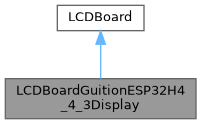
Public Member Functions | |
| LCDBoardGuitionESP32H4_4_3Display ()=default | |
| ~LCDBoardGuitionESP32H4_4_3Display () | |
| bool | begin () override |
| void | setAmplifierActive (bool active) |
| size_t | width () const override |
| Panel width in pixels. | |
| size_t | height () const override |
| Panel height in pixels. | |
| ST7701Driver< RGB565 > & | display () override |
| The board's display driver. | |
| TouchDriver * | touch () override |
| The board's touch controller. | |
| const I2SPins & | i2s () const override |
| The board's I2S pin assignment. | |
| const LEDPins & | led () const override |
| This board has no RGB LED - every LEDPins field is -1. | |
| int8_t | backlightPin () const override |
| The board's backlight GPIO pin. | |
| int | battery (int battery_readings_=100) |
| Reads and returns the battery charge percentage (0 - 100). | |
 Public Member Functions inherited from LCDBoard Public Member Functions inherited from LCDBoard | |
| virtual | ~LCDBoard ()=default |
| virtual bool | begin ()=0 |
| virtual size_t | width () const =0 |
| Panel width in pixels. | |
| virtual size_t | height () const =0 |
| Panel height in pixels. | |
| virtual DisplayDriver< RGB565 > & | display ()=0 |
| The board's display driver. | |
| virtual TouchDriver * | touch ()=0 |
| The board's touch controller, or nullptr if none is wired up. | |
| virtual const I2SPins & | i2s () const =0 |
| The board's I2S/PA pin assignment. | |
| virtual const LEDPins & | led () const =0 |
| The board's LED pin assignment. | |
| virtual int8_t | backlightPin () const |
| template<typename I2SConfig > | |
| void | setI2SPins (I2SConfig &cfg) |
Detailed Description
"Guition ESP32-P4 4.3" 480x800 Capacitive Touch Display" (JC4880P443C_I_W): it has an ST7701 MIPI-DSI display, GT911 capacitive touch (I2C), and an ES8311 audio codec with NS4150 speaker amp (speaker output only - this board has no mic). The board also has a WiFi SDIO interface and an SD_MMC interface, both of which need their own pin setup.
Note: despite the class name (kept for historical/API-compatibility reasons), the chip on this board is an ESP32-P4, not an ESP32-H4 - see ST7701Driver's docs in DisplayDriverDSI.h and the guition-jc4880p4-bsp source this driver was transcribed from.
- Note
- SD card power: kSdLdoChannel (TF_VCC) is recorded from the BSP source but not currently driven by begin() - unlike kDsiPhyLdoChan, which IS wired into ST7701Driver. If the TF socket needs that LDO switched on to work, SD_MMC.begin() may fail until this is enabled explicitly.
- Audio setup: this board's ES8311 codec needs its own I2C init (volume, mic gain, ...), not just I2S pins, so plain I2SStream leaves the codec unconfigured. If the sketch also depends on arduino-audio-driver, use its ready-made board definition instead, which owns the codec init and I2S pins together:
#include "AudioTools.h" #include "AudioTools/AudioLibs/AudioBoardStream.h"
AudioBoardStream i2s(GenericES8311); auto config = i2s.defaultConfig(TX_MODE); board.setI2SPins<I2SConfig>(config); i2s.begin(config); i2s.setVolume(0.5f); board.setAmplifierActive(true);
Without arduino-audio-driver, i2s()/setI2SPins() still give the raw MCLK/BCK/WS/DOUT/DIN pins for a plain I2SStream, but the caller is then responsible for the ES8311's I2C init and driving the PA-enable pin (i2s().paEnable, active low per paEnableActiveLow) itself.
Constructor & Destructor Documentation
◆ LCDBoardGuitionESP32H4_4_3Display()
|
default |
◆ ~LCDBoardGuitionESP32H4_4_3Display()
|
inline |
Member Function Documentation
◆ backlightPin()
|
inlineoverridevirtual |
The board's backlight GPIO pin.
Reimplemented from LCDBoard.
◆ battery()
|
inline |
Reads and returns the battery charge percentage (0 - 100).
◆ begin()
|
inlineoverridevirtual |
◆ display()
|
inlineoverridevirtual |
The board's display driver.
Implements LCDBoard.
◆ height()
|
inlineoverridevirtual |
Panel height in pixels.
Implements LCDBoard.
◆ i2s()
|
inlineoverridevirtual |
The board's I2S pin assignment.
Implements LCDBoard.
◆ led()
|
inlineoverridevirtual |
◆ setAmplifierActive()
|
inline |
Activates or deactivates the NS4150 speaker amp. The amp is active when the pin is driven low, so this function inverts the active state to make it more intuitive to the caller.
◆ touch()
|
inlineoverridevirtual |
The board's touch controller.
Implements LCDBoard.
◆ width()
|
inlineoverridevirtual |
Panel width in pixels.
Implements LCDBoard.
The documentation for this class was generated from the following file:
- src/TinyGPU/Boards/LCDBoardsESP32.h