One-call setup for ESP32(-S3) boards from the arduino-audio-tools "Audio Boards" wiki that combine an LCD/TFT display with a touch controller (and, on the same board, an I2S audio codec/amp): https://github.com/pschatzmann/arduino-audio-tools/wiki/Audio-Boards. More...
#include "TinyGPU/Emulation.h"#include <SD_MMC.h>#include "TinyGPU/Drivers/DisplayDriverDSI.h"#include "TinyGPU/Drivers/DisplayDriverQSPI.h"#include "TinyGPU/Drivers/DisplayDriverSPI.h"#include "TinyGPU/Input/TouchDriverArduino.h"#include "TinyGPU/Boards/LCDBoardsCommon.h"#include "esp_adc/adc_cali.h"#include "esp_adc/adc_cali_scheme.h"#include "esp_adc/adc_oneshot.h"#include "esp_check.h"#include "esp_log.h"
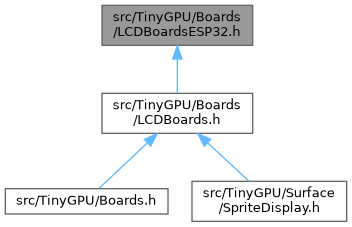
Go to the source code of this file.
Classes | |
| class | LCDBoardESP32S3_2_8Display |
| "2.8" ESP32-S3 Display" - ILI9341 SPI TFT + FT6336G capacitive touch (I2C, shares its bus with the board's ES8311 audio codec). (FBBA0125-002) - also named ESP32-S3 Hosyond Display More... | |
| class | LCDBoardGuitionESP32S3_4_3Display |
| "Guition ESP32-S3 4.3" 480x272 Capacitive Touch Display" (JC4827W543C_I): it has a NV3041A QSPI display, GT911 capacitive touch NV3041A QSPI TFT + GT911 capacitive touch (I2C) + NS4168 speaker amp (speaker output only - no codec/mic on this board). More... | |
| class | LCDBoardGuitionESP32_LVGL_2_4Display |
| "ESP32 Arduino LVGL WiFi&Bluetooth Development Board, 2.4" LCD TFT Module" - ILI9341 SPI TFT + CST816S capacitive touch, no PSRAM. (ESP32-2432S028R) - also named ESP32 Cheap Yellow Diplay More... | |
| class | LCDBoardGuitionESP32H4_4_3Display |
| "Guition ESP32-P4 4.3" 480x800 Capacitive Touch Display" (JC4880P443C_I_W): it has an ST7701 MIPI-DSI display, GT911 capacitive touch (I2C), and an ES8311 audio codec with NS4150 speaker amp (speaker output only - this board has no mic). The board also has a WiFi SDIO interface and an SD_MMC interface, both of which need their own pin setup. More... | |
Namespaces | |
| namespace | tinygpu |
Detailed Description
One-call setup for ESP32(-S3) boards from the arduino-audio-tools "Audio Boards" wiki that combine an LCD/TFT display with a touch controller (and, on the same board, an I2S audio codec/amp): https://github.com/pschatzmann/arduino-audio-tools/wiki/Audio-Boards.
Bringing one of these boards up normally means hand-wiring the SPI/QSPI bus, the backlight pin, the display controller's init sequence, the touch controller's I2C bus, and separately tracking the board's I2S pins for the audio side - each board class here does the display/touch part in a single begin() call and exposes the I2S pin assignment so it can be handed to e.g. audio_tools::I2SConfig (TinyGPU itself has no audio-tools dependency, so I2SPins is a plain pin struct, not a driver).
Only boards that actually have an LCD are covered - audio-only boards on that wiki page are out of scope for this graphics library. See LCDBoards.h for the platform-independent LCDBoard interface these classes implement.